India's
premier resume service
India's
premier resume service


- Certified LabVIEW Developer, Completed , January 2007
- Certified System Engineer Professional, Completed , January 2017
- Home

- Resume Samples
- Electrical Engineer Resume Sample
What's your job?
Electrical Engineer Resume Samples and Templates for 2026
- Table of Contents
- Downloadable Sample
- Resume Tips from Experts
- Resume Text Version
- Share


Electrical Engineer Resume: Skills, Projects & Examples
Introduction
Electrical engineers are at the forefront of India’s technological advancement, designing and developing systems that power everything from consumer electronics to national infrastructure. From developing power distribution networks at NTPC and Power Grid Corporation to designing embedded systems at semiconductor companies in Bangalore, electrical engineers combine theoretical knowledge with practical innovation to solve complex challenges. The profession offers diverse opportunities across power, electronics, telecommunications, and automation sectors.
India’s industrial growth and infrastructure development create strong demand for skilled electrical engineers across multiple sectors. Major industrial hubs like Bangalore, Chennai, Pune, Hyderabad, and Delhi NCR are home to multinational corporations, manufacturing companies, and power utilities actively seeking qualified electrical engineers. Whether you’re designing power systems, developing control systems, or working on renewable energy projects, the electrical engineering field offers rewarding career paths.
This comprehensive guide will help you create an electrical engineer resume that effectively showcases your technical expertise, project experience, and problem-solving capabilities. From highlighting your design skills to demonstrating your knowledge of industry standards, we’ll cover everything you need to secure your dream electrical engineering role in 2025.
Section 1: Understanding the Electrical Engineer Role in India
Overview of Duties and Responsibilities
Electrical engineers in India work across diverse industries including power, manufacturing, electronics, and construction. Their responsibilities include:
System Design: Designing electrical systems, circuits, and equipment for various applications including power distribution, control systems, and electronic devices.
Analysis and Testing: Conducting load calculations, circuit analysis, and testing to ensure systems meet specifications and safety standards.
Project Management: Managing electrical engineering projects from concept through commissioning, including scheduling and budget oversight.
Standards Compliance: Ensuring designs comply with Indian Electrical Rules, IS standards, and international codes like IEEE and IEC.
Technical Documentation: Preparing design drawings, specifications, BOQ, and technical reports.
Installation Supervision: Overseeing installation, testing, and commissioning of electrical systems.
Troubleshooting: Diagnosing and resolving electrical system issues in industrial and commercial settings.
Key Skills and Competencies Employers Look For
Employers in India’s electrical engineering sector value specific capabilities:
Technical Knowledge: Strong foundation in power systems, electronics, control systems, and electrical machines.
Design Software: Proficiency in AutoCAD Electrical, ETAP, MATLAB, Simulink, and PLC programming.
Standards Knowledge: Familiarity with IE Rules, IS codes, IEEE standards, and NEC guidelines.
Analytical Skills: Ability to perform load flow analysis, short circuit studies, and system optimisation.
Project Experience: Hands-on experience in design, installation, and commissioning of electrical systems.
Problem Solving: Capability to troubleshoot complex electrical issues efficiently.
Communication: Clear technical communication with multidisciplinary teams and clients.
Diversity of Roles Within Electrical Engineering
The electrical engineering field in India offers various specialisation paths:
Power Systems Engineer: Works on generation, transmission, and distribution systems.
Control Systems Engineer: Designs automation and control systems for industrial applications.
Electronics Engineer: Develops electronic circuits and embedded systems.
Instrumentation Engineer: Works on measurement and control instrumentation.
Design Engineer: Creates electrical system designs for buildings, industrial plants, and infrastructure.
Renewable Energy Engineer: Specialises in solar, wind, and other renewable energy systems.
Section 2: Preparing Your Resume - Essential Components
Contact Information
Your contact section should be professional and easily accessible:
- Full Name: Clearly displayed at the top of your resume
- Phone Number: Include your mobile number with country code (+91)
- Email Address: Use a professional email (e.g., rahul.verma@email.com)
- Location: City and state (e.g., Bangalore, Karnataka)
- LinkedIn Profile: Essential for professional networking
- Portfolio: Link to project portfolio if available
Professional Summary
Your summary should capture your technical expertise and industry experience:
Example for Experienced Professional: “Senior Electrical Engineer with 10+ years of experience in power systems design and project management. Led electrical engineering for 500 MW thermal power projects at BHEL. Expert in ETAP, protection coordination, and HT/LT system design. Familiar with CEA regulations and IS standards. Seeking senior engineering leadership role at a major power or infrastructure company.”
Example for Mid-Level Professional: “Electrical Engineer with 5 years of experience in industrial electrical design and automation. Designed power distribution systems for manufacturing plants at L&T Electrical. Proficient in AutoCAD Electrical, PLC programming, and SCADA systems. Strong background in project execution and commissioning. Looking for lead engineer position in industrial sector.”
Example for Fresher: “B.Tech Electrical Engineering graduate from NIT Warangal with distinction. Completed internship at Schneider Electric working on LV panel design. Proficient in AutoCAD, MATLAB, and basic PLC programming. Strong foundation in power systems and electrical machines. Eager to begin career at a leading engineering company.”
Work Experience
Present your experience in reverse chronological order with quantified achievements:
Senior Electrical Engineer | BHEL | Hyderabad | 2021-Present
- Lead electrical design team for 2x500 MW thermal power plant projects
- Designed HT switchyard and protection systems meeting CEA standards
- Reduced project costs by 15% through optimised cable routing and equipment selection
- Managed vendor coordination for electrical equipment worth ₹200 crore
Electrical Engineer | L&T Construction | Chennai | 2018-2021
- Designed electrical systems for commercial buildings up to 50,000 sq.m.
- Prepared load calculations, SLD, cable schedules, and equipment specifications
- Supervised installation and commissioning of HT substations
- Achieved zero safety incidents across 5 project sites
Skills Section
Technical Skills:
- Power Systems: Load Flow, Short Circuit, Protection Coordination
- Design Software: AutoCAD Electrical, ETAP, DIALux, Revit MEP
- Simulation: MATLAB, Simulink, PSCAD
- Automation: PLC Programming (Siemens, Allen Bradley), SCADA, DCS
- Standards: IE Rules, IS Codes, IEEE, IEC, NEC
- Renewable: Solar PV Design, PVSyst, Wind Energy Systems
Soft Skills:
- Technical Leadership
- Project Management
- Problem Solving
- Team Collaboration
- Client Communication
- Documentation
Section 3: Resume Formats for Electrical Engineers
Chronological Resume
Best suited for engineers with steady career progression in electrical engineering. Lists work experience from most recent to oldest.
When to use: If you have 3+ years of continuous experience in electrical engineering with clear career growth.
Functional Resume
Focuses on technical skills and competencies rather than chronological work history. Useful for career changers.
When to use: If you’re transitioning from a related field like electronics or instrumentation to core electrical engineering.
Combination Resume
Blends skills and work history, useful for those with varied experience across different sectors.
When to use: If you have experience in multiple sectors (power, construction, manufacturing) and want to highlight versatility.
Section 4: Professional Summary Examples
For Power Systems Engineer: “Power Systems Engineer with 8 years of experience in transmission and distribution. Led protection coordination studies at Power Grid Corporation for 400 kV substations. Expert in ETAP, relay coordination, and SCADA systems. Familiar with CEA regulations and grid codes. Seeking senior power systems role at utility or consulting firm.”
For Control Systems Engineer: “Control Systems Engineer with 6 years of experience in industrial automation. Designed PLC and SCADA systems at Siemens for process industries. Expert in Siemens S7, Allen Bradley, and Wonderware platforms. Strong background in DCS and plant automation. Looking for automation lead position in manufacturing sector.”
For Design Engineer: “Electrical Design Engineer with 5 years of experience in commercial and industrial projects. Designed electrical systems for IT parks and data centres at Sobha Limited. Proficient in AutoCAD Electrical, Revit MEP, and DIALux. Familiar with NBC and ECBC codes. Seeking design engineer role at a leading MEP consultancy.”
For Renewable Energy Engineer: “Renewable Energy Engineer with 4 years of experience in solar power projects. Designed utility-scale solar plants totalling 500 MW at ReNew Power. Expert in PVSyst, PVSOL, and grid integration studies. Familiar with MNRE guidelines and DISCOM requirements. Seeking solar engineering role at a leading renewable company.”
For Fresher: “B.Tech Electrical Engineering from VIT Vellore with 8.5 CGPA. Final year project on smart grid implementation using IoT sensors. Interned at ABB India working on motor control centres. Proficient in AutoCAD, MATLAB, and C programming. Passionate about power systems and automation. Ready to contribute at a leading engineering firm.”
Section 5: Showcasing Engineering Achievements
How to Present Accomplishments
Transform job descriptions into compelling achievements:
Instead of: “Worked on electrical design” Write: “Led electrical design for 200 MW solar power plant at Adani Green Energy, completing design documentation 2 weeks ahead of schedule and reducing cable costs by ₹2 crore through optimised layout”
Instead of: “Handled project execution” Write: “Managed electrical execution for ₹500 crore commercial complex at DLF, achieving commissioning 1 month early with zero safety incidents and 98% first-time test pass rate”
Sample Achievement Entries
Power Plant Project | NTPC
- Designed complete electrical system for 660 MW supercritical unit
- Prepared protection coordination studies for generator, transformer, and bus systems
- Coordinated with OEMs for electrical equipment specifications worth ₹300 crore
- Achieved successful grid synchronisation on first attempt
- Impact: Project completed on schedule contributing to national power capacity
Industrial Automation | Tata Steel
- Designed PLC-based automation for steel rolling mill
- Implemented SCADA system monitoring 500+ field devices
- Reduced unplanned downtime by 40% through predictive maintenance integration
- Trained operations team on new automation systems
- Impact: Improved plant efficiency by 15% saving ₹10 crore annually
Commercial Building | Embassy Group
- Led MEP electrical design for 1 million sq.ft. IT park
- Designed 33 kV substation and complete power distribution system
- Achieved IGBC Gold certification through energy-efficient design
- Implemented building automation system integrating all MEP services
- Impact: Building achieved 25% energy savings over baseline
Entry-Level Project Ideas
For freshers and recent graduates, showcase academic and internship work:
- Final Year Project - Detailed description with technical specifications
- Internship Experience - Projects completed during industrial training
- Design Projects - Circuit designs, simulation projects, or prototypes built
- Competition Entries - Technical competitions, hackathons, or design challenges
- Lab Work - Significant laboratory experiments or research projects
- Mini Projects - Smaller projects demonstrating specific skills
Section 6: Skills to Include in Your Electrical Engineer Resume
Technical Skills
- Power Systems: Load flow analysis, short circuit studies, protection coordination, power quality analysis
- Design Software: AutoCAD Electrical, ETAP, DIALux, Revit MEP, EPLAN
- Simulation Tools: MATLAB, Simulink, PSCAD, EMTP, PSpice
- Automation: PLC programming (Siemens, Allen Bradley, Schneider), SCADA, DCS, HMI development
- Renewable Energy: Solar PV design, PVSyst, wind energy systems, battery storage
- Standards: IE Rules, IS codes, IEEE standards, IEC codes, NEC, NFPA
- Protection: Relay settings, coordination, CT/PT sizing, arc flash analysis
- Electrical Equipment: Transformers, switchgear, motors, drives, UPS, DG sets
- Building Systems: Lighting design, BMS, fire alarm, IBMS
- Programming: C/C++, Python, ladder logic, structured text
Soft Skills
- Technical Leadership: Guiding design teams and making technical decisions
- Project Management: Planning, scheduling, and executing engineering projects
- Problem Solving: Diagnosing and resolving complex electrical issues
- Communication: Presenting technical concepts to diverse stakeholders
- Team Collaboration: Working effectively with multidisciplinary teams
- Attention to Detail: Accuracy in calculations and documentation
- Time Management: Meeting project deadlines while maintaining quality
- Continuous Learning: Keeping up with evolving technology and standards
Section 7: Certifications and Professional Development
Essential Certifications for Electrical Engineers
Chartered Engineer (CEng)
- Issued by: Institution of Engineers India (IEI)
- Value: Professional recognition for practicing engineers
ETAP Certification
- Issued by: ETAP (Operation Technology Inc.)
- Value: Validates power systems analysis software expertise
PLC Programming Certification
- Issued by: Siemens, Rockwell Automation, or recognised centres
- Value: Demonstrates automation programming skills
NABCEP Solar PV Certification
- Issued by: North American Board of Certified Energy Practitioners
- Value: Recognised credential for solar professionals
Indian Institution Qualifications
- B.Tech/B.E. in Electrical Engineering - IITs, NITs, State Engineering Colleges
- M.Tech in Power Systems/Control Systems - IITs, IISc, NITs
- Diploma in Electrical Engineering - Government Polytechnics
- Post Graduate Diploma in Energy Management - BEE recognised
- Graduate Apprentice Training - NAPS scheme
Professional Development
- Power systems protection courses (CPRI, NPTI)
- PLC and automation training (Siemens, Allen Bradley)
- Renewable energy courses (MNRE, GERMI)
- Electrical safety training (OSHA, NFPA 70E)
- Project management certification (PMP, PRINCE2)
Section 8: Tips by Experience Level
Entry-Level (0-3 Years)
- Highlight Education: Emphasise B.Tech degree, CGPA, and relevant coursework
- Technical Skills: List all software and tools you’re proficient in
- Projects: Include final year project and mini projects with technical details
- Internships: Detail industrial training and internship experiences
- Certifications: Any software certifications or online courses completed
- Enthusiasm: Show passion for electrical engineering and eagerness to learn
Mid-Level (4-8 Years)
- Project Portfolio: Quantify projects completed (MW capacity, sq.ft. designed)
- Specialisation: Demonstrate expertise in specific areas (power, automation)
- Leadership: Experience leading project teams or mentoring juniors
- Problem Solving: Examples of technical challenges solved
- Standards Knowledge: Familiarity with codes and regulations
- Professional Development: Relevant certifications and training
Senior-Level (10+ Years)
- Technical Leadership: Experience heading engineering teams or departments
- Major Projects: High-profile projects completed with significant impact
- Client Relations: Experience interfacing with clients and stakeholders
- Business Impact: Cost savings, efficiency improvements, or innovations introduced
- Mentoring: Developing junior engineers and building teams
- Industry Recognition: Awards, publications, or patents
Section 9: ATS Optimisation Tips
Understanding ATS in Engineering Sector
Major engineering companies and recruiters use Applicant Tracking Systems. Job portals like Naukri and LinkedIn also use keyword matching.
Keyword Optimisation
Include relevant keywords from the job description:
- Job titles: Electrical Engineer, Design Engineer, Power Systems Engineer, Control Systems Engineer
- Skills: Electrical Design, Power Systems, Automation, PLC Programming, Protection
- Software: AutoCAD Electrical, ETAP, MATLAB, Siemens PLC, SCADA
- Standards: IE Rules, IS Codes, IEEE, IEC, CEA
Formatting Best Practices
- Use standard fonts (Arial, Calibri, Times New Roman)
- Avoid tables, graphics, and complex formatting
- Use standard section headings (Experience, Education, Skills, Certifications)
- Save as PDF or .docx as specified
- Keep file size under 2MB
- Spell out acronyms (PLC - Programmable Logic Controller)
Common Mistakes to Avoid
- Spelling errors in technical terms or software names
- Missing contact information
- Not specifying project sizes or capacities
- Generic descriptions without technical details
- Using only abbreviations without full forms
- Inconsistent date formats
Conclusion
Creating a compelling electrical engineer resume requires showcasing your technical expertise, project experience, and problem-solving capabilities. By following this guide, you can craft a resume that effectively communicates your engineering skills, industry knowledge, and proven track record of successful project delivery to employers in India’s diverse electrical engineering sector.
The electrical engineering field in India offers rewarding opportunities across power generation, industrial automation, renewable energy, and infrastructure development. Whether you’re a fresher starting your engineering career, a mid-level professional seeking advancement, or a senior engineer targeting leadership roles, a well-crafted resume is essential for making a positive impression on employers.
Remember to quantify your achievements with specific metrics (MW capacity, project value, cost savings), highlight your software proficiency and standards knowledge, and demonstrate your ability to deliver projects successfully. Include relevant certifications and professional affiliations to strengthen your application.
Ready to create your professional electrical engineer resume? Use our resume builder to get started with professionally designed templates, or explore more resume samples for inspiration. For personalised guidance, our expert resume writers are here to help you craft a document that opens doors to your dream engineering role.
Frequently Asked Questions
What sections should a strong electrical engineer resume include?
At minimum, include contact information, a professional summary, work experience, key skills, and education. Depending on your experience level, you may also add certifications, achievements, projects, or industry-specific sections that highlight your expertise.
How do I write a professional summary for an electrical engineer role?
Keep it concise — two to three sentences highlighting your experience level, core competencies, and a key achievement or strength that shows why you're right for the job. Tailor it to match the specific role you're applying for.
What skills are most important to list on an electrical engineer resume?
Include a mix of technical skills specific to electrical engineer roles and soft skills like communication, problem-solving, and teamwork. Research job postings in your target companies to identify the most commonly requested skills.
How detailed should my work experience be?
Use bullet points to describe your roles, focusing on specific results, tools used, and the impact you made. Quantify achievements where possible — numbers and percentages help recruiters quickly understand your contributions.
Do I need certifications on my electrical engineer resume?
Certifications aren't always required, but they can strengthen your application — especially if they demonstrate advanced training or specialised expertise. List the certification name, issuing organisation, and year obtained.
What's the best resume format for an electrical engineer?
Most electrical engineer professionals benefit from a reverse-chronological format that lists your most recent experience first. If you're changing careers or have gaps, a functional or combination format might work better.
How long should my electrical engineer resume be?
Aim for one page if you're early in your career. Experienced professionals with extensive achievements can use two pages — just ensure every section adds value and remains relevant to the role.
Should I tailor my resume for each job application?
Yes. Customising your resume with keywords and responsibilities from the job posting improves your chances of passing Applicant Tracking Systems (ATS) and resonating with recruiters. Focus on relevant experience and skills for each role.
Electrical Engineer Text-Only Resume Templates and Samples
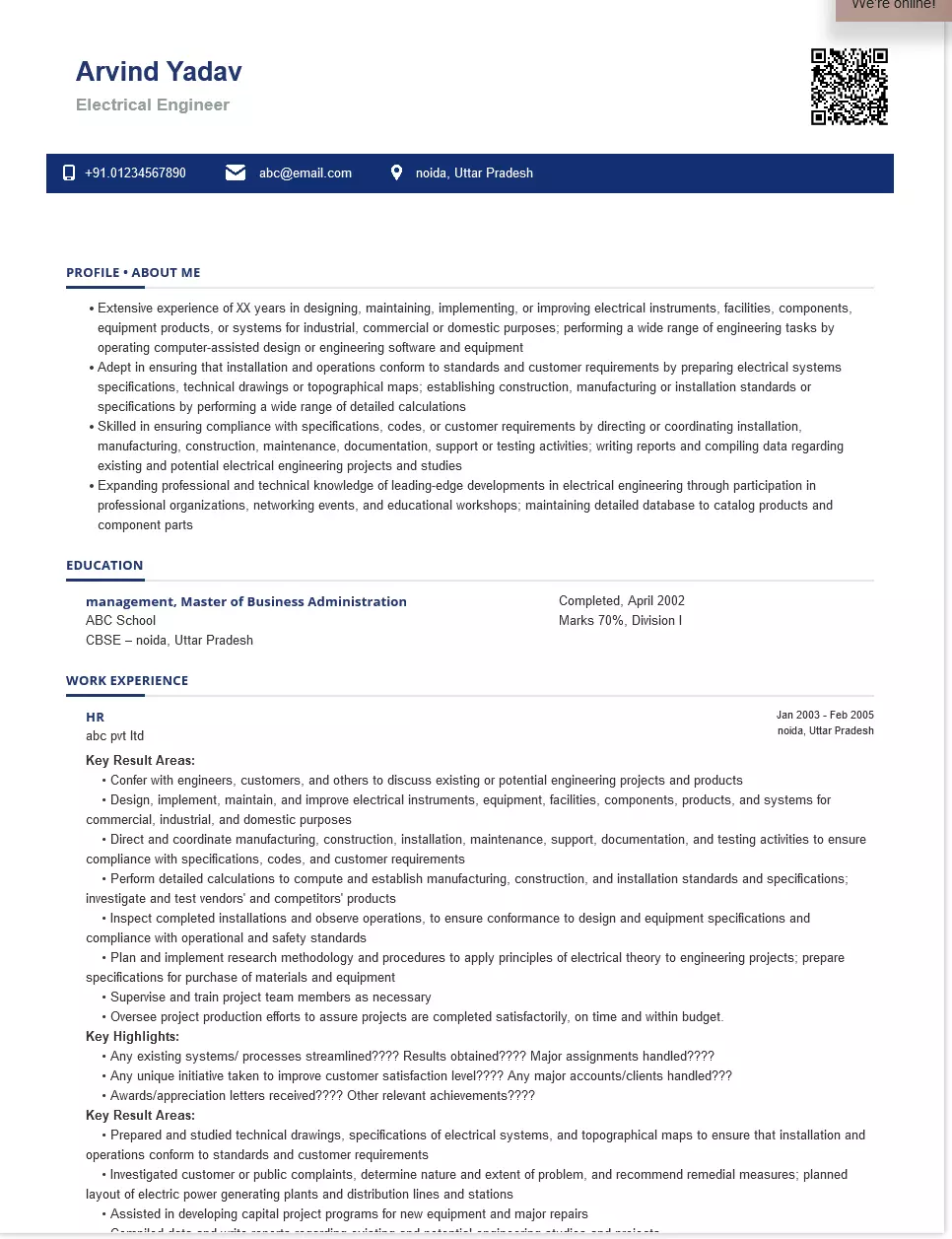
Arvind Yadav
Phone: 01234567890
Email: abc@email.com
Address: Sec-44, Noida, Noida
About Me
Electrical Engineer
- Electrical Engineer with XX years of experience in designing, maintaining, implementing, or improving electrical instruments, facilities, components, equipment products, or systems for industrial, commercial, or domestic purposes.
- Adept in ensuring that installation and operations conform to standards and customer requirements by preparing electrical systems specifications, technical drawings, or topographical maps; establishing construction, manufacturing, or installation standards or specifications by performing a wide range of detailed calculations
- Skilled in ensuring compliance with specifications, codes, or customer requirements by directing or coordinating installation, manufacturing, construction, maintenance, documentation, support, or testing activities; writing reports and compiling data regarding existing and potential electrical engineering projects and studies
- Expanding professional and technical knowledge of leading-edge developments in electrical engineering through participation in professional organizations, networking events, and educational workshops; maintaining detailed database to catalog products and component parts
Education
Electrical Engineering , Bachelor of Engineering / Bachelor of Technology, Completed, April 2002
Himpant School of Engineering
Himachal University – Marks 70
Hamirpur, HP
Certifications
Work Experience
Period: January 2011 - Current
Electrical Design Engineer
Zentech Incorporated Pvt Ltd
Noida, UP
- Conferred with engineers, customers, and others to discuss existing or potential engineering projects and products.
- Designed, implemented, maintained, and improved electrical instruments, equipment, facilities, components, products, and systems for commercial, industrial, and domestic purposes.
- Directed and coordinated manufacturing, construction, installation, maintenance, support, documentation, and testing activities to ensure compliance with specifications, codes, and customer requirements.
- Performed detailed calculations to compute and established manufacturing, construction, and installation standards and specifications.
- Investigated and tested vendors' and competitors' products.
- Inspected completed installations and observe operations, to ensure conformance to design and equipment specifications and compliance with operational and safety standards.
- Supervised and trained project team members as necessary.
- Oversee project production efforts to assure projects are completed satisfactorily, on time, and within budget.
Period: January 1998 - April 2010
Electrical Engineer
AJD Electrical Solution
Noida, UP
- Prepared and studied technical drawings, specifications of electrical systems, and topographical maps to ensure that installation and operations conform to standards and customer requirements.
- Investigated customer or public complaints, determine the nature and extent of the problem and recommend remedial measures; planned layout of electric power generating plants and distribution lines and stations.
- Assisted in developing capital project programs for new equipment and major repairs.
- Compiled data and write reports regarding existing and potential engineering studies and projects.
- Collected data relating to commercial and residential development, population, and power system interconnection to determine the operating efficiency of electrical systems.
- Conducted field surveys and study maps, graphs, diagrams, and other data to identify and correct power system problems; developed budgets, estimating labor, material, and construction costs.
Skills
Hard Skills
- Microcontrollers (8051, ARM, AVR, PIC, etc.)
- Circuit designing
- Electrical measurements
- P Spice
- PCB designing
- PLC
- Revit
- NFPA Standards
- Programmable Logic Controllers (PLC)
Soft Skills
- Organization Skills
- Accuracy
- Innovative and critical thinking
- Presentation Skills
- Complex problem-solving
- Working odd hours
- Decision-making
- Precision
- Active learning
- Leadership
- Initiative
- Communication Skills
- Mentoring Skills
- Teamwork Skills
Languages
Softwares
Operating System
Personal Interests
- Travelling
- Golfing
- Painting

Author
Kshama Sharma - Resume, CV and Cover Letter Writing Expert
Check Out Related Resume Samples
Mechanical Engineer Resume Example
Computer Science Engineer Resume Example
Telecommunications Engineer Resume Example
Marine Engineer Resume Example
Industrial Engineer Resume Example
Electrical Engineer Resume Example
Mining Engineer Resume Example
Biochemical Engineer Resume Example
Chemical Engineer Resume Example
Petroleum Engineer Resume Example
Occupational Health and Safety Resume Example
Civil Engineer Resume Example
Aerospace Engineer Resume Example