India's
premier resume service
India's
premier resume service


- Tally ERP 9 Certification, Completed , April 2024
- Financial Accounting Cost Accounting, To be Completed by , May 2024
- Taxation, Completed , April 2024
- Home

- Resume Samples
- Auditing Resume Sample
What's your job?
Auditing Resume Samples and Templates for 2026
- Table of Contents
- Downloadable Sample
- Resume Tips from Experts
- Resume Text Version
- Share


Crafting the Perfect Auditor Resume: A Comprehensive Guide
Introduction
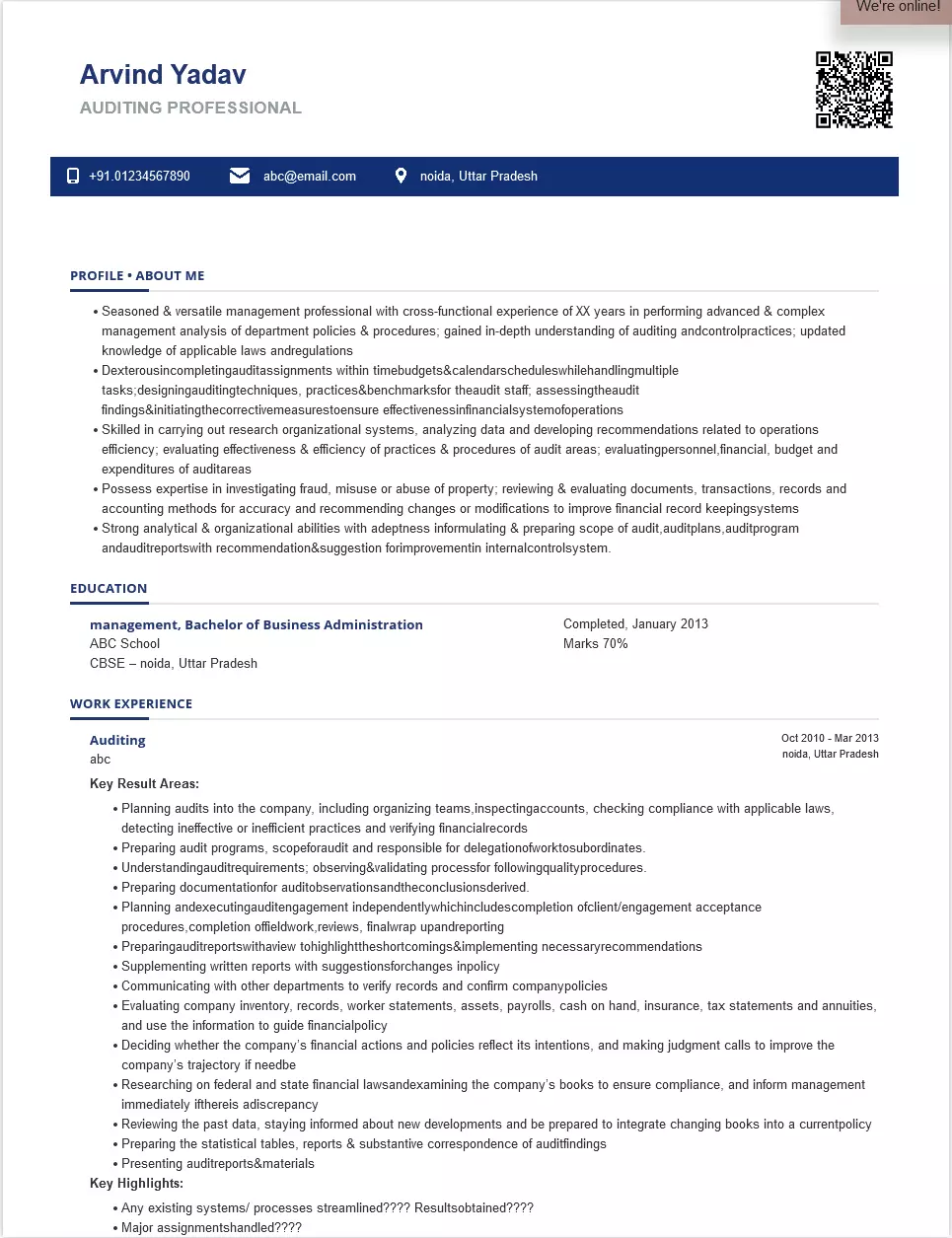
Auditing is a cornerstone profession in India’s financial ecosystem, ensuring transparency, compliance, and accountability across organisations. From Big 4 firms in Mumbai to internal audit departments in Bangalore’s tech companies, auditors play a crucial role in verifying financial statements, assessing risks, and ensuring regulatory compliance. As India’s economy grows and regulatory requirements become more stringent, the demand for skilled auditors continues to rise.
The auditing profession in India encompasses diverse specialisations including statutory audit, internal audit, tax audit, and forensic audit. With the implementation of new accounting standards (Ind AS), enhanced corporate governance requirements, and increased regulatory scrutiny, companies are actively seeking qualified professionals who can navigate complex compliance landscapes. Whether you’re a CA pursuing articleship, an experienced auditor seeking advancement, or a professional transitioning into audit, a well-crafted resume is essential for standing out.
This comprehensive guide will help you create an auditor resume that effectively showcases your technical expertise, analytical skills, and industry knowledge. From highlighting your ICAI qualifications to demonstrating your experience with audit software, we’ll cover everything you need to land your dream auditing role in 2025.
Section 1: Understanding the Auditor Role in India
Overview of Duties and Responsibilities
Auditors in India perform critical functions that ensure financial integrity and regulatory compliance. Common duties include:
Financial Statement Audit: Examining financial records, verifying transactions, and ensuring statements present a true and fair view as per Indian Accounting Standards.
Internal Control Assessment: Evaluating the effectiveness of internal controls, identifying weaknesses, and recommending improvements.
Compliance Verification: Ensuring adherence to Companies Act 2013, SEBI regulations, RBI guidelines, and other applicable laws.
Risk Assessment: Identifying and evaluating financial, operational, and compliance risks across the organisation.
Tax Audit: Conducting audits under Section 44AB of Income Tax Act, verifying tax computations and compliance.
Report Preparation: Drafting audit reports, management letters, and presentations for audit committees and stakeholders.
Key Skills and Competencies Employers Look For
Employers in India’s audit sector value a combination of technical expertise and professional judgment:
Accounting Standards Knowledge: Deep understanding of Ind AS, Indian GAAP, and IFRS for multinational engagements.
Statutory Compliance: Knowledge of Companies Act 2013, Income Tax Act, GST, and sector-specific regulations.
Analytical Skills: Ability to analyse large datasets, identify anomalies, and draw meaningful conclusions.
Audit Software Proficiency: Experience with IDEA, ACL, TeamMate, or other audit management tools.
Communication Skills: Clear articulation of audit findings to management and audit committees.
Professional Skepticism: Ability to question assumptions and verify information independently.
Diversity of Roles Within Auditing
The audit profession in India offers various specialisation paths:
Statutory Auditor: Conducts independent audits of financial statements as per Companies Act requirements.
Internal Auditor: Provides independent assurance on internal controls and risk management within organisations.
Tax Auditor: Specialises in income tax audits, GST audits, and tax compliance reviews.
Forensic Auditor: Investigates financial fraud, misconduct, and provides litigation support.
IT Auditor: Focuses on information systems controls, cybersecurity, and technology risks.
Bank Auditor: Conducts statutory and concurrent audits of banking operations.
Section 2: Preparing Your Resume - Essential Components
Contact Information
Your contact section should be professional and easily accessible:
- Full Name: Clearly displayed at the top of your resume
- Phone Number: Include your mobile number with country code (+91)
- Email Address: Use a professional email (e.g., suresh.menon@email.com)
- Location: City and state (e.g., Mumbai, Maharashtra)
- LinkedIn Profile: Essential for professional networking in audit
- ICAI Membership Number: Include if applicable
Professional Summary
Your summary should capture your qualifications, experience, and career objectives:
Example for Experienced Professional: “Chartered Accountant with 8+ years of audit experience across BFSI and manufacturing sectors. Led statutory audits for listed companies with combined market cap of ₹50,000 crore at Deloitte India. Expert in Ind AS, Companies Act compliance, and CARO reporting. Managed teams of 15+ auditors delivering 30+ engagements annually. Seeking to lead audit practice at a premier firm.”
Example for Mid-Level Professional: “Senior Audit Associate with 5 years of experience in statutory and internal audit. Conducted audits for 20+ clients across IT, manufacturing, and retail sectors at KPMG. Proficient in IDEA, advanced Excel, and audit documentation. Strong knowledge of Ind AS and GST compliance. Looking to grow into an audit management role.”
Example for Fresher/Articleship: “CA Final student completing articleship at PwC India with exposure to statutory audit and tax audit. Handled audit planning, substantive testing, and documentation for 10+ clients. Strong foundation in accounting standards, audit procedures, and analytical tools. Seeking to apply audit skills in a challenging role post-qualification.”
Work Experience
Present your experience in reverse chronological order with quantified achievements:
Audit Manager | KPMG India | Mumbai | 2020-Present
- Lead statutory audits for 15+ clients including 5 listed companies with revenues up to ₹5,000 crore
- Managed team of 12 auditors across multiple concurrent engagements
- Implemented data analytics in audit procedures reducing testing time by 30%
- Identified material misstatements worth ₹200 crore across engagements
Senior Audit Associate | EY India | Bangalore | 2017-2020
- Executed audit procedures for IT and manufacturing clients with revenues up to ₹2,000 crore
- Prepared audit working papers and documentation meeting firm quality standards
- Conducted internal control testing and communicated findings to management
- Mentored 5 junior associates on audit procedures and documentation
Skills Section
Technical Skills:
- Accounting: Ind AS, Indian GAAP, IFRS, AS (Accounting Standards)
- Compliance: Companies Act 2013, SEBI regulations, Income Tax, GST
- Audit Standards: SA (Standards on Auditing), CARO, Internal Audit Standards
- Software: IDEA, ACL, TeamMate, Tally, SAP, Oracle
- MS Office: Advanced Excel, Word, PowerPoint
- Analytics: Data analytics, Sampling techniques, Risk assessment
Soft Skills:
- Analytical Thinking
- Professional Skepticism
- Communication
- Team Leadership
- Time Management
- Attention to Detail
Section 3: Resume Formats for Auditors
Chronological Resume
Best suited for professionals with steady career progression in audit or accounting. Lists work experience from most recent to oldest, highlighting career growth from article to partner track.
When to use: If you have completed articleship and have 3+ years of post-qualification experience.
Functional Resume
Focuses on skills and expertise rather than chronological work history. Useful for career changers entering audit from related fields.
When to use: If you’re transitioning from accounting, finance, or compliance roles into audit.
Combination Resume
Blends the chronological and functional formats, highlighting both technical skills and work history. Ideal for experienced auditors seeking senior roles.
When to use: If you have diverse audit experience across multiple sectors and want to showcase breadth.
Section 4: Professional Summary Examples
For Statutory Auditor: “Chartered Accountant with 6 years of statutory audit experience specialising in listed companies. Led audits for BFSI sector clients with combined assets of ₹1 lakh crore at Deloitte. Expert in Ind AS implementation, ICFR reporting, and CARO compliance. Recognised for identifying significant audit issues resulting in qualified opinions.”
For Internal Auditor: “CIA-certified Internal Auditor with 7 years of experience in risk-based internal audit. Built internal audit function at Reliance Industries covering 50+ business processes. Expert in SOX compliance, operational audits, and fraud investigation. Reduced control deficiencies by 60% through systematic remediation tracking.”
For IT Auditor: “CISA-certified IT Auditor with 5 years of experience in information systems audit. Conducted IT general controls and application controls audits for banking clients at EY. Expert in cybersecurity assessment, data privacy compliance, and system implementation audits. Strong background in SAP and Oracle environments.”
For Fresher/Article: “CA Intermediate with 2 years of articleship experience at Grant Thornton. Exposure to statutory audit, tax audit, and GST compliance across 15+ clients. Proficient in audit documentation, substantive testing, and vouching. Strong academic record with AIR 150 in CA Foundation. Eager to complete CA Final and grow in audit.”
For Career Changer: “Finance Manager transitioning to Internal Audit with 8 years of corporate finance experience. Completed CIA Part 1 and enrolled for remaining parts. Experience in financial reporting, budgeting, and compliance at Infosys. Strong understanding of control frameworks and business processes. Ready to apply finance expertise to audit function.”
Section 5: Showcasing Audit Experience
How to Present Achievements
Transform task descriptions into compelling achievements:
Instead of: “Conducted statutory audits” Write: “Led statutory audits for 10+ listed companies with combined revenue of ₹10,000 crore, identifying material adjustments of ₹150 crore and ensuring timely completion within regulatory deadlines”
Instead of: “Reviewed internal controls” Write: “Evaluated 50+ business processes identifying 200+ control gaps, achieving 85% remediation rate within 6 months through systematic follow-up and management collaboration”
Sample Work Experience Entries
Audit Partner | Deloitte India | Mumbai
- Lead audit practice serving 30+ clients across BFSI and manufacturing sectors
- Generated audit revenue of ₹25 crore annually with 95% client retention
- Built team of 50+ professionals through recruitment and development
- Represented firm in ICAI technical committees and industry forums
- Sectors: Banking, Insurance, Manufacturing, Infrastructure
Senior Manager - Internal Audit | HDFC Bank | Mumbai
- Headed internal audit function covering 5,000+ branches and operations
- Implemented risk-based audit methodology reducing audit cycle time by 40%
- Reported directly to Audit Committee on control effectiveness and risk trends
- Led forensic investigations identifying frauds worth ₹10 crore
- Tools: TeamMate, ACL, Excel, Core Banking System
Audit Senior | PwC India | Bangalore
- Executed statutory audits for IT services companies with revenues up to ₹5,000 crore
- Led SOX compliance testing for US-listed Indian subsidiaries
- Prepared audit reports and management letters for partner review
- Trained and supervised team of 5 associates on engagement
- Software: IDEA, SAP, Oracle, Tally
Entry-Level/Articleship Examples
For students and articles, showcase relevant experience:
- Articleship Experience - Audit planning, vouching, verification, documentation
- Industrial Training - Bank branch audit, stock audit, concurrent audit
- Academic Projects - Audit case studies, internal control analysis
- Internships - Pre-articleship exposure at CA firms
- Competitions - ICAI quizzes, audit simulations, case study competitions
Section 6: Skills to Include in Your Auditor Resume
Technical Skills
- Accounting Standards: Ind AS, Indian GAAP, IFRS, AS (Accounting Standards)
- Audit Standards: Standards on Auditing (SA), CARO reporting, Internal Audit Standards
- Compliance: Companies Act 2013, SEBI regulations, RBI guidelines, Income Tax Act
- Tax Knowledge: GST audit, Tax audit (44AB), Transfer pricing, TDS compliance
- Audit Software: IDEA, ACL, TeamMate, AuditBoard, Caseware
- ERP Systems: SAP, Oracle Financials, Tally ERP 9, Microsoft Dynamics
- Data Analytics: Excel analytics, SQL basics, Data visualisation
- Documentation: Audit working papers, Management letters, Audit reports
- Sector Knowledge: BFSI, Manufacturing, IT Services, Retail, Infrastructure
- Regulatory: ICFR, SOX compliance, GDPR (for international audits)
Soft Skills
- Analytical Thinking: Breaking down complex transactions and identifying issues
- Professional Skepticism: Questioning assumptions and verifying independently
- Communication: Presenting findings to management and audit committees
- Team Leadership: Managing audit teams and delegating effectively
- Time Management: Handling multiple engagements with tight deadlines
- Attention to Detail: Ensuring accuracy in testing and documentation
- Problem Solving: Resolving audit issues and client concerns
- Integrity: Maintaining independence and ethical standards
Section 7: Certifications and Professional Development
Essential Certifications for Auditors
Chartered Accountant (CA)
- Issued by: Institute of Chartered Accountants of India (ICAI)
- Value: Most respected qualification for statutory audit in India
Certified Internal Auditor (CIA)
- Issued by: Institute of Internal Auditors (IIA)
- Value: Global certification for internal audit professionals
Certified Information Systems Auditor (CISA)
- Issued by: ISACA
- Value: Essential for IT audit and information systems assurance
Certified Fraud Examiner (CFE)
- Issued by: Association of Certified Fraud Examiners (ACFE)
- Value: Specialisation in fraud investigation and forensic audit
DISA (Diploma in Information Systems Audit)
- Issued by: ICAI
- Value: ICAI certification for IT audit and systems assurance
Professional Qualifications
- CA (Chartered Accountant)
- CMA (Cost and Management Accountant)
- CS (Company Secretary)
- MBA Finance
- B.Com / M.Com
Training Programmes
- Forensic Accounting Course - ICAI
- Bank Branch Audit Course - ICAI
- Concurrent Audit Training - RBI/ICAI
- Ind AS Implementation - ICAI
- Internal Audit Certificate - IIA India
Section 8: Tips by Experience Level
Entry-Level/Articleship (0-3 Years)
- Highlight Education: CA qualification status, academic performance, AIR if applicable
- Show Article Experience: Detailed description of audit exposure and responsibilities
- Include Technical Training: ITT, ICITSS, orientation programmes
- Mention Sector Exposure: Industries and client types worked on
- Add Competitions: ICAI quizzes, case study competitions, paper presentations
- Emphasise Software Skills: IDEA, Excel, Tally exposure during articleship
Mid-Level (4-7 Years)
- Focus on Engagement Leadership: Size of engagements led, team management
- Show Sector Expertise: Deep knowledge in specific industries
- Highlight Technical Skills: Complex accounting issues resolved, Ind AS implementation
- Include Client Relationship: Key accounts managed, client retention
- Demonstrate Quality Focus: Quality review scores, peer review feedback
- Add Certifications: CIA, CISA, or other relevant certifications
Senior-Level (8+ Years)
- Strategic Contributions: Practice development, methodology improvements
- Leadership Scale: Team size, revenue generation, client portfolio
- Industry Recognition: Speaking at conferences, publications, committee memberships
- Business Development: New client wins, practice growth
- Mentorship: Developing future leaders, training programmes conducted
- Thought Leadership: Technical guidance, industry insights
Section 9: ATS Optimisation Tips
Understanding ATS in Indian Context
Major audit firms and corporate internal audit functions use Applicant Tracking Systems. Common systems include Workday, Taleo, and SuccessFactors.
Keyword Optimisation
Include relevant keywords from the job description:
- Technical terms: Statutory Audit, Internal Audit, Ind AS, CARO, ICFR
- Job titles: Audit Manager, Internal Auditor, Statutory Auditor
- Skills: Risk Assessment, Internal Controls, Financial Statements Audit
- Certifications: CA, CIA, CISA, CFE
Formatting Best Practices
- Use standard fonts (Arial, Calibri, Times New Roman)
- Avoid tables, graphics, and complex formatting
- Use standard section headings (Experience, Education, Skills, Certifications)
- Save as PDF or .docx as specified
- Include ICAI membership number prominently
Common Mistakes to Avoid
- Using headers and footers (ATS may not read them)
- Excessive use of abbreviations without full forms
- Missing important keywords from job description
- Inconsistent formatting throughout document
- Not mentioning CA qualification status clearly
Conclusion
Creating a compelling auditor resume requires showcasing your technical expertise, professional qualifications, and ability to deliver quality audit engagements. By following this guide, you can craft a resume that effectively communicates your audit skills and experience to employers in India’s competitive professional services market.
The audit profession in India offers excellent opportunities for growth, from articleship through to partnership. Whether you’re a CA completing articleship, a senior associate seeking management roles, or an experienced professional targeting leadership positions, a well-crafted resume is your key to career advancement.
Remember to tailor your resume for each application, highlight your CA qualification prominently, and quantify your achievements with specific metrics (engagement sizes, team sizes, findings). Keep your technical skills section updated with the latest standards and tools.
Ready to create your professional auditor resume? Use our resume builder to get started with professionally designed templates, or explore more resume samples for inspiration. For personalised guidance, our expert resume writers are here to help you craft a document that opens doors to your dream audit role.
Frequently Asked Questions
What sections should a strong auditing resume include?
At minimum, include contact information, a professional summary, work experience, key skills, and education. Depending on your experience level, you may also add certifications, achievements, projects, or industry-specific sections that highlight your expertise.
How do I write a professional summary for an auditing role?
Keep it concise — two to three sentences highlighting your experience level, core competencies, and a key achievement or strength that shows why you're right for the job. Tailor it to match the specific role you're applying for.
What skills are most important to list on an auditing resume?
Include a mix of technical skills specific to auditing roles and soft skills like communication, problem-solving, and teamwork. Research job postings in your target companies to identify the most commonly requested skills.
How detailed should my work experience be?
Use bullet points to describe your roles, focusing on specific results, tools used, and the impact you made. Quantify achievements where possible — numbers and percentages help recruiters quickly understand your contributions.
Do I need certifications on my auditing resume?
Certifications aren't always required, but they can strengthen your application — especially if they demonstrate advanced training or specialised expertise. List the certification name, issuing organisation, and year obtained.
What's the best resume format for an auditing?
Most auditing professionals benefit from a reverse-chronological format that lists your most recent experience first. If you're changing careers or have gaps, a functional or combination format might work better.
How long should my auditing resume be?
Aim for one page if you're early in your career. Experienced professionals with extensive achievements can use two pages — just ensure every section adds value and remains relevant to the role.
Should I tailor my resume for each job application?
Yes. Customising your resume with keywords and responsibilities from the job posting improves your chances of passing Applicant Tracking Systems (ATS) and resonating with recruiters. Focus on relevant experience and skills for each role.
Auditing Text-Only Resume Templates and Samples
Abhiraj Saha
Phone: 9871275009
Email: writer@shriresume.com
Address: Adoni
About Me
Account Audit
Detail-oriented and motivated individual seeking an entry-level position in account auditing. Eager to apply academic knowledge and practical skills in auditing to contribute to the success of a dynamic organization.
Education
Finance, Master of Commerce, Completed, February 2024
Delhi College of Commerce
Delhi University
Delhi, DL
Certifications
Internships
Period: August 2023 - January 2024
Accounting Intern
TCS
East Delhi, DL
- Assisted in the preparation of financial statements and reports
- Conducted data entry and reconciliation of accounts
- Participated in audits under the supervision of senior auditors
- Collaborated with team members to ensure compliance with accounting standards
Skills
- Proficient in accounting principles and practices
- Strong analytical and problem-solving skills
- Attention to detail and accuracy
- Excellent communication and interpersonal abilities
- Familiarity with accounting software such as Tally and QuickBooks
- Basic understanding of auditing standards and procedures
Languages
Softwares
Operating System
Personal Interests
Dance
Music
Reading Fiction Novel
Running

Author
Kshama Sharma - Resume, CV and Cover Letter Writing Expert