India's
premier resume service
India's
premier resume service


- Certified Electronic Engineering Technician, Completed , January 2001
- Home

- Resume Samples
- Electronic and Electrical Components Resume Sample
What's your job?
Electronic and Electrical Components Resume Samples and Templates for 2026
- Table of Contents
- Downloadable Sample
- Resume Tips from Experts
- Resume Text Version
- Share


Electronic & Electrical Engineer Resume Samples and Writing Guide
Introduction
The electronics and electrical components industry forms the backbone of India’s manufacturing and technology ecosystem. From designing circuit boards at semiconductor companies in Bangalore to developing power electronics at manufacturing giants in Chennai and Pune, professionals in this field drive innovation across consumer electronics, automotive, industrial automation, and telecommunications sectors. The profession combines deep technical knowledge with practical design skills to create components that power modern devices.
India’s electronics manufacturing sector is experiencing significant growth, driven by government initiatives like Make in India and PLI schemes for electronics. Major industrial hubs like Bangalore, Hyderabad, Chennai, Noida, and Pune are home to multinational electronics companies, semiconductor design centres, and component manufacturers actively seeking skilled engineers and technicians. Whether you’re designing PCBs, developing embedded systems, or testing electronic components, the industry offers diverse and rewarding career opportunities.
This comprehensive guide will help you create an electronics and electrical components resume that effectively showcases your technical expertise, design skills, and industry experience. From highlighting your proficiency with design software to demonstrating your knowledge of industry standards, we’ll cover everything you need to secure your dream position in 2025.
Section 1: Understanding Electronics and Electrical Components Roles in India
Overview of Duties and Responsibilities
Professionals in electronics and electrical components work across diverse settings including R&D centres, manufacturing plants, and design houses. Their responsibilities include:
Circuit Design: Designing electronic circuits including analog, digital, and mixed-signal systems using simulation and design software.
PCB Design: Creating printed circuit board layouts, schematic capture, and ensuring designs meet manufacturing requirements.
Component Selection: Selecting appropriate electronic components based on specifications, cost, availability, and reliability requirements.
Testing and Validation: Conducting electrical tests, validating designs against specifications, and troubleshooting issues.
Prototype Development: Building and testing prototypes to verify design functionality before production.
Documentation: Preparing design documents, BOMs, test procedures, and technical specifications.
Quality Assurance: Ensuring components and designs meet quality standards and reliability requirements.
Key Skills and Competencies Employers Look For
Employers in India’s electronics industry value specific capabilities:
Technical Knowledge: Strong foundation in electronics, circuit theory, and component behaviour.
Design Software: Proficiency in Altium Designer, OrCAD, EAGLE, Cadence, and simulation tools like SPICE.
Embedded Systems: Experience with microcontrollers, firmware development, and hardware-software integration.
Testing Equipment: Skill in using oscilloscopes, spectrum analysers, multimeters, and automated test equipment.
Standards Knowledge: Familiarity with IPC standards, EMC/EMI requirements, and industry certifications.
Problem Solving: Ability to debug complex electronic issues and optimise designs.
Communication: Clear documentation and collaboration with cross-functional teams.
Diversity of Roles Within Electronics Components
The electronics components field in India offers various specialisation paths:
Electronics Design Engineer: Designs circuits and systems for various applications.
PCB Designer: Specialises in printed circuit board layout and manufacturing optimisation.
Embedded Systems Engineer: Works on microcontroller-based systems and firmware.
Test Engineer: Develops and executes test procedures for electronic components.
Application Engineer: Provides technical support and application guidance for components.
Component Engineer: Manages component selection, qualification, and lifecycle.
Section 2: Preparing Your Resume - Essential Components
Contact Information
Your contact section should be professional and easily accessible:
- Full Name: Clearly displayed at the top of your resume
- Phone Number: Include your mobile number with country code (+91)
- Email Address: Use a professional email (e.g., vikram.patel@email.com)
- Location: City and state (e.g., Bangalore, Karnataka)
- LinkedIn Profile: Essential for professional networking
- GitHub/Portfolio: Link to projects or design portfolio if available
Professional Summary
Your summary should capture your technical expertise and design experience:
Example for Experienced Professional: “Senior Electronics Design Engineer with 10+ years of experience in analog and digital circuit design. Led product development at Samsung India R&D designing power management ICs for mobile devices. Expert in Cadence, SPICE simulation, and DFM/DFT methodologies. Holder of 3 patents in power electronics. Seeking principal engineer role at a leading semiconductor company.”
Example for Mid-Level Professional: “Electronics Engineer with 5 years of experience in PCB design and embedded systems. Designed multi-layer PCBs for industrial automation at Siemens India. Proficient in Altium Designer, ARM microcontrollers, and EMC compliance testing. Strong background in prototype development and production support. Looking for senior design role in electronics manufacturing.”
Example for Fresher: “B.Tech Electronics graduate from VIT Vellore with distinction. Final year project on IoT-based environmental monitoring system using ESP32. Proficient in EAGLE PCB, Arduino, and C programming. Completed internship at Continental Automotive working on sensor interface circuits. Eager to start career in electronics design.”
Work Experience
Present your experience in reverse chronological order with quantified achievements:
Senior Electronics Engineer | Samsung India R&D | Bangalore | 2021-Present
- Lead design team developing power management ICs for flagship smartphone series
- Achieved 15% improvement in power efficiency through innovative circuit topology
- Managed product development from concept to mass production with ₹50 crore revenue
- Filed 2 patents for novel battery charging techniques
Electronics Design Engineer | Bosch India | Bangalore | 2018-2021
- Designed electronic control units for automotive applications
- Developed PCB layouts meeting automotive EMC and reliability standards
- Reduced board size by 25% through component optimisation and HDI technology
- Supported production of 1M+ units with zero field failures
Skills Section
Technical Skills:
- Circuit Design: Analog, Digital, Mixed-Signal, Power Electronics
- Design Software: Altium Designer, OrCAD, Cadence, EAGLE, KiCad
- Simulation: SPICE, MATLAB/Simulink, LTspice, PSpice
- Microcontrollers: ARM, PIC, AVR, ESP32, STM32
- Testing: Oscilloscope, Logic Analyser, Spectrum Analyser, ATE
- Standards: IPC, EMC/EMI, RoHS, Automotive SPICE
Soft Skills:
- Design Thinking
- Problem Solving
- Technical Documentation
- Cross-functional Collaboration
- Project Management
- Quality Focus
Section 3: Resume Formats for Electronics Professionals
Chronological Resume
Best suited for engineers with steady career progression in electronics design. Lists work experience from most recent to oldest.
When to use: If you have 3+ years of continuous experience in electronics with clear career growth.
Functional Resume
Focuses on technical skills and design competencies rather than chronological work history. Useful for career changers.
When to use: If you’re transitioning from a related field like electrical engineering or instrumentation to electronics design.
Combination Resume
Blends skills and work history, useful for those with varied experience across different domains.
When to use: If you have experience in multiple areas (consumer electronics, automotive, industrial) and want to highlight versatility.
Section 4: Professional Summary Examples
For Semiconductor Design Engineer: “Analog IC Design Engineer with 8 years of experience at Texas Instruments India. Designed power management ICs, amplifiers, and data converters for industrial applications. Expert in Cadence Virtuoso, SPICE modelling, and layout-aware design. Holder of 5 patents in analog circuit techniques. Seeking principal designer role at a semiconductor company.”
For PCB Designer: “Senior PCB Designer with 6 years of experience in high-speed and RF board design. Created 50+ complex multi-layer designs at Wipro Technologies for telecom and networking products. Expert in Altium Designer, impedance control, and signal integrity analysis. Familiar with IPC standards and DFM guidelines. Looking for lead PCB designer position.”
For Embedded Systems Engineer: “Embedded Systems Engineer with 5 years of experience in firmware development and hardware design. Developed IoT products at Tata Elxsi using ARM Cortex-M and BLE technology. Proficient in C/C++, FreeRTOS, and hardware debugging. Strong background in low-power design and battery-operated devices. Seeking senior embedded role.”
For Test Engineer: “Electronics Test Engineer with 7 years of experience in product validation and ATE development. Led test engineering at Flex India for consumer electronics products. Expert in LabVIEW, automated test development, and failure analysis. Familiar with reliability testing and qualification procedures. Looking for test engineering manager position.”
For Fresher: “B.E. Electronics from BITS Pilani with 8.8 CGPA. Final year project on FPGA-based image processing system. Interned at Intel India working on signal integrity analysis. Proficient in Verilog, MATLAB, and Python. Strong foundation in digital design and VLSI concepts. Ready to contribute at a leading electronics company.”
Section 5: Showcasing Design Achievements
How to Present Accomplishments
Transform job descriptions into compelling achievements:
Instead of: “Designed electronic circuits” Write: “Designed power supply circuit for industrial controller at Schneider Electric India, achieving 95% efficiency and reducing component count by 30%, saving ₹50 per unit in production costs”
Instead of: “Worked on PCB design” Write: “Created 16-layer high-speed digital PCB at Qualcomm India meeting DDR4 timing requirements, achieving first-spin success and reducing design cycle by 3 weeks”
Sample Achievement Entries
Consumer Electronics Project | Philips India
- Designed analog front-end for smart TV audio system
- Achieved THD+N of 0.001% exceeding original specification by 50%
- Reduced BOM cost by ₹75 per unit through component optimisation
- Supported production ramp of 500K units with 99.5% first-pass yield
- Impact: Product became best-selling model in India market
Automotive Electronics | Continental India
- Developed ECU for engine management system meeting AEC-Q100 standards
- Created robust design surviving -40°C to 125°C temperature range
- Achieved zero field returns over 5 years of production
- Reduced EMI emissions by 15 dB through layout optimisation
- Impact: Design adopted for 3 vehicle platforms globally
Industrial Automation | ABB India
- Designed motor drive controller for 50 kW industrial motors
- Achieved 98% power conversion efficiency saving significant energy
- Implemented predictive maintenance features using current sensing
- Created modular design reducing variants from 10 to 3
- Impact: Product generated ₹100 crore annual revenue
Entry-Level Project Ideas
For freshers and recent graduates, showcase academic and personal projects:
- Final Year Project - Detailed description with circuit design and PCB layout
- Internship Experience - Products or designs contributed to during training
- Personal Electronics Projects - DIY electronics, Arduino/Raspberry Pi projects
- Competition Entries - Hardware hackathons, design competitions
- Academic Labs - Significant laboratory experiments or course projects
- Open Source Contributions - Hardware designs shared on GitHub or other platforms
Section 6: Skills to Include in Your Resume
Technical Skills
- Circuit Design: Analog circuits, digital logic, power electronics, RF design, signal conditioning
- Design Software: Altium Designer, OrCAD, Cadence Allegro, EAGLE, KiCad, Mentor PADS
- Simulation Tools: LTspice, PSpice, MATLAB/Simulink, HyperLynx, ADS
- Microcontrollers: ARM Cortex, PIC, AVR, ESP32, STM32, MSP430
- Programming: C, C++, Python, Verilog, VHDL, Assembly
- Testing Equipment: Oscilloscope, logic analyser, spectrum analyser, network analyser, LCR meter
- Standards: IPC-A-610, IPC-2221, EMC/EMI (CISPR), RoHS, REACH, AEC-Q
- Manufacturing: DFM, DFT, SMT process, wave soldering, reflow
- Component Knowledge: Passive components, semiconductors, connectors, power devices
- Documentation: Schematic capture, BOM management, ECN process, technical writing
Soft Skills
- Problem Solving: Debugging complex electronic issues systematically
- Attention to Detail: Precision in design and documentation
- Communication: Clear technical communication with teams and vendors
- Project Management: Managing design projects from concept to production
- Team Collaboration: Working with software, mechanical, and manufacturing teams
- Continuous Learning: Keeping up with evolving technologies and components
- Quality Focus: Commitment to design quality and reliability
- Time Management: Meeting project deadlines while maintaining quality
Section 7: Certifications and Professional Development
Essential Certifications for Electronics Professionals
IPC Certifications
- Issued by: IPC (Association Connecting Electronics Industries)
- Value: Validates PCB design and manufacturing knowledge
Altium Designer Certification
- Issued by: Altium
- Value: Demonstrates PCB design software proficiency
Certified Electronics Technician (CET)
- Issued by: ETA International
- Value: Validates hands-on electronics skills
EMC/EMI Certification
- Issued by: Various organisations
- Value: Shows expertise in electromagnetic compatibility
Indian Institution Qualifications
- B.Tech/B.E. in Electronics Engineering - IITs, NITs, VIT, BITS
- M.Tech in VLSI/Embedded Systems - IITs, IISc, NITs
- Diploma in Electronics - Government Polytechnics
- Post Graduate Diploma in Embedded Systems - CDAC
- Graduate Apprentice Training - NAPS scheme
Professional Development
- Advanced PCB design courses (IPC, vendor training)
- EMC/EMI testing and design workshops
- VLSI design training (CDAC, industry courses)
- IoT and embedded systems courses
- Industry conferences (Electronica India, IESA events)
Section 8: Tips by Experience Level
Entry-Level (0-3 Years)
- Highlight Education: Emphasise B.Tech degree, CGPA, and relevant coursework
- Technical Skills: List all design tools and programming languages you know
- Projects: Include final year project and personal electronics projects
- Internships: Detail industrial training and internship experiences
- Certifications: Any software or industry certifications completed
- Enthusiasm: Show passion for electronics and eagerness to learn
Mid-Level (4-8 Years)
- Design Portfolio: Quantify products designed (number of designs, production volumes)
- Specialisation: Demonstrate expertise in specific domains (analog, digital, power)
- First-Spin Success: Highlight designs that worked correctly on first prototype
- Production Support: Experience supporting high-volume manufacturing
- Mentoring: Any experience guiding junior engineers
- Patents/Publications: Technical contributions to the field
Senior-Level (10+ Years)
- Technical Leadership: Experience leading design teams or projects
- Product Ownership: Complete products brought from concept to market
- Innovation: Patents, novel techniques, or significant improvements
- Business Impact: Revenue generated, cost savings achieved
- Industry Recognition: Awards, publications, or invited talks
- Strategic Contribution: Roadmap development, technology selection
Section 9: ATS Optimisation Tips
Understanding ATS in Electronics Industry
Major electronics companies and recruiters use Applicant Tracking Systems. Job portals like Naukri and LinkedIn also use keyword matching.
Keyword Optimisation
Include relevant keywords from the job description:
- Job titles: Electronics Engineer, PCB Designer, Embedded Systems Engineer, Test Engineer
- Skills: Circuit Design, PCB Layout, Embedded Firmware, Electronic Testing
- Software: Altium, OrCAD, Cadence, EAGLE, LTspice
- Standards: IPC, EMC, EMI, RoHS, AEC-Q
Formatting Best Practices
- Use standard fonts (Arial, Calibri, Times New Roman)
- Avoid tables, graphics, and complex formatting
- Use standard section headings (Experience, Education, Skills, Certifications)
- Save as PDF or .docx as specified
- Keep file size under 2MB
- Spell out acronyms (PCB - Printed Circuit Board)
Common Mistakes to Avoid
- Spelling errors in technical terms or software names
- Missing contact information
- Not specifying design complexity or production volumes
- Generic descriptions without technical details
- Using only abbreviations without full forms
- Inconsistent date formats
Conclusion
Creating a compelling electronics and electrical components resume requires showcasing your design expertise, technical skills, and proven track record of successful product development. By following this guide, you can craft a resume that effectively communicates your engineering capabilities, industry knowledge, and ability to deliver innovative electronic solutions to employers in India’s growing electronics sector.
The electronics components field in India offers rewarding opportunities across semiconductor companies, consumer electronics, automotive, industrial automation, and telecommunications. Whether you’re a fresher starting your design career, a mid-level engineer seeking advancement, or a senior professional targeting leadership roles, a well-crafted resume is essential for making a positive impression on employers.
Remember to quantify your achievements with specific metrics (production volumes, efficiency improvements, cost savings), highlight your software proficiency and design portfolio, and demonstrate your ability to take products from concept to production. Include patents or publications to showcase your innovative contributions.
Ready to create your professional electronics engineer resume? Use our resume builder to get started with professionally designed templates, or explore more resume samples for inspiration. For personalised guidance, our expert resume writers are here to help you craft a document that opens doors to your dream electronics role.
Frequently Asked Questions
What sections should a strong electronic and electrical components resume include?
At minimum, include contact information, a professional summary, work experience, key skills, and education. Depending on your experience level, you may also add certifications, achievements, projects, or industry-specific sections that highlight your expertise.
How do I write a professional summary for an electronic and electrical components role?
Keep it concise — two to three sentences highlighting your experience level, core competencies, and a key achievement or strength that shows why you're right for the job. Tailor it to match the specific role you're applying for.
What skills are most important to list on an electronic and electrical components resume?
Include a mix of technical skills specific to electronic and electrical components roles and soft skills like communication, problem-solving, and teamwork. Research job postings in your target companies to identify the most commonly requested skills.
How detailed should my work experience be?
Use bullet points to describe your roles, focusing on specific results, tools used, and the impact you made. Quantify achievements where possible — numbers and percentages help recruiters quickly understand your contributions.
Do I need certifications on my electronic and electrical components resume?
Certifications aren't always required, but they can strengthen your application — especially if they demonstrate advanced training or specialised expertise. List the certification name, issuing organisation, and year obtained.
What's the best resume format for an electronic and electrical components?
Most electronic and electrical components professionals benefit from a reverse-chronological format that lists your most recent experience first. If you're changing careers or have gaps, a functional or combination format might work better.
How long should my electronic and electrical components resume be?
Aim for one page if you're early in your career. Experienced professionals with extensive achievements can use two pages — just ensure every section adds value and remains relevant to the role.
Should I tailor my resume for each job application?
Yes. Customising your resume with keywords and responsibilities from the job posting improves your chances of passing Applicant Tracking Systems (ATS) and resonating with recruiters. Focus on relevant experience and skills for each role.
Electronic and Electrical Components Text-Only Resume Templates and Samples
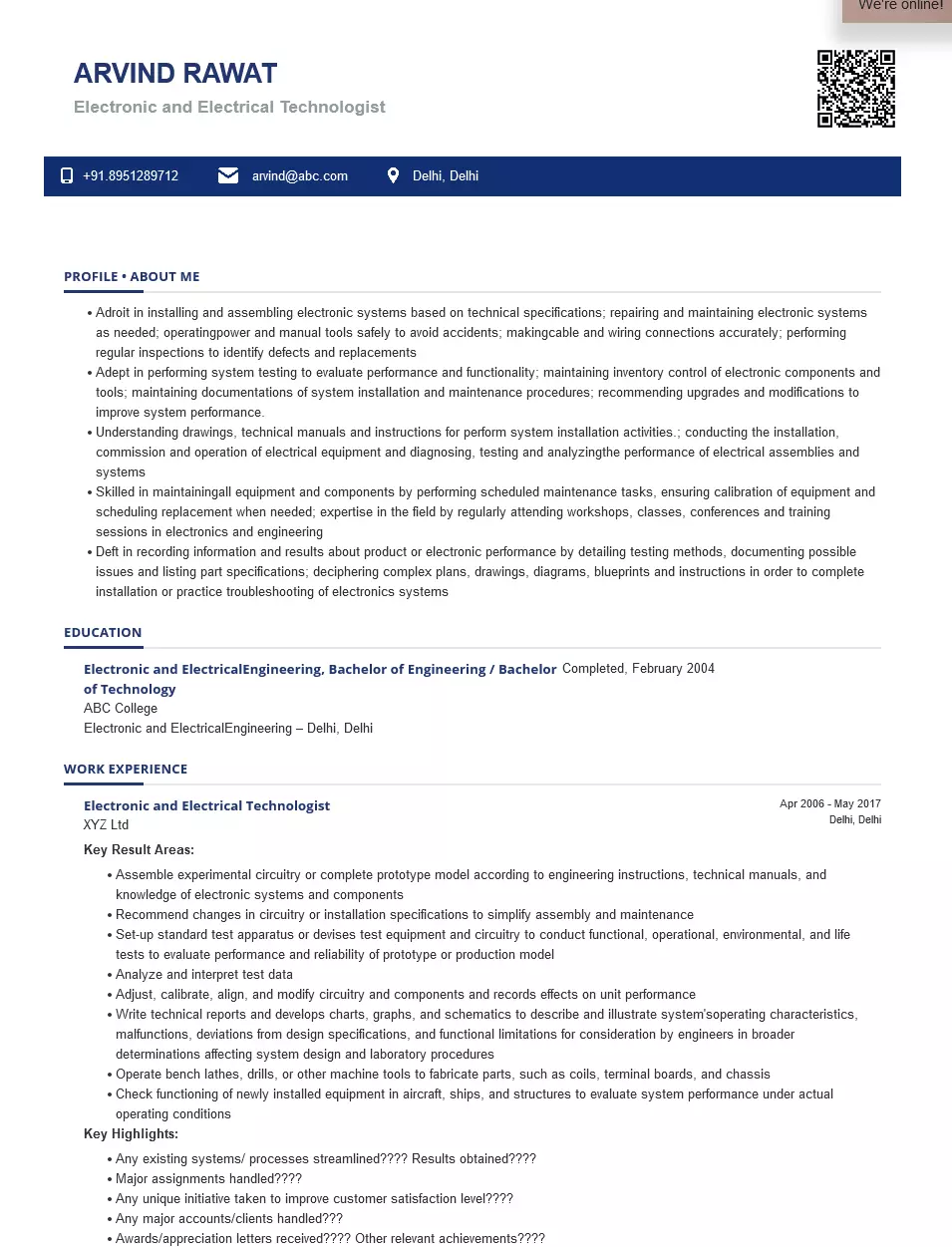
ARVIND RAWAT
Phone: 8951289712
Email: arvind@abc.com
Address: C-21, Sector-21, Delhi
About Me
Electronic and Electrical Technologist
- Conscientious Electronic Technician with XX years of experience installing and assembling electronic systems based on technical specifications. Adept in performing system testing to evaluate performance and functionality. Proficient in performing system testing to assess performance and functionality; maintaining inventory control of electronic components and tools; maintaining documentation of system installation and maintenance procedures; recommending upgrades and modifications to improve system performance.
- Understanding drawings, technical manuals, and instructions for performing system installation activities.; conducting the installation, commission, and operation of electrical equipment and diagnosing, testing, and analyzing the performance of electrical assemblies and systems
- Skilled in maintaining all equipment and components by performing scheduled maintenance tasks, ensuring calibration of equipment, and preparing replacement when needed; expertise in the field by regularly attending workshops, classes, conferences, and training sessions in electronics and engineering
- Deft in recording information and results about product or electronic performance by detailing testing methods, documenting possible issues, and listing part specifications; deciphering complex plans, drawings, diagrams, blueprints, and instructions in order to complete installation or practice troubleshooting of electronics systems
Education
Electronic and ElectricalEngineering, Bachelor of Engineering / Bachelor of Technology, Completed, February 2004
Indian Institute of Management
– Marks null
Bangalore, KA
Certifications
Work Experience
Period: April 2010 - Current
Electronic and Electrical Technologist
M/S. G.Chavan Manpower Consultant
Delhi,
- Assembled experimental circuitry or completed prototype models according to engineering instructions, technical manuals, and knowledge of electronic systems and components.
- Recommended changes in circuitry or installation specifications to simplify assembly and maintenance.
- Set up standard test apparatus or devices test equipment and circuitry to conduct functional, operational, environmental, and life tests to evaluate the performance and reliability of prototype or production model.
- Wrote technical reports and developed charts, graphs, and schematics to describe and illustrate the system's operating characteristics, malfunctions, deviations from design specifications, and functional limitations for consideration by engineers in broader determinations affecting system design and laboratory procedures.
- Operated bench lathes, drills, or other machine tools to fabricate parts, such as coils, terminal boards, and chassis.
- Checked the functioning of newly installed equipment in aircraft, ships, and structures to evaluate system performance under actual operating conditions.
Period: October 1981 - February 2009
Electronics Engineering Technician
Electrocon Consumer Electronics
Navi Mumbai, MH
- Identified and resolved equipment malfunctions, working with manufacturers or field representatives as necessary to procure replacement parts.
- Tested electronics units, using standard test equipment, and analyze results to evaluate performance and determine the need for adjustment.
- Performed preventative maintenance or calibration of equipment or systems.
- Maintained system logs or manuals to document testing or operation of equipment.
- Procured parts and maintain inventory and related documentation.
- Prepared reports or recorded data on testing techniques, laboratory equipment, or specifications to assist engineers.
- Designed basic circuitry and draft sketches for clarification of details and design documentation under engineers' direction, using drafting instruments or computer-aided design (CAD) equipment.
- Researched equipment or component needs, sources, competitive prices, delivery times, or ongoing operational costs.
- Provided user applications or engineering support or recommendations for new or existing equipment with regard to installation, upgrades, or enhancements.
Skills
Hard Skills
- Heat Gun Operations
- Board Assemblies
- Riveting experience
- Laser welding
- Component Installations
- Blueprint reading
- Hand tools
- Blueprint Interpretation
- [Software Program] expertise
- Soldering skills
Soft Skills
- Communication Skills
- Compassion & Empathy
- Interpersonal Skills
- Organizational Skills
- Creativity & Innovation
- Patience & Understanding
- Enthusiasm & Friendliness
- Respectful
- Collaboration
Languages
Softwares
Operating System
Personal Interests
- Travelling
- Yoga
- Gardening

Author
Kshama Sharma - Resume, CV and Cover Letter Writing Expert
Check Out Related Resume Samples
Computer Repair Resume Example
Cleaning Services Resume Example
HVAC and Refrigeration Resume Example
Office Machines Resume Example
Automotive and Body Resume Example
Industrial Machinery Resume Example
Roads Resume Example
Medical Equipment Resume Example
Telecommunications Resume Example
Electronic and Electrical Components Resume Example
Buildings and Facilities Resume Example