India's
premier resume service
India's
premier resume service


- AWS Certified DevOps Engineer, Completed , January 2009
- DevOps Project Manager Certification, Completed , January 2017
- Home

- Resume Samples
- DevOps Engineer Resume Sample
What's your job?
DevOps Engineer Resume Samples and Templates for 2026
- Table of Contents
- Downloadable Sample
- Resume Tips from Experts
- Resume Text Version
- Share


DevOps Engineer Resume: Skills, Tools & Examples
Introduction
DevOps has transformed how organisations in India build, deploy, and manage software applications. From tech giants in Bangalore to fintech startups in Mumbai, companies are increasingly adopting DevOps practices to accelerate delivery, improve reliability, and enhance collaboration between development and operations teams. The demand for skilled DevOps engineers continues to surge as Indian enterprises embrace cloud computing, containerisation, and automation.
India’s position as a global technology hub has created tremendous opportunities for DevOps professionals. Major IT companies like TCS, Infosys, and Wipro, along with product companies like Flipkart, Swiggy, and Razorpay, are constantly seeking engineers who can bridge the gap between development and operations. Whether you’re a system administrator transitioning to DevOps, a developer expanding your skillset, or an experienced SRE looking to advance, a well-crafted resume is essential for standing out in this competitive field.
This comprehensive guide will help you create a DevOps engineer resume that effectively showcases your infrastructure automation skills, cloud expertise, and ability to implement CI/CD pipelines. From highlighting your Kubernetes experience to demonstrating your impact on deployment frequency and system reliability, we’ll cover everything you need to land your dream DevOps role in 2025.
Section 1: Understanding the DevOps Engineer Role in India
Overview of Duties and Responsibilities
DevOps engineers in India handle a diverse range of responsibilities that span development, operations, and automation. Common duties include:
CI/CD Pipeline Management: Designing, implementing, and maintaining continuous integration and continuous deployment pipelines using tools like Jenkins, GitLab CI, or GitHub Actions.
Infrastructure as Code: Managing cloud infrastructure using Terraform, CloudFormation, or Pulumi to ensure reproducible and version-controlled environments.
Container Orchestration: Deploying and managing containerised applications using Docker and Kubernetes across development and production environments.
Cloud Infrastructure: Provisioning and managing resources on AWS, Azure, or GCP, including compute, storage, networking, and managed services.
Monitoring and Observability: Implementing monitoring solutions using Prometheus, Grafana, ELK Stack, or cloud-native tools to ensure system health and performance.
Security and Compliance: Implementing DevSecOps practices, managing secrets, and ensuring infrastructure meets security and compliance requirements.
Key Skills and Competencies Employers Look For
Employers in India’s technology sector value a combination of technical expertise and operational mindset:
Cloud Platforms: Deep knowledge of AWS, Azure, or GCP services and best practices for cloud architecture.
Container Technologies: Hands-on experience with Docker, Kubernetes, and container orchestration at scale.
Automation Tools: Proficiency in configuration management tools like Ansible, Chef, or Puppet.
Scripting Languages: Strong skills in Python, Bash, or Go for automation and tooling.
CI/CD Expertise: Experience building and maintaining pipelines with Jenkins, GitLab CI, CircleCI, or similar tools.
Infrastructure as Code: Expert-level Terraform or CloudFormation skills for managing cloud resources.
Diversity of Roles Within DevOps
The DevOps field in India offers numerous specialisation paths:
Site Reliability Engineer (SRE): Focuses on reliability, scalability, and performance of production systems.
Platform Engineer: Builds internal developer platforms and tools to improve developer productivity.
Cloud Engineer: Specialises in designing and managing cloud infrastructure and migrations.
DevSecOps Engineer: Integrates security practices into the DevOps pipeline.
Release Engineer: Manages release processes, versioning, and deployment strategies.
Infrastructure Engineer: Focuses on core infrastructure components and networking.
Section 2: Preparing Your Resume - Essential Components
Contact Information
Your contact section should be professional and easily accessible:
- Full Name: Clearly displayed at the top of your resume
- Phone Number: Include your mobile number with country code (+91)
- Email Address: Use a professional email (e.g., amit.sharma@email.com)
- Location: City and state (e.g., Bangalore, Karnataka)
- LinkedIn Profile: Essential for professional networking
- GitHub Profile: Showcase your automation scripts and tools
- Personal Blog/Website: If you write about DevOps topics
Professional Summary
Your summary should capture your technical expertise, experience, and career objectives:
Example for Experienced Professional: “Senior DevOps Engineer with 8+ years of experience building scalable infrastructure and CI/CD pipelines. Led platform engineering at PhonePe handling 2B+ monthly transactions. Expert in Kubernetes, Terraform, and AWS. Reduced deployment time from hours to minutes through pipeline automation. Seeking to lead DevOps transformation initiatives at an innovative technology company.”
Example for Mid-Level Professional: “DevOps Engineer with 5 years of experience in cloud infrastructure and automation. Built Kubernetes platform at Razorpay supporting 100+ microservices. Proficient in AWS, Docker, and Jenkins. Strong background in infrastructure as code and monitoring. Looking to drive reliability and efficiency improvements in a fast-paced environment.”
Example for Fresher/Career Changer: “Linux System Administrator transitioning to DevOps with 3 years of infrastructure experience. Completed AWS Solutions Architect certification and Kubernetes training. Built personal projects automating deployment pipelines and infrastructure provisioning. Passionate about automation and eager to apply skills in a DevOps role.”
Work Experience
Present your experience in reverse chronological order with quantified achievements:
Senior DevOps Engineer | Flipkart | Bangalore | 2021-Present
- Architected Kubernetes platform running 500+ microservices handling 10M+ daily orders
- Reduced deployment frequency from weekly to 50+ times daily through CI/CD optimisation
- Implemented infrastructure as code reducing provisioning time from days to minutes
- Led team of 6 engineers in building internal developer platform
DevOps Engineer | Paytm | Noida | 2018-2021
- Managed AWS infrastructure supporting 300M+ registered users
- Built Jenkins pipeline reducing build time from 45 minutes to 8 minutes
- Implemented Prometheus and Grafana monitoring reducing MTTR by 60%
- Automated infrastructure provisioning using Terraform across 3 AWS regions
Skills Section
Technical Skills:
- Cloud: AWS (EC2, EKS, S3, RDS, Lambda), Azure, GCP
- Containers: Docker, Kubernetes, Helm, Istio
- CI/CD: Jenkins, GitLab CI, GitHub Actions, ArgoCD
- IaC: Terraform, CloudFormation, Ansible, Pulumi
- Monitoring: Prometheus, Grafana, ELK Stack, Datadog
- Scripting: Python, Bash, Go
Soft Skills:
- Problem Solving
- Incident Management
- Cross-Team Collaboration
- Technical Documentation
- Mentoring
- On-Call Support
Section 3: Resume Formats for DevOps Engineers
Chronological Resume
Best suited for professionals with steady career progression in infrastructure or DevOps. Lists work experience from most recent to oldest, highlighting career growth.
When to use: If you have 3+ years of continuous DevOps/infrastructure experience with clear progression.
Functional Resume
Focuses on skills and technical expertise rather than chronological work history. Useful for career changers from system administration or development.
When to use: If you’re transitioning from sysadmin, development, or networking roles.
Combination Resume
Blends the chronological and functional formats, highlighting both skills and work history. Ideal for experienced professionals seeking senior or leadership roles.
When to use: If you have diverse experience across multiple cloud platforms and tools.
Section 4: Professional Summary Examples
For SRE: “Site Reliability Engineer with 6 years of experience ensuring reliability for high-traffic platforms. Maintained 99.99% uptime for Swiggy’s order processing system handling 3M+ daily orders. Expert in Kubernetes, chaos engineering, and incident management. Implemented SLO-based alerting reducing alert fatigue by 70%.”
For Cloud Engineer: “AWS Certified Solutions Architect with 5 years of experience designing cloud infrastructure. Led cloud migration for HDFC Bank moving 100+ applications to AWS. Expert in multi-region architecture, disaster recovery, and cost optimisation. Achieved 40% cost reduction through right-sizing and reserved instances.”
For Platform Engineer: “Platform Engineer with 7 years of experience building internal developer platforms. Created self-service infrastructure platform at Ola used by 200+ developers. Expert in Kubernetes, Terraform, and GitOps. Reduced infrastructure request time from 2 weeks to 15 minutes through automation.”
For Fresher: “B.Tech Computer Science graduate from BITS Pilani with AWS and Kubernetes certifications. Completed internship at TCS implementing CI/CD pipelines. Built personal projects including automated infrastructure provisioning and monitoring setup. Strong foundation in Linux, Python, and cloud services.”
For Career Changer: “System Administrator transitioning to DevOps with 6 years of Linux infrastructure experience. Completed Certified Kubernetes Administrator (CKA) and Terraform Associate certifications. Automated routine tasks using Python and Ansible. Ready to apply infrastructure expertise to modern DevOps practices.”
Section 5: Showcasing DevOps Projects
How to Present Projects
Transform project descriptions into compelling achievements using metrics:
Instead of: “Managed Kubernetes cluster” Write: “Architected and managed production Kubernetes cluster with 500+ pods, implementing auto-scaling that handled 10x traffic spikes during sales events while maintaining 99.9% availability”
Instead of: “Built CI/CD pipeline” Write: “Designed Jenkins pipeline reducing deployment time from 4 hours to 15 minutes, enabling teams to deploy 50+ times daily with zero-downtime deployments”
Sample Project Entries
Kubernetes Platform | Amazon India
- Built multi-tenant Kubernetes platform hosting 300+ microservices
- Implemented Istio service mesh for traffic management and security
- Designed auto-scaling policies handling 100x traffic during Prime Day
- Achieved 99.99% platform availability through proper resource planning
- Technologies: Kubernetes, Istio, Helm, ArgoCD, Prometheus, Grafana
CI/CD Transformation | ICICI Bank
- Migrated 50+ applications from manual deployments to GitLab CI pipelines
- Implemented blue-green deployments reducing rollback time from hours to seconds
- Integrated security scanning reducing vulnerabilities by 80% before production
- Technologies: GitLab CI, Docker, Kubernetes, SonarQube, Trivy
Cloud Migration | Reliance Jio
- Led migration of on-premise infrastructure to AWS for telecom platform
- Designed multi-AZ architecture ensuring high availability and disaster recovery
- Achieved 35% cost savings through reserved instances and spot instances
- Technologies: AWS, Terraform, Ansible, CloudWatch, Route53
Entry-Level Project Ideas
For freshers and career changers, showcase personal projects:
- Home Lab Kubernetes - Set up local Kubernetes cluster with monitoring
- CI/CD for Personal Projects - Automated pipelines for code deployment
- Infrastructure as Code - Terraform modules for common infrastructure patterns
- Monitoring Stack - Prometheus and Grafana setup with custom dashboards
- Ansible Automation - Configuration management for server setup
- Docker Compose Applications - Multi-container application deployments
Section 6: Skills to Include in Your DevOps Engineer Resume
Technical Skills
- Cloud Platforms: AWS (EC2, EKS, S3, RDS, Lambda, CloudFront), Azure (AKS, VMs, Storage), GCP (GKE, Compute Engine)
- Containers: Docker, Kubernetes, Helm, Container registries, Pod security
- CI/CD: Jenkins, GitLab CI, GitHub Actions, ArgoCD, CircleCI, Spinnaker
- Infrastructure as Code: Terraform, CloudFormation, Pulumi, Ansible, Chef, Puppet
- Monitoring: Prometheus, Grafana, ELK Stack, Datadog, New Relic, CloudWatch
- Scripting: Python, Bash, Go, PowerShell
- Version Control: Git, GitHub, GitLab, Bitbucket
- Networking: VPC, Load Balancers, DNS, CDN, VPN, Security Groups
- Security: HashiCorp Vault, AWS Secrets Manager, IAM, SSL/TLS, DevSecOps
- Databases: PostgreSQL, MySQL, MongoDB, Redis, DynamoDB
Soft Skills
- Problem Solving: Troubleshooting complex infrastructure and deployment issues
- Incident Management: Handling production incidents with calm and methodical approach
- Communication: Explaining technical concepts to developers and stakeholders
- Collaboration: Working effectively with development and security teams
- Documentation: Creating runbooks, architecture diagrams, and process documentation
- On-Call Reliability: Managing on-call responsibilities and incident response
- Continuous Learning: Staying updated with rapidly evolving DevOps landscape
- Automation Mindset: Always looking for opportunities to automate manual tasks
Section 7: Certifications and Professional Development
Essential Certifications for DevOps Engineers
AWS Certified DevOps Engineer - Professional
- Issued by: Amazon Web Services
- Value: Validates expertise in provisioning, operating, and managing AWS environments
Certified Kubernetes Administrator (CKA)
- Issued by: Cloud Native Computing Foundation (CNCF)
- Value: Demonstrates hands-on Kubernetes administration skills
HashiCorp Certified: Terraform Associate
- Issued by: HashiCorp
- Value: Proves proficiency in infrastructure as code using Terraform
Azure DevOps Engineer Expert
- Issued by: Microsoft
- Value: Shows competency in Azure DevOps and cloud development
Google Professional Cloud DevOps Engineer
- Issued by: Google Cloud
- Value: Validates ability to manage GCP infrastructure and deployments
Additional Valuable Certifications
- Certified Kubernetes Security Specialist (CKS)
- AWS Solutions Architect - Professional
- Red Hat Certified Engineer (RHCE)
- Docker Certified Associate
- Linux Professional Institute Certification (LPIC)
Indian Institution Certifications
- DevOps Certification - Simplilearn
- Cloud Computing Specialisation - IIT Madras (NPTEL)
- AWS Training - UpGrad
- Kubernetes Training - Edureka
- DevOps Bootcamp - Scaler Academy
Section 8: Tips by Experience Level
Entry-Level (0-2 Years)
- Highlight Certifications: AWS, CKA, Terraform Associate add credibility
- Showcase Home Lab: Personal Kubernetes clusters and automation projects
- Include Relevant Experience: System administration, development, or IT support
- Mention Training: Bootcamps, online courses, hands-on labs
- Emphasise Linux Skills: Fundamental for any DevOps role
- Add Version Control: Git proficiency is essential
Mid-Level (3-7 Years)
- Focus on Impact: Quantify improvements (deployment frequency, MTTR, uptime)
- Show Scale: Size of infrastructure managed, number of services
- Leadership Indicators: Mentoring, leading projects, on-call management
- Specialisation: Deep expertise in specific area (Kubernetes, AWS, CI/CD)
- Incident Management: Examples of handling and resolving critical incidents
- Process Improvements: Automation initiatives and efficiency gains
Senior-Level (8+ Years)
- Strategic Impact: Architecture decisions, platform design, tool selection
- Team Leadership: Size of teams led, building DevOps practices
- Cross-Functional Influence: Working with security, development, and product teams
- Cost Optimisation: Cloud spend management and efficiency improvements
- Technical Vision: Setting standards, introducing new technologies
- Industry Contribution: Speaking, writing, open-source contributions
Section 9: ATS Optimisation Tips
Understanding ATS in Indian Context
Major Indian IT companies and startups use Applicant Tracking Systems. Common systems include Greenhouse, Lever, Workday, and Naukri RMS.
Keyword Optimisation
Include relevant keywords from the job description:
- Technical terms: Kubernetes, Docker, AWS, Terraform, Jenkins, CI/CD
- Job titles: DevOps Engineer, SRE, Platform Engineer, Cloud Engineer
- Skills: Infrastructure as Code, Container Orchestration, Automation
- Tools: Prometheus, Grafana, Ansible, Helm, ArgoCD
Formatting Best Practices
- Use standard fonts (Arial, Calibri, Times New Roman)
- Avoid tables, graphics, and complex formatting
- Use standard section headings (Experience, Education, Skills, Certifications)
- Save as PDF or .docx as specified
- Keep file size under 2MB
- Include both acronyms and full forms (CI/CD - Continuous Integration/Continuous Deployment)
Common Mistakes to Avoid
- Using headers and footers (ATS may not read them)
- Excessive use of graphics or icons
- Missing important keywords from job description
- Using only tool names without context
- Inconsistent formatting throughout document
Conclusion
Creating a compelling DevOps engineer resume requires demonstrating both your technical depth in infrastructure and automation, and your ability to improve software delivery and system reliability. By following this guide, you can craft a resume that effectively communicates your expertise in cloud platforms, containerisation, and CI/CD to employers in India’s competitive technology market.
The DevOps field in India offers tremendous opportunities for growth and innovation. Whether you’re a system administrator transitioning to DevOps, a developer expanding into operations, or a senior engineer seeking leadership roles, a well-crafted resume is your gateway to exciting opportunities at top technology companies.
Remember to tailor your resume for each application, quantify your achievements with specific metrics (deployment frequency, uptime percentages, cost savings), and keep your certifications current. Include links to your GitHub profile showcasing your automation scripts and infrastructure code.
Ready to create your professional DevOps engineer resume? Use our resume builder to get started with professionally designed templates, or explore more resume samples for inspiration. For personalised guidance, our expert resume writers are here to help you craft a document that opens doors to your dream DevOps role.
Frequently Asked Questions
What sections should a strong devops engineer resume include?
At minimum, include contact information, a professional summary, work experience, key skills, and education. Depending on your experience level, you may also add certifications, achievements, projects, or industry-specific sections that highlight your expertise.
How do I write a professional summary for a devops engineer role?
Keep it concise — two to three sentences highlighting your experience level, core competencies, and a key achievement or strength that shows why you're right for the job. Tailor it to match the specific role you're applying for.
What skills are most important to list on a devops engineer resume?
Include a mix of technical skills specific to devops engineer roles and soft skills like communication, problem-solving, and teamwork. Research job postings in your target companies to identify the most commonly requested skills.
How detailed should my work experience be?
Use bullet points to describe your roles, focusing on specific results, tools used, and the impact you made. Quantify achievements where possible — numbers and percentages help recruiters quickly understand your contributions.
Do I need certifications on my devops engineer resume?
Certifications aren't always required, but they can strengthen your application — especially if they demonstrate advanced training or specialised expertise. List the certification name, issuing organisation, and year obtained.
What's the best resume format for a devops engineer?
Most devops engineer professionals benefit from a reverse-chronological format that lists your most recent experience first. If you're changing careers or have gaps, a functional or combination format might work better.
How long should my devops engineer resume be?
Aim for one page if you're early in your career. Experienced professionals with extensive achievements can use two pages — just ensure every section adds value and remains relevant to the role.
Should I tailor my resume for each job application?
Yes. Customising your resume with keywords and responsibilities from the job posting improves your chances of passing Applicant Tracking Systems (ATS) and resonating with recruiters. Focus on relevant experience and skills for each role.
DevOps Engineer Text-Only Resume Templates and Samples
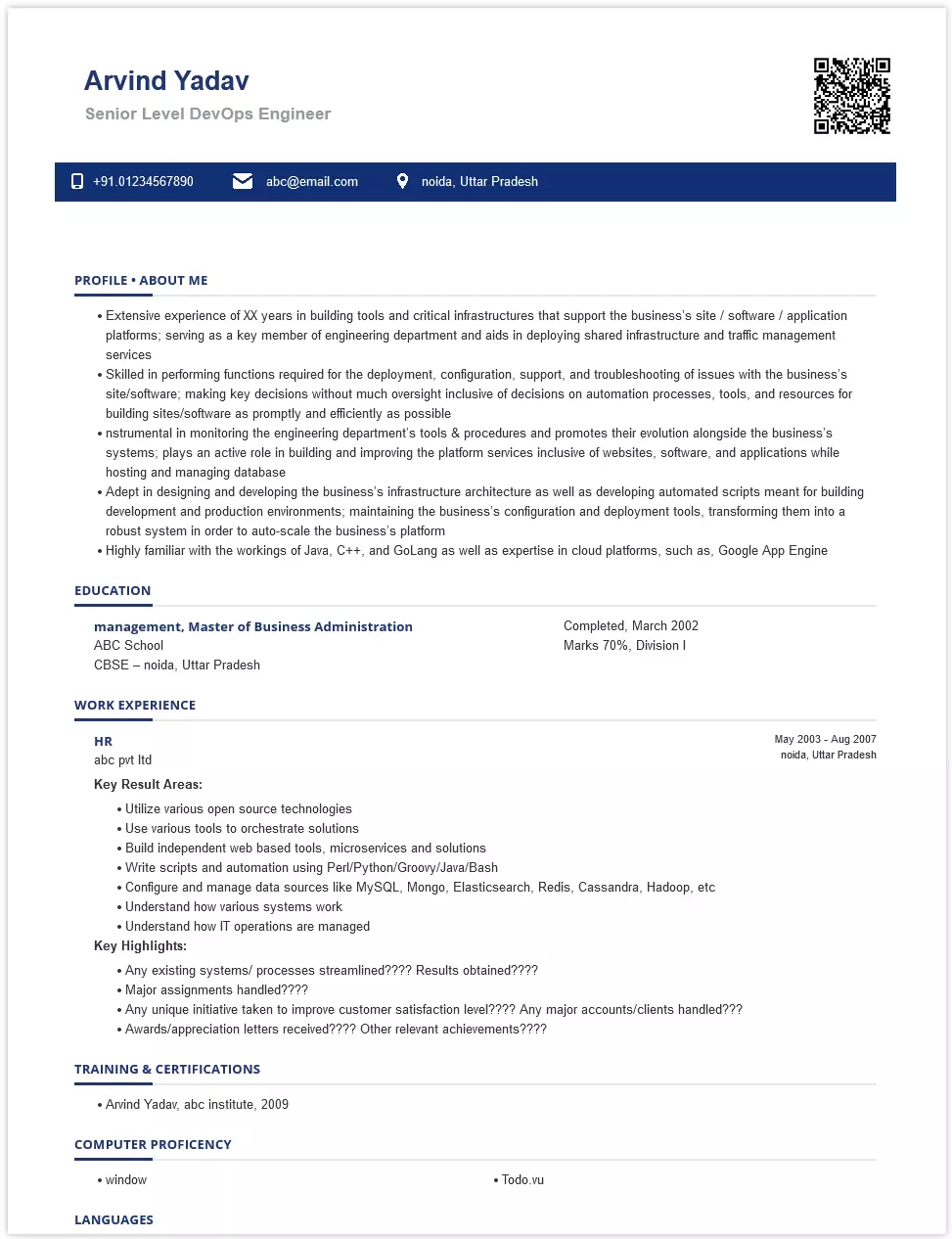
Arvind Yadav
Phone: 01234567890
Email: abc@email.com
Address: Sec-44, Noida, Noida
About Me
Senior DevOps Engineer
- Highly skilled DevOps Manager with XX years of experience in building tools and critical infrastructures that support the business’s site/software/application platforms. Skilled in monitoring the engineering department’s tools & procedures and promoting their evolution alongside the business’s systems. Familiar with the workings of Java, C++, and GoLang as well as expertise in cloud platforms, such as Google App Engine.
- Skilled in performing functions required and making key decisions without much oversight inclusive of decisions on automation processes, tools, and resources for building sites/software as promptly and efficiently as possible
- Play an active role in building and improving the platform services inclusive of websites, software, and applications while hosting and managing the database
- Adept in designing and developing the business’s infrastructure architecture as well as developing automated scripts meant for building development and production environments; maintaining the business’s configuration and deployment tools, transforming them into a robust system in order to auto-scale the business’s platform
Education
Computer Science, Master of Science, Completed, March 2002
Indian Institute of Technology Bombay
– Marks 70
Mumbai, MH
Certifications
Work Experience
Period: May 2003 - August 2007
Senior DevOps Engineer
Reliance Jio Infocomm
Mumbai, MH
- Boosted quality via Puppet and Zabbix and reduced customer complaints by 30%.
- Led a team of 7 developers and 3 SysAdmins in the continuous deployment of SaaS real estate solutions with 1 million+ user.
- Worked effectively to improve the effectiveness and security of the current network operations.
- Developed and managed new scaling processes and hired, trained, and supervised IT Interns.
- Maintained corporate internal servers and installed and configured various hardware and software.
Period: April 1997 - January 2008
Cloud DevOps Engineer
Enflexis Solutions
Hyderabad, TG
- Took complete responsibility for the deployment of high-volume SaaS investment tools.
- Set up 30 Unix servers and managed them with 90% uptime.
- Reduced 15% vulnerabilities by writing scripts automating security.
- Improved 18% customer satisfaction by deploying 2 iterations each month.
- Participated in the development of automation technologies, and handled and arranged relevant documents and records.
- Managed DevOps during a period of 40% revenue growth.
Skills
Hard Skills
- Unix/Linux
- Networking Protocols
- GIT
- Jenkins
- Puppet/Chef
- Deployment
- Configuration Management
- Docker
- Containers
- AWS/VMWare/Cisco
- Python/Perl
- Apache/Nginx
- Zabbix/Sensu
Soft Skills
- Detail-oriented
- Communication
- Critical thinking
- Decision making
- Efficiency
- Flexibility
- Independence
- Organizational
Languages
Softwares
Operating System
Personal Interests
- Reading Books
- Travelling
- Video Games

Author
Kshama Sharma - Resume, CV and Cover Letter Writing Expert
Check Out Related Resume Samples
DevOps Architect Resume Example
DevOps Engineer Resume Example
Cloud Engineer - AWS Resume Example
Cloud Engineer - VMWare Resume Example
Cloud Engineer - Azure/Hyper-V Resume Example
Cloud Engineer - Rackspace Resume Example
Cloud Engineer - OpenStack Resume Example
Cloud Architect Resume Example
DevOps Manager Resume Example