India's
premier resume service
India's
premier resume service


- Wrote DevOps blogs for CO Tech Services.
- Home

- Resume Samples
- DevOps Architect Resume Sample
What's your job?
DevOps Architect Resume Samples and Templates for 2026
- Table of Contents
- Downloadable Sample
- Resume Tips from Experts
- Resume Text Version
- Share


DevOps Architect Resume Guide: Projects, Tools & Format
Introduction
DevOps architecture has become the backbone of modern software delivery in India’s rapidly evolving technology ecosystem. From designing cloud-native infrastructures at Flipkart to implementing enterprise-scale automation at major banks like HDFC and ICICI, DevOps Architects are driving digital transformation across industries. The role combines deep technical expertise with strategic thinking, requiring professionals who can bridge the gap between development and operations while designing scalable, secure, and efficient systems.
India’s enterprise technology sector is experiencing unprecedented growth, with organisations investing heavily in cloud infrastructure, containerisation, and automation. Technology hubs like Bangalore, Hyderabad, Pune, and Chennai are home to global technology centres of leading multinational corporations, all seeking skilled DevOps Architects to lead their infrastructure modernisation initiatives. Whether you’re at a product startup or a large enterprise, DevOps Architects command premium compensation and play critical roles in technology strategy.
This comprehensive guide will help you create a DevOps Architect resume that effectively showcases your technical leadership, architecture design capabilities, and proven track record of implementing DevOps transformations. From highlighting your cloud platform expertise to demonstrating your ability to drive organisational change, we’ll cover everything you need to secure your dream DevOps Architect role in 2025.
Section 1: Understanding the DevOps Architect Role in India
Overview of Duties and Responsibilities
DevOps Architects in India work at the intersection of development, operations, and business strategy. Their responsibilities span technical design to organisational transformation:
Infrastructure Architecture: Designing scalable, resilient, and cost-effective cloud infrastructure using AWS, Azure, or GCP platforms.
CI/CD Pipeline Design: Architecting end-to-end continuous integration and delivery pipelines that enable rapid, reliable software releases.
Container Orchestration: Designing Kubernetes-based container platforms for microservices deployment and management.
Platform Engineering: Building internal developer platforms that improve developer productivity and reduce time-to-market.
Security Architecture: Implementing DevSecOps practices, ensuring security is embedded throughout the software delivery lifecycle.
Automation Strategy: Developing infrastructure-as-code strategies using Terraform, Ansible, or CloudFormation.
Technical Leadership: Guiding development and operations teams on DevOps best practices and tooling decisions.
Key Skills and Competencies Employers Look For
Employers in India’s enterprise technology sector value a combination of deep technical expertise and leadership capabilities:
Cloud Platform Expertise: Advanced knowledge of AWS, Azure, or GCP services including compute, networking, storage, and managed services.
Container Technologies: Expertise in Docker, Kubernetes, and container orchestration patterns at enterprise scale.
Infrastructure as Code: Mastery of Terraform, Ansible, Pulumi, or CloudFormation for infrastructure automation.
CI/CD Mastery: Deep experience with Jenkins, GitLab CI, GitHub Actions, or Azure DevOps for pipeline design.
Scripting Proficiency: Strong coding skills in Python, Go, or Bash for automation and tooling.
Security Knowledge: Understanding of cloud security, network security, and DevSecOps practices.
Architectural Thinking: Ability to design systems for scalability, reliability, and cost optimisation.
Diversity of Roles Within DevOps Architecture
The DevOps architecture field in India offers various specialisation paths:
Cloud Architect: Focuses on cloud platform design, migration strategies, and cloud-native architecture.
Platform Engineer: Builds internal developer platforms and self-service infrastructure capabilities.
Site Reliability Engineer (SRE): Combines software engineering with operations to build reliable systems.
DevSecOps Architect: Specialises in integrating security practices throughout the DevOps pipeline.
Infrastructure Architect: Focuses on network design, data centre architecture, and hybrid cloud solutions.
Automation Architect: Leads automation strategy and tooling decisions across the organisation.
Section 2: Preparing Your Resume - Essential Components
Contact Information
Your contact section should be professional and easily accessible:
- Full Name: Clearly displayed at the top of your resume
- Phone Number: Include your mobile number with country code (+91)
- Email Address: Use a professional email (e.g., priya.sharma@email.com)
- Location: City and state (e.g., Bangalore, Karnataka)
- LinkedIn Profile: Essential for professional networking
- GitHub Profile: Showcase your infrastructure code and automation projects
- Personal Blog/Website: If you write about DevOps practices
Professional Summary
Your summary should capture your architectural expertise, leadership experience, and transformation impact:
Example for Experienced Professional: “DevOps Architect with 10+ years of experience designing and implementing enterprise-scale infrastructure platforms. Led cloud transformation at Reliance Jio serving 400M+ subscribers. Expert in AWS, Kubernetes, and Terraform. Proven track record of reducing deployment time by 80% and infrastructure costs by 40%. Seeking to drive digital transformation at a technology-forward organisation.”
Example for Mid-Level Professional: “DevOps Architect with 6 years of experience in cloud infrastructure design and CI/CD implementation. Architected microservices platform at Ola handling 5M+ daily rides. Proficient in Azure, Docker, and Jenkins. Strong background in infrastructure automation and platform engineering. Looking to lead DevOps transformation initiatives in a high-growth environment.”
Example for Transitioning Professional: “Senior DevOps Engineer transitioning to Architecture with 5 years of hands-on infrastructure experience. Designed Kubernetes platform at Swiggy supporting 50+ microservices. AWS Solutions Architect certified. Led migration of legacy applications to cloud-native architecture. Ready to take on architectural leadership in DevOps transformation.”
Work Experience
Present your experience in reverse chronological order with quantified achievements:
Principal DevOps Architect | Flipkart | Bangalore | 2021-Present
- Designed multi-region Kubernetes platform handling 10M+ daily orders during peak sales
- Led migration of 200+ microservices from EC2 to EKS reducing infrastructure costs by 45%
- Architected GitOps-based deployment pipeline reducing release time from days to hours
- Established platform engineering team building developer self-service capabilities
Senior DevOps Architect | TCS | Pune | 2018-2021
- Designed hybrid cloud architecture for BFSI client managing ₹1 lakh crore transactions
- Implemented infrastructure-as-code practices reducing environment provisioning from weeks to hours
- Led DevSecOps transformation integrating security scanning into CI/CD pipelines
- Mentored team of 15 DevOps engineers across multiple project teams
Skills Section
Technical Skills:
- Cloud Platforms: AWS, Azure, GCP, OpenStack
- Containers: Docker, Kubernetes, Helm, Istio, OpenShift
- IaC: Terraform, Ansible, Pulumi, CloudFormation, ARM Templates
- CI/CD: Jenkins, GitLab CI, GitHub Actions, Azure DevOps, ArgoCD
- Languages: Python, Go, Bash, PowerShell
- Monitoring: Prometheus, Grafana, Datadog, ELK Stack, Splunk
Soft Skills:
- Technical Leadership
- Architecture Design
- Stakeholder Communication
- Strategic Planning
- Team Mentoring
- Vendor Management
Section 3: Resume Formats for DevOps Architects
Chronological Resume
Best suited for architects with steady career progression in infrastructure and DevOps roles. Lists work experience from most recent to oldest, highlighting career growth from engineer to architect.
When to use: If you have 7+ years of continuous experience with clear progression from DevOps Engineer to Architect roles.
Functional Resume
Focuses on architectural competencies and project impact rather than chronological work history. Useful for professionals transitioning from traditional infrastructure roles.
When to use: If you’re transitioning from system administration, network engineering, or traditional IT operations.
Combination Resume
Blends the chronological and functional formats, highlighting both architectural achievements and career progression. Ideal for experienced architects seeking principal or director-level positions.
When to use: If you have diverse experience across cloud platforms and want to showcase both technical depth and leadership growth.
Section 4: Professional Summary Examples
For Cloud-Native Architect: “Cloud-Native DevOps Architect with 8 years of experience building containerised platforms at scale. Designed Kubernetes infrastructure at Paytm handling 50M+ daily transactions. Expert in AWS EKS, Istio service mesh, and GitOps workflows. Contributed to CNCF projects with 500+ GitHub stars. Seeking principal architect role in product engineering.”
For Enterprise Architect: “Enterprise DevOps Architect with 12 years of experience transforming legacy infrastructure at Fortune 500 companies. Led hybrid cloud migration at HDFC Bank ensuring 99.99% availability. Expert in Azure, Terraform, and enterprise security. Proven track record of managing ₹50 crore infrastructure budgets. Looking to drive digital transformation at scale.”
For Platform Engineering Leader: “Platform Engineering Architect with 7 years of experience building internal developer platforms. Created self-service infrastructure at Razorpay reducing developer onboarding time by 70%. Proficient in Backstage, Kubernetes, and ArgoCD. Experience building golden path templates and platform APIs. Seeking to lead platform initiatives at a developer-focused company.”
For Transitioning Infrastructure Architect: “Senior Infrastructure Engineer transitioning to DevOps Architecture with 6 years of experience in data centre and cloud operations. Designed disaster recovery architecture at Infosys for banking clients. AWS and Azure certified. Led containerisation initiative for legacy applications. Ready to architect modern DevOps solutions.”
For Security-Focused Architect: “DevSecOps Architect with 9 years of experience integrating security into software delivery pipelines. Implemented security-as-code practices at Wipro reducing vulnerabilities by 80%. Expert in container security, compliance automation, and zero-trust architecture. CISSP and AWS Security Specialty certified. Seeking to lead DevSecOps transformation.”
Section 5: Showcasing Architecture Achievements
How to Present Projects
Transform project descriptions into compelling achievements using the STAR method:
Instead of: “Worked on cloud migration” Write: “Architected cloud migration strategy for 500+ applications at Infosys, reducing data centre footprint by 60% and saving ₹15 crore annually in infrastructure costs”
Instead of: “Implemented Kubernetes” Write: “Designed enterprise Kubernetes platform at Mindtree handling 1000+ pods across 3 regions with 99.99% availability and automated disaster recovery”
Sample Project Entries
Multi-Cloud Platform Architecture | Reliance Industries
- Designed multi-cloud strategy spanning AWS, Azure, and GCP for enterprise workloads
- Architected cross-cloud networking using Transit Gateway and Cloud Interconnect
- Implemented unified infrastructure-as-code using Terraform with custom providers
- Achieved 40% cost reduction through workload placement optimisation
- Technologies: AWS, Azure, GCP, Terraform, Kubernetes, HashiCorp Vault
Enterprise CI/CD Platform | ICICI Bank
- Architected enterprise-scale CI/CD platform serving 500+ development teams
- Designed secure pipeline architecture meeting RBI compliance requirements
- Implemented automated security scanning and compliance gates
- Reduced deployment frequency from monthly to daily while improving quality
- Technologies: Jenkins, Artifactory, SonarQube, Aqua Security, Kubernetes
Kubernetes Platform Migration | PhonePe
- Led architecture for migration of 100+ microservices to Kubernetes
- Designed service mesh implementation using Istio for traffic management
- Implemented GitOps workflow using ArgoCD for declarative deployments
- Achieved 99.99% uptime during migration with zero customer impact
- Technologies: Kubernetes, Istio, ArgoCD, Helm, Prometheus, Grafana
Entry-Level Architecture Project Ideas
For engineers transitioning to architecture roles, showcase technical leadership:
- Internal Platform Design - Self-service infrastructure platform for development teams
- CI/CD Framework - Reusable pipeline templates and shared libraries
- Kubernetes Cluster Design - Production-ready cluster with monitoring and security
- Infrastructure Automation - Terraform modules for standard infrastructure patterns
- Migration Blueprint - Architecture document for cloud migration strategy
- Disaster Recovery Design - DR architecture with automated failover
Section 6: Skills to Include in Your DevOps Architect Resume
Technical Skills
- Cloud Platforms: AWS (EC2, EKS, Lambda, S3, RDS, CloudFront), Azure (AKS, Functions, Cosmos DB), GCP (GKE, Cloud Run, BigQuery)
- Container Orchestration: Kubernetes, Docker, Helm, Istio, Linkerd, OpenShift, Rancher
- Infrastructure as Code: Terraform, Pulumi, Ansible, CloudFormation, ARM Templates, Crossplane
- CI/CD Tools: Jenkins, GitLab CI, GitHub Actions, Azure DevOps, ArgoCD, Spinnaker, Tekton
- Monitoring & Observability: Prometheus, Grafana, Datadog, New Relic, ELK Stack, Splunk, Jaeger
- Security Tools: HashiCorp Vault, Aqua Security, Twistlock, Snyk, Trivy, OPA, Falco
- Networking: Service Mesh, API Gateway, Load Balancing, CDN, DNS, VPN, Firewall
- Scripting & Development: Python, Go, Bash, PowerShell, YAML, JSON, HCL
- Source Control: Git, GitHub, GitLab, Bitbucket, Gerrit
- Databases: PostgreSQL, MySQL, MongoDB, Redis, Cassandra, Elasticsearch
Soft Skills
- Technical Leadership: Guiding teams on architecture decisions and best practices
- Strategic Thinking: Aligning technology decisions with business objectives
- Communication: Presenting complex technical concepts to diverse stakeholders
- Problem Solving: Designing solutions for complex infrastructure challenges
- Mentoring: Developing engineering talent and building high-performing teams
- Vendor Management: Evaluating and managing technology vendor relationships
- Change Management: Driving organisational transformation and adoption
- Cost Optimisation: Balancing performance, reliability, and cost considerations
Section 7: Certifications and Professional Development
Essential Certifications for DevOps Architects
AWS Certified Solutions Architect - Professional
- Issued by: Amazon Web Services
- Value: Validates advanced AWS architecture skills for complex applications
AWS Certified DevOps Engineer - Professional
- Issued by: Amazon Web Services
- Value: Demonstrates expertise in provisioning, operating, and managing AWS systems
Microsoft Certified: Azure Solutions Architect Expert
- Issued by: Microsoft
- Value: Proves advanced skills in designing Azure-based solutions
Google Cloud Professional Cloud Architect
- Issued by: Google Cloud
- Value: Validates ability to design and manage Google Cloud solutions
Certified Kubernetes Administrator (CKA)
- Issued by: Cloud Native Computing Foundation
- Value: Demonstrates Kubernetes administration expertise
Certified Kubernetes Security Specialist (CKS)
- Issued by: Cloud Native Computing Foundation
- Value: Proves advanced Kubernetes security knowledge
HashiCorp Certified: Terraform Associate
- Issued by: HashiCorp
- Value: Validates infrastructure-as-code skills with Terraform
Indian Institution Certifications
- Cloud Architecture Programme - IIT Madras
- DevOps & Cloud Computing - IIIT Bangalore
- Advanced Cloud Computing - Great Learning with BITS Pilani
- Cloud Solutions Architecture - UpGrad
- Enterprise Architecture - TCS iON
Industry Certifications
- TOGAF Certified Enterprise Architect
- ITIL 4 Foundation
- Certified Information Systems Security Professional (CISSP)
- Docker Certified Associate
- Red Hat Certified Engineer in DevOps
Section 8: Tips by Experience Level
Entry-Level Architects (5-7 Years Total Experience)
- Highlight Technical Depth: Show deep expertise in at least one cloud platform
- Showcase Automation: Demonstrate infrastructure-as-code and automation capabilities
- Include Design Documents: Reference architecture documents you’ve created
- Show Leadership: Highlight technical leadership on projects or initiatives
- Emphasise Certifications: Cloud and container certifications add credibility
- Document Learning: Show continuous learning and skill development
Mid-Level Architects (8-10 Years Total Experience)
- Focus on Transformation: Quantify DevOps transformation impact (deployment frequency, lead time)
- Show Platform Thinking: Highlight platform engineering and self-service capabilities
- Leadership Experience: Teams mentored, engineers influenced, initiatives led
- Business Impact: Cost savings, revenue enablement, time-to-market improvements
- Multi-Cloud Experience: Demonstrate experience across multiple cloud platforms
- Community Contributions: Conference talks, blog posts, open-source contributions
Senior/Principal Architects (12+ Years Total Experience)
- Strategic Impact: Technology strategy, platform vision, multi-year roadmaps
- Organisational Influence: DevOps culture transformation, engineering practices, standards
- Executive Communication: Experience presenting to C-level stakeholders
- Budget Management: Experience managing infrastructure budgets in crores
- Vendor Strategy: Technology evaluation, vendor negotiations, partnership management
- Thought Leadership: Industry recognition, publications, advisory roles
Section 9: ATS Optimisation Tips
Understanding ATS in Indian Context
Major Indian IT companies and startups use Applicant Tracking Systems to filter resumes. Common systems include Greenhouse, Lever, Workday, and Naukri RMS.
Keyword Optimisation
Include relevant keywords from the job description:
- Technical terms: DevOps, Kubernetes, Terraform, AWS, CI/CD, Infrastructure as Code
- Job titles: DevOps Architect, Cloud Architect, Platform Architect, Solutions Architect
- Skills: Cloud Architecture, Container Orchestration, Automation, Security
- Tools: Jenkins, Docker, Helm, Ansible, Prometheus, Grafana
Formatting Best Practices
- Use standard fonts (Arial, Calibri, Times New Roman)
- Avoid tables, graphics, and complex formatting
- Use standard section headings (Experience, Education, Skills, Certifications)
- Save as PDF or .docx as specified
- Keep file size under 2MB
- Include both acronyms and full forms (CI/CD - Continuous Integration/Continuous Deployment)
Common Mistakes to Avoid
- Using headers and footers (ATS may not read them)
- Excessive use of graphics or icons
- Missing important keywords from job description
- Using only acronyms without full forms
- Inconsistent date formats or formatting
- Listing tools without context of how they were used
Conclusion
Creating a compelling DevOps Architect resume requires showcasing both your deep technical expertise and your ability to drive organisational transformation. By following this guide, you can craft a resume that effectively communicates your architectural capabilities, leadership experience, and proven impact to employers in India’s competitive technology market.
The DevOps architecture landscape in India offers tremendous opportunities across product companies, IT services, and enterprise organisations. Whether you’re transitioning from a DevOps Engineer role, seeking senior architect positions, or targeting principal-level leadership, a well-crafted resume is your gateway to exciting opportunities.
Remember to tailor your resume for each application, quantify your achievements with specific metrics (cost savings, deployment frequency, availability improvements), and keep your certifications section updated with relevant cloud and container credentials. Include links to your GitHub profile to showcase your infrastructure code and automation projects.
Ready to create your professional DevOps Architect resume? Use our resume builder to get started with professionally designed templates, or explore more resume samples for inspiration. For personalised guidance, our expert resume writers are here to help you craft a document that opens doors to your dream architecture role.
Frequently Asked Questions
What sections should a strong devops architect resume include?
At minimum, include contact information, a professional summary, work experience, key skills, and education. Depending on your experience level, you may also add certifications, achievements, projects, or industry-specific sections that highlight your expertise.
How do I write a professional summary for a devops architect role?
Keep it concise — two to three sentences highlighting your experience level, core competencies, and a key achievement or strength that shows why you're right for the job. Tailor it to match the specific role you're applying for.
What skills are most important to list on a devops architect resume?
Include a mix of technical skills specific to devops architect roles and soft skills like communication, problem-solving, and teamwork. Research job postings in your target companies to identify the most commonly requested skills.
How detailed should my work experience be?
Use bullet points to describe your roles, focusing on specific results, tools used, and the impact you made. Quantify achievements where possible — numbers and percentages help recruiters quickly understand your contributions.
Do I need certifications on my devops architect resume?
Certifications aren't always required, but they can strengthen your application — especially if they demonstrate advanced training or specialised expertise. List the certification name, issuing organisation, and year obtained.
What's the best resume format for a devops architect?
Most devops architect professionals benefit from a reverse-chronological format that lists your most recent experience first. If you're changing careers or have gaps, a functional or combination format might work better.
How long should my devops architect resume be?
Aim for one page if you're early in your career. Experienced professionals with extensive achievements can use two pages — just ensure every section adds value and remains relevant to the role.
Should I tailor my resume for each job application?
Yes. Customising your resume with keywords and responsibilities from the job posting improves your chances of passing Applicant Tracking Systems (ATS) and resonating with recruiters. Focus on relevant experience and skills for each role.
DevOps Architect Text-Only Resume Templates and Samples
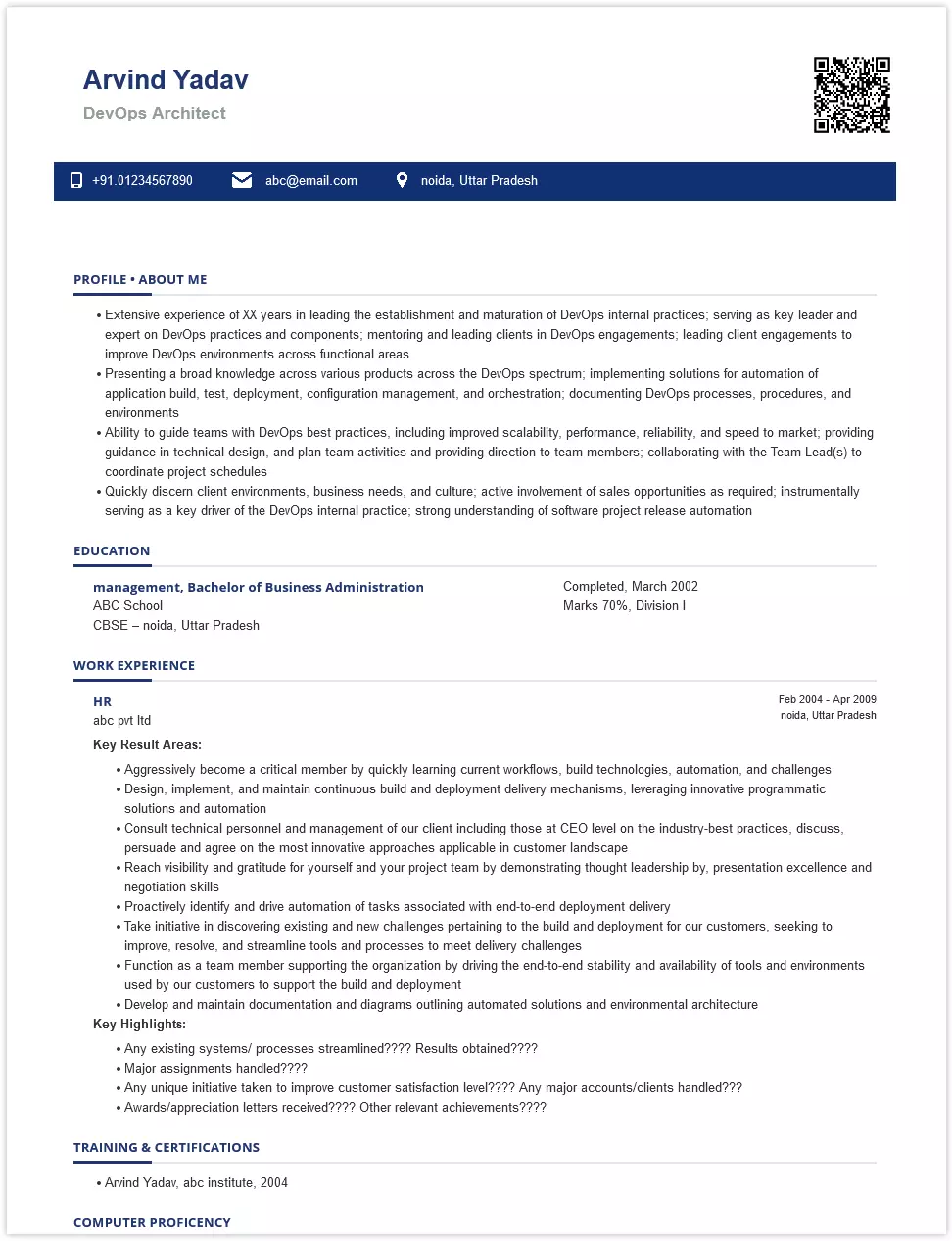
Arvind Yadav
Phone: 01234567890
Email: abc@email.com
Address: Sec-44, Noida, Noida
About Me
DevOps Architect / DevOps Architect Solution
- Dedicated and motivated DevOps Architect with XX years of experience in leading client engagements to improve DevOps environments across functional areas. Skilled in serving as a key driver of the DevOps internal practice and possesses a strong understanding of software project release automation.Presenting a broad knowledge of various products across the DevOps spectrum; implementing solutions for automation of application build, test, deployment, configuration management, and orchestration; documenting DevOps processes, procedures, and environments
- Ability to guide teams with DevOps best practices, including improved scalability, performance, reliability, and speed to market; providing guidance in technical design, and plan team activities, and providing direction to team members; collaborating with the Team Lead(s) to coordinate project schedules
- Quickly discern client environments, business needs, and culture; active involvement in sales opportunities as required; instrumentally serving as a key driver of the DevOps internal practice; strong understanding of software project release automation
Extra Curricular Activities
Education
, Bachelor of Computer Applications, Completed, March 2002
Vellore Institute of Technology
– Marks 70
Vellore, TG
Certifications
- Certified DevOps Architect- AWS DevOps Certification, Completed , January 2018
Work Experience
Period: February 2010 - Current
DevOps Architect
Hexaware Technologies
Mumbai, MH
- Aggressively become a critical member by quickly learning current workflows, building technologies, automation, and challenges
- Design, implement, and maintain continuous build and deployment delivery mechanisms, leveraging innovative programmatic solutions and automation
- Consult technical personnel and management of our client including those at the CEO level on the industry-best practices, discuss, persuade and agree on the most innovative approaches applicable in the customer landscape
- Reach visibility and gratitude for yourself and your project team by demonstrating thought leadership, presentation excellence, and negotiation skills
- Proactively identify and drive automation of tasks associated with end-to-end deployment delivery
- Take initiative in discovering existing and new challenges pertaining to the build and deployment for our customers, seeking to improve, resolve, and streamline tools and processes to meet delivery challenges
- Function as a team member supporting the organization by driving the end-to-end stability and availability of tools and environments used by our customers to support the build and deployment
- Develop and maintain documentation and diagrams outlining automated solutions and environmental architecture
Period: January 1996 - August 2009
Cloud Devops Architect
SCIKEY
Mumbai, MH
- Facilitating the development process and operations.
- Created suitable DevOps channels across the organization.
- Managed and reviewed technical operations.
- Developed appropriate DevOps channels throughout the organization.
- Established a continuous build environment to accelerate software deployment and development processes.
- Supervised, Examined, and Handled technical operations.
- Analyzed, executed, and tailored the DevOps practices as per needs.
- Effective automation of processes using suitable tools.
- Implemented architectural strategies in an efficient and comprehensive manner.
- Set up a consistent growth environment to increase the speed of the development process and software development.
- Enabled development operations and processes.
Skills
Hard Skills
- SaaS operation
- Automation skills
- Infrastructure management
- Automation service provisioning
- Middleware configuration
- DevOps Platform tooling (Chef, Puppet, and Docker.)
Soft Skills
- Strong analytical skills
- Team player
- Ability to work independently
Languages
Softwares
Operating System
Personal Interests
- Gardening
- Traveling
- Designing

Author
Kshama Sharma - Resume, CV and Cover Letter Writing Expert
Check Out Related Resume Samples
DevOps Architect Resume Example
DevOps Engineer Resume Example
Cloud Engineer - AWS Resume Example
Cloud Engineer - VMWare Resume Example
Cloud Engineer - Azure/Hyper-V Resume Example
Cloud Engineer - Rackspace Resume Example
Cloud Engineer - OpenStack Resume Example
Cloud Architect Resume Example
DevOps Manager Resume Example