India's
premier resume service
India's
premier resume service


- Organized and participated in wildlife conservation projects and field trips.
- Attended seminars and workshops on wildlife biology and conservation.
- Home

- Resume Samples
- Zoologists and Wildlife Biologist Resume Sample
What's your job?
Zoologists and Wildlife Biologist Resume Samples and Templates for 2026
- Table of Contents
- Downloadable Sample
- Resume Tips from Experts
- Resume Text Version
- Share


Zoologist and Wildlife Biologist Resume Guide for India: Examples, Skills and Format
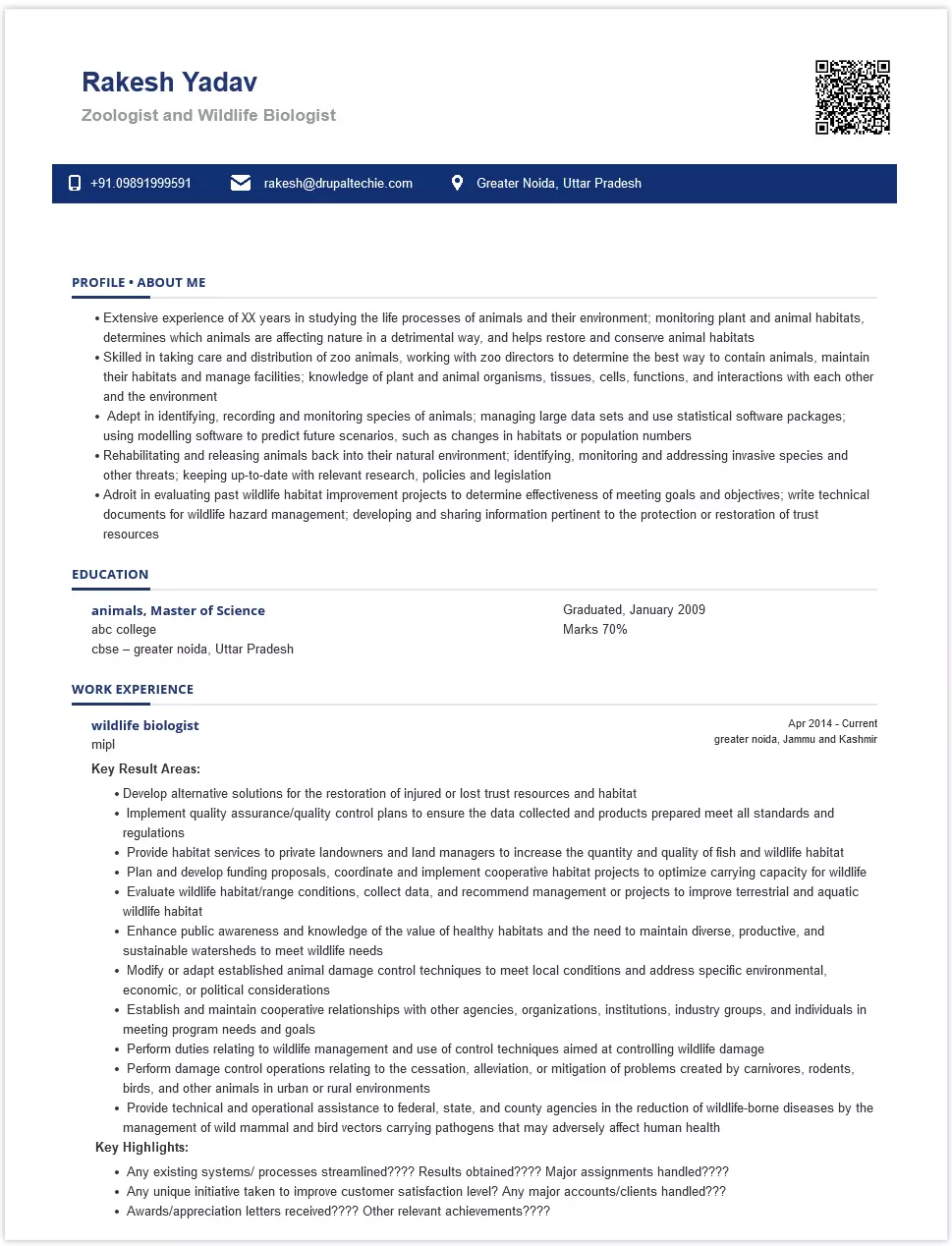
A well-crafted Zoologist and Wildlife Biologist resume is essential for success in India’s growing wildlife conservation and research sector. Whether you’re pursuing a career with the Wildlife Institute of India (WII), Forest Survey of India, WWF India, Wildlife Trust of India, national parks, or research institutions, this guide provides everything you need to create a standout resume.
This comprehensive guide includes:
- Resume format recommendations for wildlife careers in India
- Key skills employers look for in zoologists
- Complete resume example with Indian context
- Top wildlife and conservation employers in India
- Salary insights in INR by experience level
- Required qualifications and certifications
- ATS optimization tips for conservation job portals
Why Your Wildlife Biologist Resume Matters in India
India is one of the world’s most biodiverse countries, hosting 7-8% of global species including Bengal tigers, Asian elephants, one-horned rhinos, and Asiatic lions. With growing focus on wildlife conservation, habitat protection, and human-wildlife conflict management, skilled zoologists and wildlife biologists are in high demand.
A strong zoologist resume helps you:
- Stand out from competition for wildlife research and conservation positions
- Showcase expertise in species studies, habitat assessment, and field research
- Demonstrate knowledge of Indian wildlife legislation and conservation practices
- Highlight research publications and field experience
Conservation organisations receive many applications. Your resume must immediately communicate your field research experience, species expertise, and commitment to wildlife protection.
Zoologist Resume Format for India
Indian wildlife employers prefer professional resume formats that highlight research experience and field skills.
Recommended Format
- Length: 2 pages
- Layout: Reverse chronological
- Font: Arial, Calibri, or Times New Roman (11-12pt)
- Sections: Contact, Summary, Skills, Experience, Research, Education, Publications
Personal Details for Indian Wildlife Resumes
Include:
- Full name
- Phone number with +91 country code
- Professional email address
- City, State
- ResearchGate or ORCID profile (if applicable)
What to Avoid
- Personal details like religion or marital status
- Unverified species counts or claims
- Confidential research data
- Salary expectations in resume
Key Skills for Zoologists in India
Indian wildlife employers look for a combination of field expertise and research abilities.
Field Research Skills
- Wildlife Surveys: Camera trapping, transect surveys, point counts
- Animal Tracking: GPS/VHF telemetry, sign surveys
- Species Identification: Mammals, birds, reptiles, amphibians
- Habitat Assessment: Vegetation sampling, land-use mapping
- Population Estimation: Mark-recapture, distance sampling
Conservation Skills
- Human-Wildlife Conflict Mitigation: Community engagement, crop protection
- Protected Area Management: Buffer zones, corridors
- Wildlife Rescue: Animal handling, rehabilitation
- Environmental Impact Assessment: EIA studies
- Community Conservation: Participatory approaches
Technical Skills
- GIS & Remote Sensing: ArcGIS, QGIS, Google Earth Engine
- Statistical Analysis: R, SPSS, DISTANCE software
- Camera Trap Analysis: Wild-ID, CameraBase
- Report Writing: Scientific papers, project reports
- Data Management: Excel, database management
Soft Skills
- Field Endurance: Extended fieldwork in remote areas
- Team Leadership: Managing field teams
- Communication: Presenting to stakeholders
- Collaboration: Working with forest departments
- Patience: Long-term species monitoring
Zoologist Resume Example for India
Here’s a complete resume example tailored for Indian wildlife employers:
Dr. Priya Sharma
Dehradun, Uttarakhand | +91-98XXX-XXXXX | priya.sharma.wildlife@email.com | ResearchGate: priyasharma-wildlife
Professional Summary
Wildlife Biologist with 8+ years of experience in large carnivore research and conservation in the Indian subcontinent. Currently Research Fellow at Wildlife Institute of India (WII) leading tiger population monitoring across Central Indian landscape. Expertise in camera trap studies, GIS-based habitat modelling, and human-wildlife conflict assessment. Published 12 peer-reviewed papers including in Biological Conservation and PLoS ONE. M.Sc. Wildlife Science from WII with strong fieldwork experience across 15+ protected areas in India.
Key Skills
Wildlife Research | Camera Trapping | GIS Mapping | Species Monitoring | Habitat Assessment | Tiger Conservation | Human-Wildlife Conflict | Statistical Analysis (R) | Population Estimation | Community Conservation | Report Writing | Field Team Management
Professional Experience
Research Fellow - Tiger Conservation | Wildlife Institute of India | Dehradun | March 2020 – Present
- Lead landscape-level tiger monitoring across 6 tiger reserves in Central India
- Deploy and monitor 500+ camera traps for All India Tiger Estimation
- Analyse population data using spatial capture-recapture methods in R
- Map habitat connectivity corridors using GIS and satellite imagery
- Assess human-wildlife conflict patterns in buffer zones
- Train state forest department staff on camera trapping protocols
- Present findings to National Tiger Conservation Authority (NTCA)
- Collaborate with international partners from WWF and WCS
- Supervise 5 M.Sc. students on tiger-related research projects
Key Achievements:
- Co-authored NTCA report documenting 15% tiger population increase
- Identified 3 critical wildlife corridors adopted for protection
- Trained 200+ forest staff across 6 states
Project Biologist | WWF India | Raipur | June 2017 – February 2020
- Conducted elephant movement studies in Chhattisgarh forests
- Assessed human-elephant conflict and tested mitigation measures
- Implemented community-based conservation with forest villages
- Used GPS collaring data for elephant ranging pattern analysis
- Prepared environmental impact assessments for development projects
- Coordinated with Forest Department for joint protection activities
Key Achievements:
- Reduced human-elephant conflict incidents by 40% in project area
- Published 3 papers on elephant ecology
Research Assistant | Centre for Wildlife Studies | Bangalore | August 2015 – May 2017
- Assisted in Western Ghats biodiversity surveys
- Conducted bird and mammal surveys using standard protocols
- Performed camera trap data processing and identification
- Contributed to scientific papers on endemic species
- Gained field experience in tropical forest ecosystems
Research Publications
- Sharma, P. et al. (2023). “Tiger population dynamics in Central Indian landscape.” Biological Conservation.
- Sharma, P. & Jhala, Y. (2022). “Camera trap density estimation for tigers in fragmented habitats.” PLoS ONE.
- Sharma, P. et al. (2021). “Corridor connectivity for large carnivores in Central India.” Conservation Biology.
- [+9 more peer-reviewed publications]
Education
Ph.D. (Wildlife Science) | Wildlife Institute of India | 2023 (Ongoing)
- Research: Large carnivore ecology and conservation
- CSIR-JRF Fellowship
M.Sc. (Wildlife Science) | Wildlife Institute of India | 2015
- Gold Medal, First Class with Distinction
- Dissertation: Camera trap based tiger monitoring
B.Sc. (Zoology) | Delhi University | 2013
- First Class with Honours
Certifications & Training
- Advanced Statistical Ecology | WII-NCBS Workshop | 2022
- GIS for Conservation | IIRS Dehradun | 2021
- Camera Trapping Certificate | Wildlife Conservation Society | 2019
- Wildlife Crime Investigation | WCCB Training | 2018
Field Experience
Protected areas worked in:
- Bandhavgarh Tiger Reserve, MP
- Kanha Tiger Reserve, MP
- Tadoba-Andhari Tiger Reserve, MH
- Pench Tiger Reserve, MP
- Satpura Tiger Reserve, MP
- Achanakmar Tiger Reserve, CG
- Nagarahole National Park, KA
- Bandipur National Park, KA
Languages
Hindi (Native) | English (Fluent) | Marathi (Conversational)
Top Zoologist Employers in India
India offers diverse opportunities for wildlife professionals.
Government Research Institutions
- Wildlife Institute of India (WII): Premier wildlife research institute
- Forest Survey of India (FSI): Forest and wildlife surveys
- Zoological Survey of India (ZSI): Species documentation
- Bombay Natural History Society (BNHS): Ornithology, conservation
- Salim Ali Centre for Ornithology (SACON): Bird research
Conservation Organisations
- WWF India: Tiger, elephant, rhino conservation
- Wildlife Conservation Society (WCS) India: Large carnivore research
- Wildlife Trust of India (WTI): Wildlife rescue, rehabilitation
- Wildlife Protection Society of India (WPSI): Anti-poaching
- Nature Conservation Foundation (NCF): Community conservation
State Forest Departments
- Project Tiger Reserves: 53 tiger reserves across India
- Project Elephant: Elephant range states
- State Wildlife Wings: Wildlife protection and management
- Wildlife Crime Control Bureau (WCCB): Wildlife crime investigation
Academic Institutions
- NCBS Bangalore: Ecology and evolution
- IISc Bangalore: Centre for Ecological Sciences
- Ashoka Trust for Research in Ecology (ATREE): Conservation science
- Various Universities: Wildlife departments
Zoos and Breeding Centres
- Central Zoo Authority (CZA): Zoo regulation
- Delhi Zoological Park: Conservation breeding
- Mysore Zoo: Wildlife education
- Species Recovery Programmes: Vulture, crocodile, bustard
How to Apply
- Institution career portals
- Conservation Jobs India portal
- WII job notifications
- State Forest Department recruitment
- WWF/WCS career pages
- Research fellowships (CSIR-JRF, UGC-JRF, DBT-JRF)
Zoologist Salary in India
Salaries vary based on experience, employer type, and qualifications.
Salary by Experience Level
| Experience | Annual Salary (INR) |
|---|---|
| Research Assistant (0-2 years) | ₹3 - ₹5 LPA |
| Project Biologist (2-5 years) | ₹4.5 - ₹8 LPA |
| Research Fellow/Scientist (5-10 years) | ₹7 - ₹15 LPA |
| Senior Scientist (10+ years) | ₹12 - ₹25 LPA |
| Principal Scientist/Director | ₹18 - ₹35 LPA |
Note: Government positions follow 7th Pay Commission scales. NGOs may pay differently.
Salary by Employer Type
| Employer Type | Salary Range (Mid-Level) |
|---|---|
| Government (WII, FSI) | ₹8 - ₹15 LPA + benefits |
| International NGOs (WWF, WCS) | ₹6 - ₹12 LPA |
| National NGOs (WTI, NCF) | ₹4.5 - ₹9 LPA |
| Academic/Research | ₹5 - ₹12 LPA |
| Private Consultancy | ₹5 - ₹15 LPA |
Research Fellowships
| Fellowship | Monthly Stipend |
|---|---|
| CSIR-JRF | ₹31,000 + HRA |
| UGC-JRF | ₹31,000 + HRA |
| DBT-JRF | ₹31,000 + HRA |
| ICMR-JRF | ₹31,000 + HRA |
| WII-JRF | ₹25,000 - ₹35,000 |
Salary Boosters
- Ph.D. Degree: Significant salary premium
- Publications Record: High-impact papers valued
- Field Experience: Extensive fieldwork preferred
- GIS/Statistics Skills: Technical proficiency premium
- Language Skills: Regional languages for community work
Qualifications for Wildlife Careers in India
Educational Background
Minimum:
- B.Sc. in Zoology, Life Sciences, or Environmental Science
- Post-graduate diploma in Wildlife Management
Preferred:
- M.Sc. Wildlife Science (WII, Aligarh, Bharathidasan)
- M.Sc. Zoology with specialisation in ecology
- Ph.D. for research scientist positions
Valuable Certifications
- WII Training Courses: Various wildlife management courses
- GIS Certification: IIRS, ESRI, or online platforms
- Statistical Ecology: R programming, DISTANCE sampling
- Camera Trapping: Field protocols and analysis
- Wildlife Crime Investigation: WCCB training
Career Path
- Research Trainee/Assistant
- Project Fellow/Associate
- Research Fellow
- Scientist B/C/D
- Senior Scientist
- Principal Scientist
- Director/Professor
ATS Tips for Your Wildlife Resume
Conservation organisations use ATS to screen resumes. Optimise yours:
Keyword Optimisation
Include relevant terms like:
- Zoologist, wildlife biologist, ecologist
- Wildlife conservation, species monitoring
- Camera trapping, population estimation
- Tiger, elephant, specific species names
- GIS, remote sensing, R statistical
- Protected areas, national parks
- Human-wildlife conflict, corridor
Formatting Tips
- Use standard section headings
- List publications in proper citation format
- Include specific protected areas worked in
- Quantify survey efforts (transects, camera days)
- Save as PDF for format preservation
Final Tips for Your Wildlife Biologist Resume
✅ Lead with field experience - Protected areas, species studied prominently
✅ Quantify research - Camera trap days, transect km, species surveyed
✅ Show publications - Peer-reviewed papers demonstrate credibility
✅ Include technical skills - GIS, R, species identification
✅ Mention species expertise - Specific taxonomic groups studied
✅ Highlight collaboration - Forest department, communities, partners
✅ Update regularly - Add new publications and fieldwork
Quick Checklist
- Contact information with ResearchGate/ORCID
- Summary highlights species and landscape expertise
- Skills include field and analytical techniques
- Experience shows specific research projects
- Publications listed in academic format
- Education with specialisation mentioned
- Field areas and species expertise highlighted
Ready to create your professional wildlife biologist resume? Use our resume builder to get started with expert-designed templates.
Looking for more guidance? Check out our resume format guide for additional tips.
Frequently Asked Questions
What is the best resume format for Zoologists in India?
Use a 2-page reverse chronological format with publications section. Include summary, skills, experience, research projects, publications, and education. Highlight fieldwork in specific protected areas, species studied, and technical skills like GIS and statistical analysis.
What qualifications are needed for wildlife research in India?
M.Sc. in Wildlife Science (from WII preferred), Zoology, or Ecology is typically required. Ph.D. is needed for scientist positions. B.Sc. with relevant experience may suffice for field assistant roles. Research fellowships (CSIR-JRF, UGC-JRF) are common entry points.
What skills should I highlight on a wildlife biologist resume?
Highlight field research skills (camera trapping, transect surveys, telemetry), GIS and remote sensing, statistical analysis (R, DISTANCE), species identification, and report writing. Include both technical skills and fieldwork endurance abilities.
How much do Zoologists earn in India?
Research assistants earn ₹3-5 LPA. Project biologists earn ₹4.5-8 LPA. Research fellows earn ₹7-15 LPA. Senior scientists earn ₹12-25 LPA. Government positions follow pay commission scales. International NGOs may pay higher.
How important are publications for wildlife careers?
Very important for research positions. Publications in peer-reviewed journals demonstrate research credibility. For field positions, extensive fieldwork experience may be more valued. Include all publications on your resume with proper citations.
Should I mention specific species on my resume?
Yes, mention species you've studied and taxonomic expertise. India-specific species like tigers, elephants, leopards, or endemic species are valuable. Employers look for relevant species experience matching their conservation focus.
How do I get into wildlife research in India?
Complete M.Sc. in Wildlife Science (WII is most prestigious), apply for JRF fellowships, volunteer with conservation organisations, build fieldwork experience, develop GIS and statistics skills, and network at wildlife conferences.
Is WII the only option for wildlife education?
While WII is the premier institute, other options include AMU (Aligarh), Bharathidasan University, Saurashtra University, Periyar University, and AVC College. Many zoology departments offer ecology specialisations. NCBS and IISc offer Ph.D. programmes.
Should I include volunteer experience on my resume?
Yes, especially early in your career. Volunteer fieldwork with NGOs, wildlife surveys, and conservation projects demonstrate passion and provide hands-on experience. Many successful researchers started as volunteers.
What is the career path for wildlife biologists in India?
Typical path: Research Assistant → Project Fellow → Research Fellow → Scientist B/C → Senior Scientist → Principal Scientist. Alternatively, move into conservation management, policy, or academic teaching roles.
Zoologists and Wildlife Biologist Text-Only Resume Templates and Samples
Abhi sandilya
Phone: 9871275111
Email: writer@shriresume.com
Address: Amreli
About Me
Zoologists and Wildlife
Dedicated and passionate Zoologist and Wildlife Specialist with hands-on experience gained through internships and active involvement in extracurricular activities. Committed to wildlife conservation and research, aiming to contribute to wildlife preservation efforts and biodiversity studies. Seeking an entry-level position to apply my knowledge and enthusiasm for zoology and wildlife management.
Extra Curricular Activities
Education
Zoology, Bachelor of Science, Completed, April 2024
Trev College Of Science
State University
Bilaspur, HR
Certifications
- Certificate in Wildlife Conservation, Completed , May 2024
Internships
Period: March 2024 - June 2024
Wildlife Research Intern
Trek Wildlife Research Center
Arukutti, KL
- Conducted field research on local wildlife populations and their habitats.
- Collected and analyzed data on animal behavior, health, and population dynamics.
- Assisted in the development and implementation of conservation programs.
- Prepared reports and presentations on research findings.
Skills
- Wildlife research and data analysis
- Animal behavior observation
- Conservation program development
- Fieldwork and data collection
- Public education and outreach
Languages
Softwares
Operating System
Personal Interests
- Wildlife photography
- Bird watching and ornithology

Author
Kshama Sharma - Resume, CV and Cover Letter Writing Expert