India's
premier resume service
India's
premier resume service


- Certificate in Animal Behaviour and Welfare, Completed , January 2021
- Home

- Resume Samples
- Animal Science Resume Sample
What's your job?
Animal Science Resume Samples and Templates for 2026
- Table of Contents
- Downloadable Sample
- Resume Tips from Experts
- Resume Text Version
- Share


Animal Science Resume Guide for India
A well-crafted animal science resume is essential for success in India’s growing livestock, dairy, and veterinary research sector. Whether you’re pursuing a career with ICAR research institutes, NDDB, state veterinary universities, dairy companies, or pharmaceutical firms like Zoetis or Boehringer Ingelheim, this guide provides everything you need to create a standout resume.
This comprehensive guide includes:
- Resume format recommendations for animal science roles in India
- Key skills employers look for in animal scientists
- Complete resume example with Indian context
- Top animal science employers in India
- Salary insights in INR by experience level
- Required qualifications and certifications
- ATS optimization tips for research and industry job portals
Why Your Animal Science Resume Matters in India
India has the world’s largest livestock population and a rapidly growing dairy and poultry industry. Animal scientists play crucial roles in livestock improvement, animal nutrition research, breeding programmes, and veterinary product development. With increasing focus on productivity and animal welfare, skilled professionals are in high demand.
A strong animal science resume helps you:
- Stand out from competition for research and industry positions
- Showcase your expertise in animal physiology, nutrition, and genetics
- Demonstrate your research capabilities and publications
- Highlight your practical experience with Indian livestock species
Research institutions and companies receive many applications. Your resume must immediately communicate your technical expertise, research experience, and knowledge of Indian animal husbandry practices.
Animal Science Resume Format for India
Indian research institutions and companies prefer professional resume formats that highlight academic and research credentials.
Recommended Format
- Length: 2 pages for academic/research; 1-2 pages for industry
- Layout: Reverse chronological
- Font: Arial, Calibri, or Times New Roman (11-12pt)
- Sections: Contact, Summary, Skills, Experience, Education, Research, Publications
Personal Details for Indian Animal Science Resumes
Include:
- Full name
- Phone number with +91 country code
- Professional email address
- City, State
- ORCID/ResearchGate profile (for research roles)
What to Avoid
- Personal details like religion or caste
- Confidential research data
- Unverified claims or fabricated publications
- Salary expectations in resume
Key Skills for Animal Scientists in India
Indian employers look for a combination of research expertise and practical livestock knowledge.
Research Skills
- Experimental Design: Trial design, statistical analysis
- Laboratory Techniques: Biochemical analysis, histopathology
- Data Analysis: R, SAS, SPSS statistical software
- Scientific Writing: Research papers, reports
- Literature Review: Database searching, meta-analysis
Animal Production Skills
- Animal Nutrition: Feed formulation, nutrient requirements
- Animal Genetics: Breeding programmes, genetic evaluation
- Reproduction: AI, embryo transfer, reproductive management
- Animal Health: Disease prevention, biosecurity
- Production Management: Housing, growth monitoring
Species-Specific Skills
- Cattle & Buffalo: Dairy and beef production
- Poultry: Layer and broiler management
- Small Ruminants: Goat and sheep production
- Pigs: Swine nutrition and management
- Fisheries: Aquaculture (if applicable)
Soft Skills
- Communication: Presenting research findings
- Teamwork: Collaborating in research teams
- Problem-Solving: Troubleshooting experiments
- Adaptability: Working in field conditions
- Teaching: Training students and farmers
Animal Science Resume Example for India
Here’s a complete resume example tailored for Indian employers:
Dr. Meenakshi Rathore
Karnal, Haryana | +91-98XXX-XXXXX | meenakshi.rathore.anisci@email.com | ORCID: 0000-0000-0000-0000
Professional Summary
Animal Scientist with 7+ years of experience in dairy cattle nutrition and production research. Currently Scientist at ICAR-NDRI (National Dairy Research Institute) leading research on improving milk production efficiency in crossbred cattle. Expertise in ruminant nutrition, feed evaluation, and methane mitigation strategies. Published 15+ peer-reviewed papers including in Journal of Dairy Science and Animal Feed Science and Technology. Ph.D. in Animal Nutrition from NDRI with strong background in both basic and applied research. Passionate about improving Indian dairy productivity through scientific research.
Key Skills
Animal Nutrition | Feed Formulation | Ruminant Research | Methane Mitigation | In Vitro Digestion | Near-Infrared Spectroscopy | Statistical Analysis (R, SAS) | Scientific Writing | Trial Management | Dairy Cattle | Buffalo | Graduate Teaching
Professional Experience
Scientist | ICAR-National Dairy Research Institute | Karnal | April 2020 – Present
- Lead research projects on improving feed efficiency in dairy cattle
- Conduct feeding trials with 100+ cattle investigating alternate feed resources
- Develop methane mitigation strategies using feed additives
- Establish in vitro gas production laboratory for feed evaluation
- Supervise 5 M.Sc. and 2 Ph.D. students
- Teach Animal Nutrition course to postgraduate students
- Collaborate with international researchers on climate-smart dairy
- Prepare project proposals for DBT, ICAR, and NASF funding
Key Achievements:
- Published 15+ peer-reviewed papers in international journals
- Received ICAR Young Scientist Award 2022
- Secured ₹1.5 Cr research funding as Principal Investigator
Research Associate | ICAR-NDRI | Karnal | June 2017 – March 2020
- Conducted doctoral research on bypass protein nutrition in dairy cattle
- Performed nutrient digestibility and nitrogen balance trials
- Analysed feed samples using proximate analysis and NIRS
- Presented research at national and international conferences
- Contributed to institute’s All India Coordinated Research Project
Key Achievements:
- Awarded ICAR Senior Research Fellowship
- Best Poster Award at ANPA Conference 2019
Junior Research Fellow | Gujarat Agricultural University | Anand | August 2015 – May 2017
- Assisted in buffalo nutrition research project
- Conducted feeding experiments and data collection
- Performed laboratory analysis of feed and biological samples
- Managed experimental animal unit
- Contributed to research publications
Education
Ph.D. (Animal Nutrition) | ICAR-NDRI, Karnal | 2020
- Thesis: Bypass protein supplementation in lactating crossbred cows
- ICAR Junior/Senior Research Fellowship
- First Division
M.V.Sc. (Animal Nutrition) | Gujarat Agricultural University | 2015
- Specialisation in Ruminant Nutrition
- ICAR-PGS Scholarship
- First Division with Gold Medal
B.V.Sc. & A.H. | Rajasthan University of Veterinary and Animal Sciences | 2013
- Bachelor of Veterinary Science
- First Division with Distinction
Research Publications
- Rathore, M. et al. (2023). “Effect of tannin supplementation on methane emission in dairy cattle.” Animal Feed Science and Technology.
- Rathore, M. & Sharma, V. (2022). “Bypass protein in tropical dairy systems: A review.” Tropical Animal Health and Production.
- Rathore, M. et al. (2021). “In vitro evaluation of agro-industrial by-products for ruminant feeding.” Indian Journal of Animal Sciences.
- [+12 more peer-reviewed publications]
Research Projects
PI: Methane Mitigation through Nutritional Interventions | DBT | 2021-2024 | ₹85 Lakhs Co-PI: AICRP on Nutrient Requirements of Livestock | ICAR | 2020-Present
Certifications & Training
- Advanced Statistical Methods in Animal Science | CAFT-NDRI | 2021
- NIRS for Feed Analysis | ANGRAU | 2019
- Scientific Writing Workshop | NAARM | 2018
- Laboratory Animal Ethics | CPCSEA | 2016
Languages
Hindi (Native) | English (Fluent) | Rajasthani (Native)
Top Animal Science Employers in India
India’s animal science sector offers diverse opportunities.
ICAR Research Institutes
- ICAR-NDRI: National Dairy Research Institute, Karnal
- ICAR-IVRI: Indian Veterinary Research Institute, Bareilly
- ICAR-NIANP: National Institute of Animal Nutrition and Physiology
- ICAR-CIRB: Central Institute for Research on Buffaloes
- ICAR-CSWRI: Central Sheep and Wool Research Institute
- ICAR-DPR: Directorate of Poultry Research
State Agricultural/Veterinary Universities
- DUVASU: Mathura
- GADVASU: Ludhiana
- TANUVAS: Chennai
- KVAFSU: Bidar
- MAFSU: Nagpur
Industry - Animal Health
- Zoetis India: Veterinary pharmaceuticals
- Boehringer Ingelheim: Animal health
- Elanco: Animal nutrition and health
- Vetoquinol: Veterinary medicines
- Virbac: Animal health products
Industry - Feed and Nutrition
- Cargill India: Animal nutrition
- De Heus: Feed manufacturing
- Godrej Agrovet: Animal feed
- Suguna Foods: Poultry feed
- SKM Animal Feeds: Integrated nutrition
Dairy and Poultry Companies
- Amul (GCMMF): Dairy cooperative
- Nestle India: Dairy R&D
- Venky’s: Poultry research
- IB Group: Integrated poultry
- Hatsun Agro: Dairy products
How to Apply
- ICAR-ASRB for research scientist positions
- University recruitment for teaching positions
- Company career portals
- LinkedIn with “animal scientist,” “nutrition researcher” keywords
- Research fellowship announcements (DBT-JRF, ICAR-JRF)
Animal Science Salary in India
Salaries vary based on experience, employer type, and qualifications.
Salary by Experience Level
| Experience | Annual Salary (INR) |
|---|---|
| JRF/SRF (Research Scholar) | ₹31,000 - ₹35,000/month |
| Scientist/Assistant Professor (0-5 years) | ₹8 - ₹15 LPA |
| Senior Scientist/Associate Professor (5-10 years) | ₹12 - ₹22 LPA |
| Principal Scientist/Professor (10+ years) | ₹18 - ₹35 LPA |
Note: ICAR/university positions follow UGC/ICAR pay scales.
Salary by Employer Type
| Employer Type | Salary Range (Mid-Level) |
|---|---|
| ICAR Institutes | ₹10 - ₹18 LPA + benefits |
| State Universities | ₹8 - ₹15 LPA + benefits |
| Pharma/Health Companies | ₹10 - ₹25 LPA |
| Feed Companies | ₹8 - ₹18 LPA |
| Dairy Companies | ₹8 - ₹15 LPA |
| Consultancy | ₹10 - ₹20 LPA |
Research Fellowships
| Fellowship | Monthly Stipend |
|---|---|
| ICAR-JRF | ₹31,000 + HRA |
| DBT-JRF | ₹31,000 + HRA |
| ICAR-SRF | ₹35,000 + HRA |
| CSIR-JRF | ₹31,000 + HRA |
Qualifications for Animal Scientists in India
Educational Background
Minimum for Industry:
- B.V.Sc. or B.Sc. Animal Science/Dairy Science
- M.V.Sc./M.Sc. in relevant specialisation
Required for Research/Teaching:
- Ph.D. in Animal Science/Nutrition/Genetics/Physiology
- NET qualification for teaching positions
- Publications record for scientist positions
Specialisations
- Animal Nutrition: Feed and nutritional research
- Animal Genetics & Breeding: Genetic improvement
- Animal Physiology: Reproductive and lactation physiology
- Livestock Production Management: Production systems
- Poultry Science: Avian research
Career Path (Research)
- Junior Research Fellow
- Senior Research Fellow
- Scientist
- Senior Scientist
- Principal Scientist
- Director/Head
Career Path (Teaching)
- Assistant Professor
- Associate Professor
- Professor
- Head of Department
- Dean
ATS Tips for Your Animal Science Resume
Research institutions and companies use ATS for screening:
Keyword Optimization
Include relevant terms like:
- Animal scientist, nutritionist, geneticist
- ICAR, NDRI, veterinary university
- Feed formulation, nutrition research
- Cattle, buffalo, poultry
- Publications, research projects
- Statistical analysis, R, SAS
Formatting Tips
- Use standard section headings
- List publications in proper citation format
- Include ORCID/ResearchGate profiles
- Quantify research output (papers, projects, funding)
- Save as PDF for format preservation
Final Tips for Your Animal Science Resume
✅ Lead with qualifications - Ph.D., M.V.Sc., B.V.Sc. prominently displayed
✅ Highlight publications - Peer-reviewed papers, impact factors
✅ Show research funding - Projects secured, amounts
✅ Include species expertise - Cattle, buffalo, poultry specialisation
✅ Mention analytical skills - Software, laboratory techniques
✅ Add teaching experience - Courses taught, students supervised
✅ Update regularly - Add new publications and projects
Quick Checklist
- Contact information with research profiles
- Summary highlights research expertise
- Skills include technical and species-specific
- Experience shows quantified results
- Education with specialisations listed
- Publications in proper format
- Clean, academic format
Ready to create your professional animal science resume? Use our resume builder to get started with expert-designed templates.
Looking for more guidance? Check out our resume format guide for additional tips.
Frequently Asked Questions
What is the best resume format for Animal Scientists in India?
Use a 2-page academic format for research positions highlighting publications, projects, and grants. For industry roles, use 1-2 pages focusing on practical skills and achievements. Include summary, skills, experience, education, and publications sections.
What qualifications are needed for animal science jobs?
Industry roles require B.V.Sc./M.V.Sc. Research scientist positions at ICAR require Ph.D. with NET/ASRB qualification. Publications are essential for academic positions. Specialisations in nutrition, genetics, or physiology add value.
What skills should I highlight on an animal science resume?
Highlight research skills (experimental design, statistical analysis), species-specific knowledge (cattle, buffalo, poultry), laboratory techniques (biochemistry, histopathology), software skills (R, SAS), and communication skills (scientific writing, teaching).
How much do Animal Scientists earn in India?
JRF/SRF stipend is ₹31,000-35,000/month. Scientists earn ₹8-15 LPA. Senior scientists earn ₹12-22 LPA. Principal scientists earn ₹18-35 LPA. Industry positions at pharma/feed companies may pay higher.
How do I get a scientist position at ICAR?
Apply through ASRB (Agricultural Scientists Recruitment Board) when notifications are released. Requires Ph.D., NET qualification, and publications. Selection through written exam and interview. Maintain updated resume with all research credentials.
Should I include publications on my resume?
Absolutely essential for research positions. List peer-reviewed publications with full citations. Mention impact factors of journals. Include papers under review or in press. For industry, include if relevant.
What is the scope of animal science in India?
Excellent scope with India's large livestock population. Opportunities in ICAR institutes, veterinary universities, feed companies, pharma (Zoetis, Elanco), dairy (Amul, Nestle), and poultry companies. Research funding is increasing.
How important is species specialisation?
Very important. Specialise in cattle/buffalo for dairy research, poultry for commercial opportunities, small ruminants for regional programmes. Match your specialisation with employer focus areas.
Should I mention research funding secured?
Yes, essential for senior positions. List projects as PI/Co-PI with funding amounts. Shows your ability to secure grants. Include DBT, ICAR, NASF, DST funding. This demonstrates leadership and credibility.
What is the career growth for animal scientists?
Research path: JRF → SRF → Scientist → Senior Scientist → Principal Scientist → Director. Teaching path: Assistant Professor → Associate Professor → Professor → Dean. Industry: Scientist → Senior Scientist → Manager → Director.
Animal Science Text-Only Resume Templates and Samples
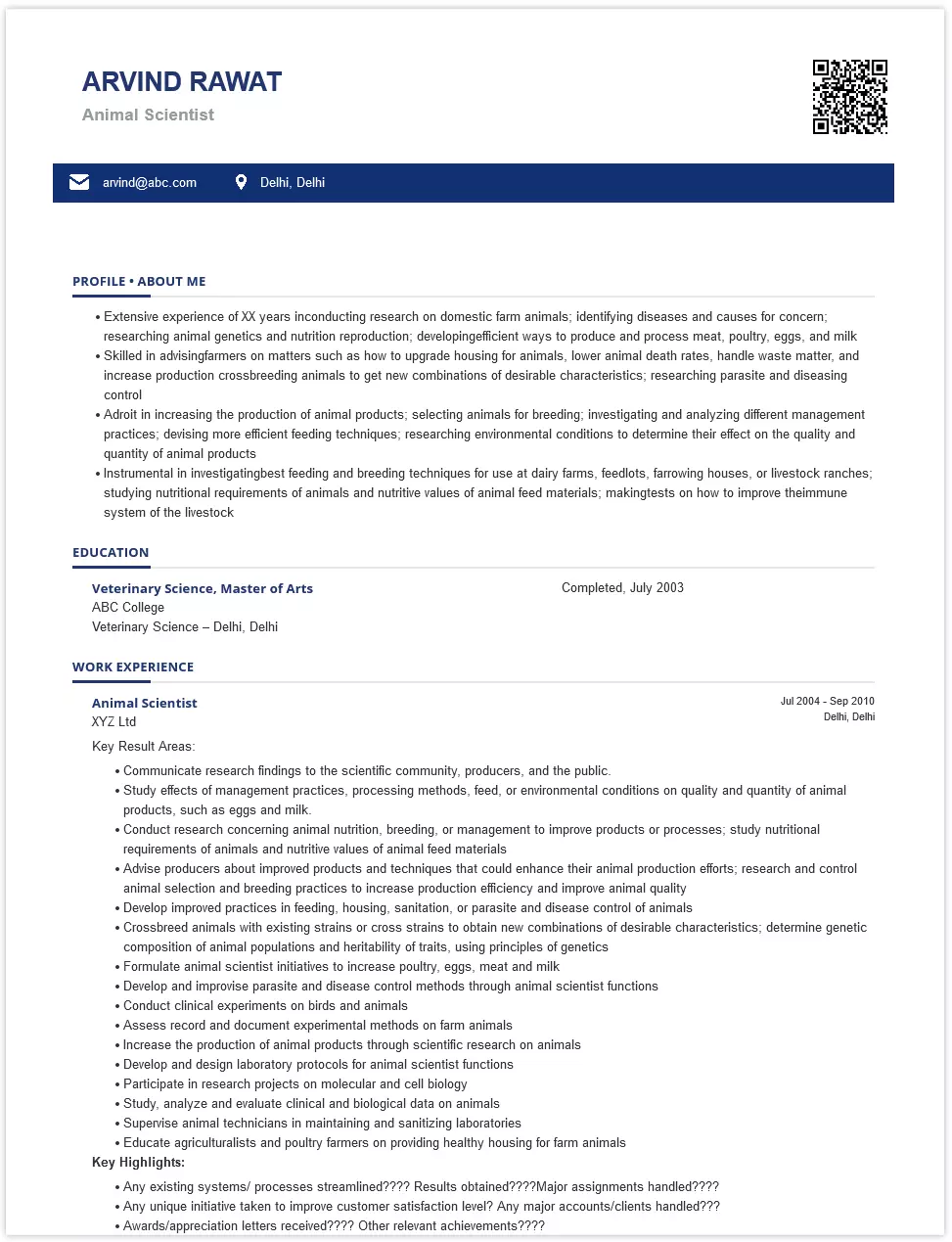
ARVIND RAWAT
Phone: 0000000
Email: arvind@abc.com
Address: C-21, Sector-21, Delhi
About Me
Animal Scientist
- Highly-Versatile Animal Scientist Skilled in ensuring a high level of animal welfare and working to improve the quality of life for animals; instrumental in monitoring the condition of animals and recognizing; resolving any behavioral problems
- Extensive experience of XX years conducting research on domestic farm animals; identifying diseases and causes for concern; researching animal genetics and nutrition reproduction; developing efficient ways to produce and process meat, poultry, eggs, and milk
- Skilled in advising farmers on matters such as how to upgrade housing for animals, lower animal death rates, handle the waste matter, and increase production by crossbreeding animals to get new combinations of desirable characteristics; researching parasite and diseasing control
- Adroit in increasing the production of animal products; selecting animals for breeding; investigating and analyzing different management practices; devising more efficient feeding techniques; researching environmental conditions to determine their effect on the quality and quantity of animal products
- Instrumental in investigating best feeding and breeding techniques for use at dairy farms, feedlots, farrowing houses, or livestock ranches; studying nutritional requirements of animals and nutritive values of animal feed materials; making tests on how to improve the immune system of the livestock
Education
Veterinary Science, Master of Veterinary Science, Completed, July 2007
Delhi University
– Marks null
Delhi,
Certifications
Work Experience
Period: July 2013 - Current
Animal Scientist
Aurigene Pharmaceutical Services Limited
Hyderabad, TG
- Communicate research findings to the scientific community, producers, and the public.
- Study effects of management practices, processing methods, feed, or environmental conditions on the quality and quantity of animal products, such as eggs and milk.
- Conduct research concerning animal nutrition, breeding, or management to improve products or processes; study nutritional requirements of animals and nutritive values of animal feed materials
- Advise producers about improved products and techniques that could enhance their animal production efforts; research and control animal selection and breeding practices to increase production efficiency and improve animal quality
- Develop improved practices in feeding, housing, sanitation, or parasite and disease control of animals
- Crossbreed animals with existing strains or cross strains to obtain new combinations of desirable characteristics; determine the genetic composition of animal populations and heritability of traits, using principles of genetics
- Formulate animal scientist initiatives to increase poultry, eggs, meat, and milk
- Develop and improvise parasite and disease control methods through animal scientist functions
- Conduct clinical experiments on birds and animals
- Assess record and document experimental methods on farm animals
- Increase the production of animal products through scientific research on animals
- Develop and design laboratory protocols for animal scientist functions
- Participate in research projects on molecular and cell biology
- The study, analysis, and evaluate clinical and biological data on animals
- Supervise animal technicians in maintaining and sanitizing laboratories
- Educate agriculturalists and poultry farmers on providing healthy housing for farm animals
Period: November 2010 - September 2012
Animal Scientist / Animal Care Specialist / Animal Care Tech
Zeneca
Delhi,
- Studied the nutritional requirements of animals, and advised producers about required improvements in feeds; researched and controlled animal selection and breeding practices, aimed at increasing production efficiency
- Developed and implemented improved practices in feeding, housing, sanitation, and disease control, pertaining to animals
- determined the genetic composition of animal populations, using principles of genetics
- Qualified to identify diseases and causes for concern, and recommend vaccines for animals
- Documented success in developing efficient and safe ways of producing and processing meat, poultry, eggs, and milk; ensured that waste matter is properly disposed of, to reduce chances of contamination
- Researched genetic characteristics or expression; developed agricultural methods
- Researched livestock management methods; prepared scientific or technical reports or presentations
Skills
- Veterinary Medicine
- Behavior Analysis
- Communication
- Welfare
- Pet Care
- Pet Sitting
- Detail Oriented
- Disinfectant
- Patience
- Affectionate
Languages
Softwares
Operating System
Personal Interests
- Reading
- Trekking
- Traveling

Author
Kshama Sharma - Resume, CV and Cover Letter Writing Expert