India's
premier resume service
India's
premier resume service


- Storage Solutions Architect V2 and V3, Completed , January 2015
- Home

- Resume Samples
- Storage Architect Resume Sample
What's your job?
Storage Architect Resume Samples and Templates for 2026
- Table of Contents
- Downloadable Sample
- Resume Tips from Experts
- Resume Text Version
- Share


Storage Architect Resume Guide for India: Skills, Tools and Examples
A well-crafted storage architect resume is essential for success in India’s growing enterprise IT infrastructure sector. Whether you’re pursuing a career with TCS, Infosys, Wipro, HCL, or global technology companies like IBM, Dell EMC, NetApp, HPE, this guide provides everything you need to create a standout resume.
This comprehensive guide includes:
- Resume format recommendations for storage architect roles in India
- Key skills employers look for in storage architects
- Complete resume example with Indian context
- Top IT infrastructure employers in India
- Salary insights in INR by experience level
- Certifications that boost your profile (NetApp, EMC, AWS, Azure)
- ATS optimization tips for Indian job portals
Why Your Storage Architect Resume Matters in India
India’s data center and enterprise IT market is experiencing rapid growth with digital transformation, cloud adoption, and massive data growth driving demand for skilled storage architects. Organizations need professionals who can design scalable storage solutions, optimize performance, and ensure data availability.
A strong storage architect resume helps you:
- Stand out from competition for senior infrastructure roles
- Pass ATS screening used by IT companies on Naukri and LinkedIn
- Showcase expertise in storage design, SAN/NAS architecture, and cloud storage
- Demonstrate certifications valued by Indian enterprise employers
IT recruiters receive numerous applications. Your resume must immediately communicate your architectural expertise, design experience, and hands-on knowledge of enterprise storage systems.
Storage Architect Resume Format for India
Indian IT employers prefer professional, technically detailed resume formats that highlight your architecture skills and certifications.
Recommended Format
- Length: 2 pages
- Layout: Reverse chronological
- Font: Arial, Calibri, or Times New Roman (11-12pt)
- Sections: Contact, Summary, Skills, Certifications, Experience, Education, Projects
Personal Details for Indian Storage Architect Resumes
Include:
- Full name
- Phone number with +91 country code
- Professional email address
- City, State
- LinkedIn profile
What to Avoid
- Personal details like religion or marital status
- Outdated storage technologies
- Generic descriptions without architecture details
- Salary expectations in resume
Key Skills for Storage Architects in India
Indian employers look for a combination of deep technical expertise and design thinking abilities.
Storage Architecture Skills
- SAN Architecture: Fibre Channel fabric design, zoning strategies, multi-path I/O
- NAS Architecture: Scale-out NAS, clustered file systems, NFS/CIFS optimization
- Object Storage: S3-compatible storage, scale-out object platforms
- Storage Virtualization: VMware vSAN, Nutanix, Dell VxRail design
- Hybrid Cloud Storage: On-prem to cloud integration architectures
Enterprise Storage Platforms
- Dell EMC: PowerStore, Unity XT, PowerMax, Isilon
- NetApp: ONTAP, AFF/FAS, Cloud Volumes, StorageGRID
- HPE: Primera, Nimble, 3PAR
- Pure Storage: FlashArray, FlashBlade
- Hitachi Vantara: VSP, HCP
- IBM: Spectrum Scale, FlashSystem
Cloud Storage Architecture
- AWS: EBS, EFS, S3, FSx, Storage Gateway, DataSync
- Azure: Managed Disks, Azure Files, Blob Storage, NetApp Files
- GCP: Persistent Disks, Filestore, Cloud Storage
- Multi-cloud: Design for cloud portability and data mobility
Data Protection Architecture
- Backup Architecture: Veeam, Commvault, NetBackup design
- Disaster Recovery: RPO/RTO planning, DR site design
- Replication: Synchronous/asynchronous replication strategies
- Data Lifecycle: Tiering, archival, compliance retention
Soft Skills
- Solution Design: Creating comprehensive storage solutions
- Technical Leadership: Guiding teams on storage best practices
- Stakeholder Communication: Presenting designs to business and IT leadership
- Vendor Management: Working with storage vendors and partners
Storage Architect Resume Example for India
Here’s a complete resume example tailored for Indian IT employers:
Rajesh Menon
Bangalore, Karnataka | +91-98XXX-XXXXX | rajesh.menon.storage@email.com | linkedin.com/in/rajeshmenon-storage
Professional Summary
Senior Storage Architect with 12+ years of experience designing and implementing enterprise storage solutions for Fortune 500 clients across banking, telecom, and manufacturing sectors. Expert in Dell EMC, NetApp, and Pure Storage platforms with proven track record of designing 50+ PB storage infrastructure. AWS Certified Solutions Architect with extensive hybrid cloud storage design experience. Currently Principal Architect at Infosys leading storage practice for BFSI clients. NCIE and Dell EMC Expert certified with strong background in high-availability storage design.
Key Skills
Storage Architecture | SAN Design | NAS Architecture | Dell EMC PowerStore/Unity | NetApp ONTAP | Pure Storage | VMware vSAN | AWS Storage | Azure Storage | Disaster Recovery Design | Data Protection | Capacity Planning | Performance Optimization | Technical Leadership | Solution Design
Certifications
- NetApp Certified Implementation Engineer (NCIE) - SAN/ONTAP | NetApp | 2023
- Dell EMC Proven Professional - Expert - Storage Administrator | Dell EMC | 2022
- AWS Certified Solutions Architect - Professional | AWS | 2023
- Azure Solutions Architect Expert | Microsoft | 2022
- VMware Certified Professional - Data Center Virtualization | VMware | 2021
- ITIL v4 Expert | PeopleCert | 2020
Professional Experience
Principal Storage Architect | Infosys Limited | Bangalore | April 2020 – Present
- Lead storage architecture practice for BFSI clients managing 50+ PB enterprise storage
- Design hybrid cloud storage solutions integrating on-prem with AWS and Azure
- Create storage reference architectures adopted across Infosys delivery units
- Architect high-availability storage for core banking applications (99.999% uptime)
- Lead storage migration projects from legacy EMC to modern Dell PowerStore
- Provide technical governance for ₹100+ Cr storage infrastructure deals
- Mentor team of 15 storage administrators and engineers
- Present storage strategies to CIO-level stakeholders
- Conduct storage assessments and optimization recommendations
Key Projects:
- Designed 20 PB all-flash storage infrastructure for leading private bank
- Architected DR solution with RPO under 15min for critical banking applications
- Led migration of 8 PB data from legacy NetApp to AFF with zero downtime
Senior Storage Architect | TCS | Mumbai | June 2016 – March 2020
- Architected storage solutions for telecom and manufacturing clients
- Designed 15+ PB SAN/NAS infrastructure using Dell EMC and NetApp
- Created storage standards and design templates for delivery teams
- Led storage refresh and consolidation projects saving 30% infrastructure costs
- Implemented storage virtualization reducing physical footprint by 40%
- Worked with pre-sales on storage solution proposals
- Achieved 99.99% storage availability across managed accounts
Storage Engineer | Wipro | Bangalore | January 2013 – May 2016
- Implemented storage solutions for enterprise clients
- Managed 5+ PB storage environment across multiple data centers
- Performed storage migrations and technology upgrades
- Developed automation scripts for storage provisioning
- Provided L3 support for complex storage issues
Storage Administrator | HCL Technologies | Noida | August 2010 – December 2012
- Administered SAN/NAS storage for banking client
- Performed daily operations including provisioning and monitoring
- Handled incident management and problem resolution
- Gained hands-on experience with EMC and NetApp platforms
Education
M.Tech (Computer Science) | IIT Bombay | 2010
- Specialization: Distributed Systems
B.Tech (Information Technology) | NIT Surathkal | 2008
- First Class with Distinction
Key Achievements
- Designed 50+ PB enterprise storage infrastructure
- 99.999% uptime achieved for banking core systems
- ₹100+ Cr storage deals technically validated
- 30% cost reduction through storage optimization
- Published 5+ storage architecture white papers
Languages
English (Fluent) | Hindi (Native) | Malayalam (Native) | Kannada (Conversational)
Top Storage Architect Employers in India
India’s IT sector offers diverse opportunities for storage architects.
IT Services Companies
- TCS: Largest IT services with enterprise infrastructure practice
- Infosys: Major IT services with storage COE
- Wipro: Enterprise infrastructure services
- HCL Technologies: Infrastructure managed services
- Tech Mahindra: Infrastructure and cloud services
- LTIMindtree: Enterprise infrastructure
- Cognizant: Infrastructure architecture services
Global Technology Centers (GTCs)
- IBM India: Storage solutions and services
- Dell EMC India: Storage product and services
- NetApp India: Storage solutions development
- HPE India: Enterprise storage
- Hitachi Vantara India: Data infrastructure
- Pure Storage: Flash storage R&D
- Nutanix India: HCI development
System Integrators
- Dimension Data (NTT): Data center solutions
- Atos: Infrastructure services
- Capgemini: Technology transformation
- DXC Technology: Infrastructure services
- Kyndryl: Enterprise infrastructure
Enterprise IT (In-house)
- Major Banks: HDFC, ICICI, SBI, Kotak - Core banking infrastructure
- Telecom: Airtel, Jio, Vodafone Idea - Network infrastructure
- Manufacturing: Tata Group, Reliance, L&T - Enterprise IT
- E-commerce: Flipkart, Amazon India - Data platform infrastructure
How to Apply
- Company career portals
- Naukri.com with “storage architect,” “SAN architect,” “infrastructure architect” keywords
- LinkedIn job postings
- IT recruitment consultants
- Professional networking
Storage Architect Salary in India
Salaries vary based on experience, certifications, location, and company type.
Salary by Experience Level
| Experience | Annual Salary (INR) |
|---|---|
| Mid Level (5-8 years) | ₹15 - ₹25 LPA |
| Senior Architect (8-12 years) | ₹25 - ₹40 LPA |
| Principal/Lead Architect (12-15 years) | ₹40 - ₹60 LPA |
| Chief Architect (15+ years) | ₹60 - ₹1 Cr+ |
Note: Product companies and GTCs pay at higher end. Certified architects earn 20-30% premium.
Salary by Employer Type
| Employer Type | Salary Range (Senior) |
|---|---|
| Global Technology Centers (Dell, NetApp) | ₹35 - ₹70 LPA |
| IT Services (TCS, Infosys) | ₹25 - ₹50 LPA |
| System Integrators | ₹25 - ₹45 LPA |
| Enterprise IT (Banks, Telecom) | ₹30 - ₹55 LPA |
Salary by City
| City | Salary Range (Senior) |
|---|---|
| Bangalore | ₹30 - ₹55 LPA |
| Mumbai | ₹28 - ₹50 LPA |
| Hyderabad | ₹25 - ₹48 LPA |
| Pune | ₹25 - ₹45 LPA |
| Delhi NCR | ₹26 - ₹48 LPA |
| Chennai | ₹24 - ₹45 LPA |
Salary Boosters
- NetApp NCIE/NCDA Certification: 20-25% premium
- Dell EMC Expert Certification: 20-25% premium
- AWS/Azure Architect Certification: Additional premium
- Multi-vendor Expertise: Higher packages
- BFSI Domain Experience: Premium in banking sector
Certifications for Storage Architects in India
Professional certifications significantly boost credibility and salary.
NetApp Certifications
- NCDA (NetApp Certified Data Administrator): Foundation certification
- NCIE (NetApp Certified Implementation Engineer): Advanced SAN/ONTAP
- NCSIE (NetApp Certified Support Engineer): Support specialization
Dell EMC Certifications
- Dell EMC Proven Professional - Specialist: Entry-level
- Dell EMC Proven Professional - Expert: Advanced level
- Dell EMC Certified Master: Highest level
Cloud Certifications
- AWS Certified Solutions Architect - Professional: Advanced AWS
- Azure Solutions Architect Expert: Azure architecture
- Google Professional Cloud Architect: GCP expertise
Other Valuable Certifications
- VMware Certified Professional - Data Center: Virtualization
- Pure Storage Certified Architect: All-flash expertise
- Nutanix Certified Professional: HCI certification
- TOGAF: Enterprise architecture framework
ATS Tips for Your Storage Architect Resume
IT companies use ATS to screen resumes. Optimize yours:
Keyword Optimization
Include relevant terms like:
- Storage architect, SAN architect, infrastructure architect
- Dell EMC, NetApp, Pure Storage, HPE
- Fibre Channel, iSCSI, NFS, CIFS
- Storage design, capacity planning
- High availability, disaster recovery
- AWS storage, Azure storage, hybrid cloud
- ONTAP, PowerStore, FlashArray
Formatting Tips
- Use standard section headings
- List certifications prominently with dates
- Include specific storage products and versions
- Quantify design scale (PB managed, uptime achieved)
- Save as PDF for format preservation
Final Tips for Your Storage Architect Resume
✅ Lead with certifications - NCIE/EMC Expert prominently displayed
✅ Quantify design scale - PB designed, uptime percentages
✅ Show architecture breadth - SAN, NAS, object, cloud storage
✅ Include vendor expertise - Dell EMC, NetApp, Pure, HPE experience
✅ Highlight cloud skills - AWS, Azure storage architecture
✅ Mention design achievements - Reference architectures, standards created
✅ Update regularly - Add new certifications and projects
Quick Checklist
- Certifications prominently displayed
- Contact information with LinkedIn
- Summary highlights architecture expertise
- Skills include design and implementation
- Experience shows quantified achievements
- Education and certifications listed
- Clean, ATS-friendly format
Ready to create your professional storage architect resume? Use our resume builder to get started with expert-designed templates.
Looking for more guidance? Check out our resume format guide for additional tips.
Frequently Asked Questions
What is the best resume format for a Storage Architect in India?
Use a 2-page reverse chronological format with certifications prominently displayed. Include sections for summary, certifications, skills, experience, projects, and education. Quantify your design scale (PB managed, uptime achieved) and list specific storage platforms.
What's the difference between Storage Administrator and Storage Architect?
Storage Administrators focus on day-to-day operations, provisioning, and support. Storage Architects handle design, architecture decisions, capacity planning, and technology roadmaps. Architect roles are senior positions requiring 8+ years of experience with strong design thinking.
What skills should I highlight on a storage architect resume?
Highlight storage architecture and design, SAN/NAS expertise, specific platforms (Dell EMC, NetApp, Pure), cloud storage (AWS, Azure), data protection design, capacity planning, and technical leadership. Include both design skills and hands-on implementation experience.
How much do Storage Architects earn in India?
Mid-level architects earn ₹15-25 LPA. Senior architects earn ₹25-40 LPA. Principal architects earn ₹40-60 LPA. Chief architects can earn ₹60 LPA to ₹1 Cr+. Product companies and GTCs pay higher. Certifications add 20-30% premium.
Which certifications are most valuable for storage architects?
NetApp NCIE and Dell EMC Expert are most valued for on-prem expertise. AWS Solutions Architect Professional and Azure Solutions Architect Expert are essential for cloud storage. Having multi-vendor certifications increases market value significantly.
How do I transition from Storage Admin to Storage Architect?
Get advanced certifications (NCIE, EMC Expert, AWS Professional), take on design responsibilities in current role, document architecture decisions, lead storage projects end-to-end, develop business communication skills, and build expertise across multiple storage platforms.
Should I include specific storage array models on my resume?
Yes, include specific products like Dell PowerStore 9000, NetApp AFF A800, Pure FlashArray//XL. This demonstrates hands-on experience and helps with ATS keyword matching. Mention both current and legacy platforms you've worked with.
How important is cloud storage expertise for architect roles?
Very important. Most enterprises are adopting hybrid cloud, so AWS Storage Gateway, Azure Files, and multi-cloud architecture skills are essential. Pure on-prem expertise limits opportunities. Combine storage platform knowledge with cloud certifications.
What projects should I highlight on my resume?
Highlight large-scale design projects (10+ PB), migrations with zero downtime, DR implementations with stringent RPO/RTO, cost optimization initiatives, storage consolidation projects, and reference architecture creation. Quantify impact with metrics.
What is the career path for storage architects in India?
Typical path: Storage Admin → Senior Admin → Storage Engineer → Senior Engineer → Storage Architect → Senior Architect → Principal Architect → Chief Architect/Practice Head. Alternatively, move into pre-sales, product management, or CTO track.
Storage Architect Text-Only Resume Templates and Samples
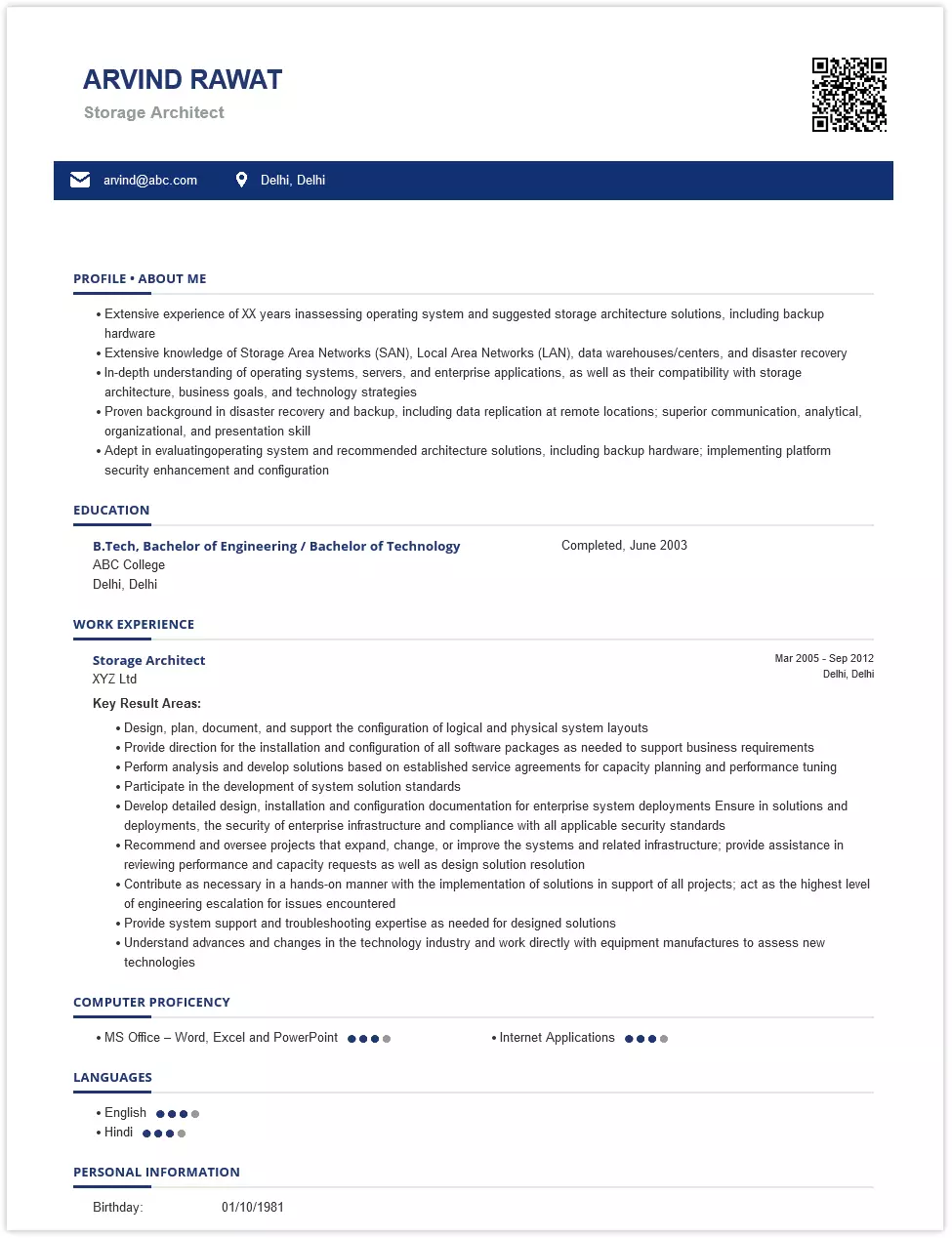
ARVIND RAWAT
Phone: 0000000
Email: arvind@abc.com
Address: C-21, Sector-21, Delhi
About Me
Storage Architect
- Results-driven and goal-oriented Storage Architect with XX years of experience in assessing operating systems and suggested storage architecture solutions, including backup hardware. Possesses strong knowledge of Storage Area Networks (SAN), Local Area Networks (LAN).
- In-depth understanding of operating systems, servers, and enterprise applications, as well as their compatibility with storage architecture, business goals, and technology strategies
- Proven background in disaster recovery and backup, including data replication at remote locations; superior communication, analytical, organizational, and presentation skill
- Adept in evaluating operating systems and recommended architecture solutions, including backup hardware; implementing platform security enhancement and configuration
Education
Computer Science, Bachelor of Engineering / Bachelor of Technology, Completed, June 2003
Birla Institute Of Technology And Science
– Marks null
Pilani, GA
Certifications
Work Experience
Period: March 2012 - Current
Storage Architect / Storage Consultant Specialist
Hitachi
Mumbai, MH
- Built central database systems to keep the most crucial business information for the company.
- Established enterprise-level storage standards, policies, and procedures according to best practices.
- Communicated and negotiated vendor support relationships and achieved an overall reduction in cost for maintenance agreements.
- Evaluated operating systems and recommended architecture solutions, including backup hardware.
- Proven background in disaster recovery and backup, including data replication at remote locations.
- Implemented platform security enhancement and configuration.
Period: January 2002 - February 2010
Senior Storage Architect
SavoirFaire Consultancy
Mumbai, MH
- Developed and worked on cross-country disaster recovery solutions for production systems.
- Skilfully used operating systems, servers, and enterprise applications, as well as their compatibility with storage architecture, business goals, and technology strategies.
- Monitored the capacity and performance of the storage environment and presented monthly reports to Senior IT management.
- Implemented a footprint large capacity drive solution for storage products which decreased costs by up to 30%.
- Managed 99.9% uptime for production storage units.
Skills
Hard Skills
- Architecture.
- Cloud.
- Windows.
- Linux.
- Servers.
- Storage Infrastructure.
- Virtualization.
- Disaster Recovery.
Soft Skills
- Communication skill
- Leadership Skill
- Time-management skill
- Problem-Solving skill
- Analytical skill
- Organizational skill
- Presentation skill
Languages
Softwares
Operating System
Personal Interests
- Travelling
- Golfing
- Cooking

Author
Kshama Sharma - Resume, CV and Cover Letter Writing Expert