India's
premier resume service
India's
premier resume service


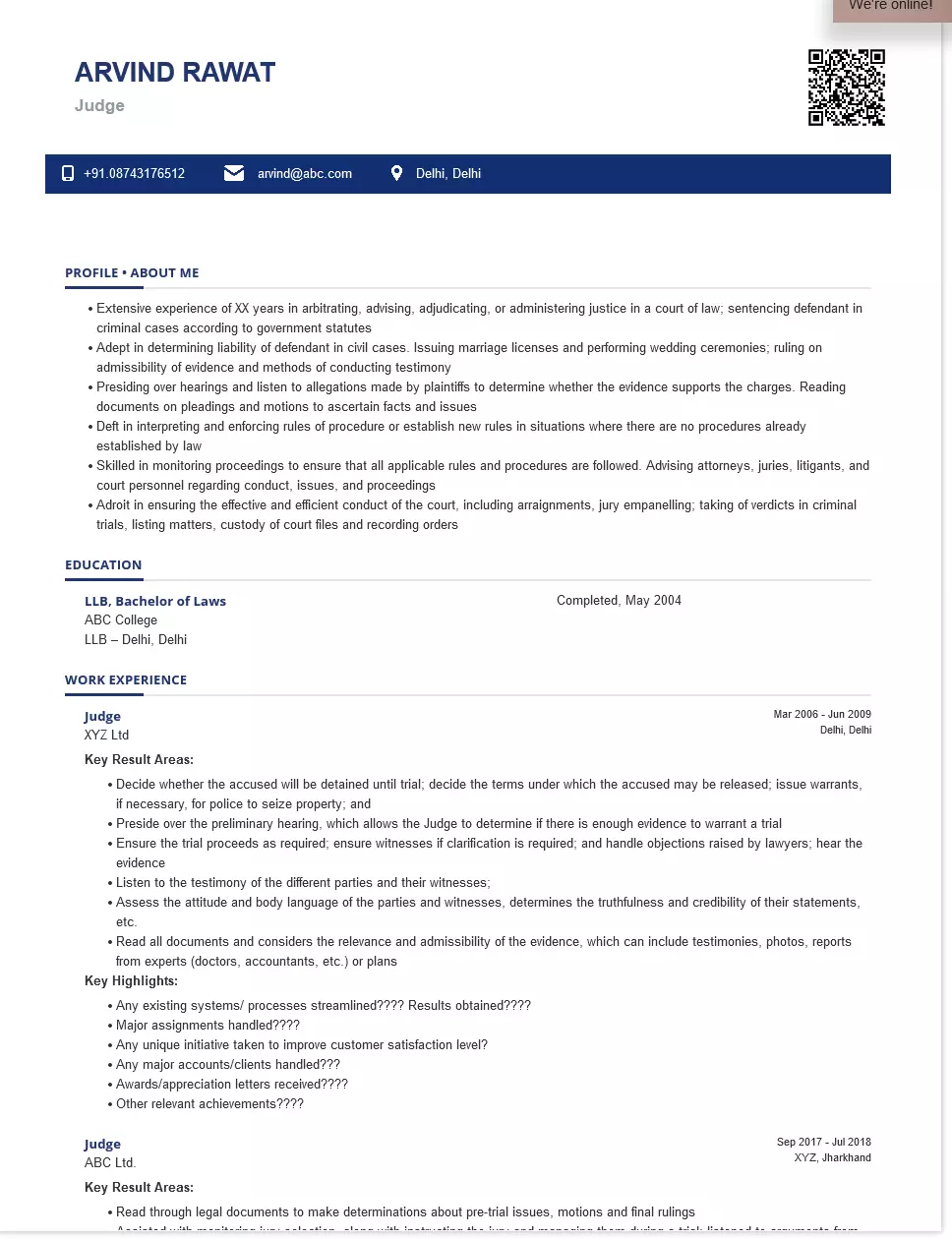
- Decide whether the accused will be detained until trial; decide the terms under which the accused may be released; issue warrants, if necessary, for police to seize property
- Preside over the preliminary hearing, which allows the Judge to determine if there is enough evidence to warrant a trial
- Ensure the trial proceeds as required; ensure witnesses if clarification is required; and handle objections raised by lawyers; hear the evidence
- Listen to the testimony of the different parties and their witnesses;
- Assess the attitude and body language of the parties and witnesses, determines the truthfulness and credibility of their statements, etc.
- Read all documents and considers the relevance and admissibility of the evidence, which can include testimonies, photos, reports from experts (doctors, accountants, etc.), or plans
- Home

- Resume Samples
- Judge Resume Sample
What's your job?
Judge Resume Samples and Templates for 2026
- Table of Contents
- Downloadable Sample
- Resume Tips from Experts
- Resume Text Version
- Share


Judicial Officer Resume Examples and Templates: A Complete Guide
A professional judicial officer resume is essential for standing out in India’s competitive judicial services examinations and appointments. Whether you’re applying for positions through State Judicial Services examinations, Higher Judicial Services, or seeking elevation within the judiciary, your resume should highlight your legal expertise, judicial temperament, academic achievements, and commitment to upholding the rule of law.
This guide walks you through judicial officer resume examples and templates, formatting tips, and keywords to help you write a resume that stands out for judicial appointments and legal positions in India.
Understanding Judicial Positions in India
Judicial officers in India are responsible for administering justice, interpreting laws, and ensuring the fair resolution of disputes. From presiding over civil and criminal matters as a Civil Judge (Junior Division) to handling complex commercial disputes as a District Judge, judicial officers form the backbone of India’s legal system.
Key responsibilities include:
- Presiding over civil and criminal proceedings
- Hearing arguments and examining evidence
- Interpreting and applying laws and legal precedents
- Delivering judgments and orders
- Managing court administration and case flow
- Conducting mediation and alternative dispute resolution
- Ensuring fair trial and due process
- Maintaining judicial decorum and ethics
India’s large court system and focus on judicial reforms create ongoing demand for qualified judicial officers across district courts, civil courts, and tribunals.
Preparing to Write Your Judicial Resume
Before drafting your resume, gather all relevant information:
Professional details to compile:
- Complete legal education and qualifications
- Bar Council enrollment and practice details
- Types of matters handled (civil, criminal, constitutional)
- Courts practiced in (District, High Court, Supreme Court)
- Judicial services examination results
- Notable cases argued or judgments delivered
- Academic achievements and rankings
- Publications and legal writings
Research position requirements:
- Review eligibility criteria for State Judicial Services
- Understand requirements for Higher Judicial Services
- Note specific qualifications and experience requirements
Choosing the Best Resume Format
Select a format that best presents your legal and judicial experience:
Chronological Format
Best for practicing advocates with steady career progression or sitting judicial officers seeking elevation. Highlights your work in reverse chronological order.
Functional Format
Suitable for fresh law graduates appearing for judicial services examinations who want to emphasise academic achievements over limited practice experience.
Combination Format
Ideal for advocates with diverse practice areas balancing litigation experience across multiple courts and specialisations.
Format recommendations by experience: | Experience Level | Recommended Format | Resume Length | |-----------------|-------------------|---------------| | Fresh graduate (0-3 years) | Chronological | 1-2 pages | | Practicing advocate (3-7 years) | Combination | 2 pages | | Senior advocate (7+ years) | Chronological | 2-3 pages |
Professional Summary Examples
Your professional summary should immediately communicate your legal and judicial credentials:
Fresh Law Graduate
LLB graduate from National Law School of India University (NLSIU) Bangalore seeking position through State Judicial Services examination. Secured All India Rank 15 in CLAT. Completed internships at Delhi High Court and leading litigation chambers. Expertise in constitutional law and criminal procedure. Strong academic record with gold medal in Jurisprudence. Committed to upholding rule of law and delivering timely justice.
Practicing Advocate
Practicing advocate with 7+ years of experience in civil and criminal litigation at District Courts and High Court of Delhi. Enrolled with Bar Council of Delhi since 2016. Handled 500+ matters including property disputes, matrimonial cases, and criminal trials. Expertise in CPC, CrPC, and Evidence Act. Appeared in landmark bail matters and writ petitions. Cleared Delhi Judicial Service examination seeking appointment as Civil Judge (Junior Division).
Higher Judicial Services Candidate
Experienced advocate with 12+ years of civil and criminal practice seeking elevation through Higher Judicial Services. Currently practicing at Delhi High Court with expertise in commercial and constitutional matters. Argued 50+ writ petitions and appeals with significant success rate. Published articles in legal journals on judicial reforms. LLM from Delhi University with specialisation in Constitutional Law. Strong commitment to judicial ethics and access to justice.
Sitting Judicial Officer
Presiding Officer with 15 years of judicial experience across civil and criminal courts. Currently Additional District and Sessions Judge at Delhi handling complex civil and criminal matters. Delivered 2,000+ judgments with minimal reversal rate. Expertise in managing court administration and reducing pendency. Achieved 40% reduction in case backlog through active case management. Recipient of Best Judicial Officer Award from High Court. Seeking elevation to Delhi High Court.
Showcasing Your Legal Experience
Present your legal and judicial experience with specific achievements and metrics:
Additional District and Sessions Judge
District Courts, Delhi | Delhi April 2019 – Present
- Preside over criminal sessions cases including murder, rape, and NDPS matters
- Handle civil appeals and commercial disputes at district level
- Delivered 500+ judgments with 95% affirmation rate on appeal
- Reduced pending cases by 40% through active case management
- Conducted 200+ mediations achieving 60% settlement rate
- Implemented e-courts initiative improving efficiency
- Mentored junior judicial officers on judgment writing
- Chair District Legal Services Authority promoting access to justice
- Received “Best Performing Court” recognition from High Court
Civil Judge (Senior Division)
District Courts, Delhi | Delhi June 2015 – March 2019
- Presided over civil matters including property, contract, and recovery suits
- Handled matrimonial cases under Hindu Marriage Act and Special Marriage Act
- Delivered 400+ judgments with comprehensive reasoning
- Conducted effective case management reducing average disposal time
- Implemented ADR mechanisms for faster resolution
- Trained in judicial ethics and court administration
- Promoted from Junior Division based on performance
- Received appreciation from High Court for quality of judgments
Civil Judge (Junior Division)
District Courts, Delhi | Delhi July 2012 – May 2015
- Presided over civil cases up to pecuniary jurisdiction
- Handled criminal matters as Metropolitan Magistrate
- Delivered 300+ orders and judgments in initial years
- Completed all mandatory judicial training programmes
- Maintained court records and administrative compliance
- Participated in legal literacy and Lok Adalat camps
- Selected through Delhi Judicial Service Examination
Essential Skills for Judicial Officers
Legal Knowledge
- Constitutional law and interpretation
- Civil procedure (CPC, Limitation Act)
- Criminal procedure and evidence (CrPC, IEA)
- Specific substantive laws (IPC, Contract Act)
- Commercial and corporate laws
- Family and matrimonial laws
- Service and administrative law
- Alternative dispute resolution
- Legal research and precedent analysis
- Judgment and order writing
Judicial Skills
- Case analysis and fact finding
- Legal reasoning and interpretation
- Courtroom management and decorum
- Time management and docket control
- Mediation and conciliation
- Oral and written communication
- Decision-making and judgment
- Impartiality and fairness
- Administrative competence
- Technology adoption (e-courts)
Personal Qualities
- Integrity and ethical conduct
- Judicial temperament
- Patience and composure
- Analytical thinking
- Attention to detail
- Independence and impartiality
- Commitment to justice
- Continuous learning
- Time consciousness
- Empathy with fairness
Qualifications for Judicial Officers
Educational Qualifications
| Qualification | Requirement | Relevance |
|---|---|---|
| LLB (3 or 5 year) | Recognised university | Mandatory |
| LLM | Recognised university | Preferred for HJS |
| PhD in Law | Recognised university | Academic distinction |
| Bar Council Enrollment | State Bar Council | Mandatory for practice |
| Practice Certificate | Bar Council | Proof of practice |
| Judicial Training | State Judicial Academy | Post-appointment |
Competitive Examinations
- State Judicial Services Examination (Civil Judge JD)
- Higher Judicial Services Examination (District Judge)
- All India Judicial Services (proposed)
- State Public Service Commission examinations
- CLAT/AILET (for NLU admission)
Training Programmes
- National Judicial Academy training
- State Judicial Academy programmes
- Specialised training (cyber, commercial)
- Mediation and ADR training
- Leadership and administration courses
- Continuing judicial education
Tips by Experience Level
Fresh Law Graduates (0-3 years)
- Highlight law school education and rankings
- Include moot court and internship experience
- Emphasise academic achievements and subjects studied
- Showcase research and writing samples
- Include preparation for judicial services examinations
Target positions: Civil Judge (Junior Division), Metropolitan Magistrate
Practicing Advocates (3-7 years)
- Quantify matters handled and courts appeared in
- Highlight areas of specialisation and expertise
- Showcase significant cases and outcomes
- Demonstrate professional standing and ethics
- Include Bar Council membership and positions
Target positions: Civil Judge (JD/SD), Higher Judicial Services
Senior Advocates/Judicial Officers (7+ years)
- Emphasise judicial experience and performance
- Highlight judgments delivered and affirmation rates
- Showcase administrative and leadership roles
- Demonstrate contribution to judicial reforms
- Include awards and recognition received
Target positions: District Judge, High Court elevation, Tribunal appointments
ATS Optimisation for Judicial Resumes
Ensure your resume passes Applicant Tracking Systems:
Essential keywords to include:
- Advocate, judicial officer, judge
- LLB, LLM, Bar Council enrolled
- Civil, criminal, constitutional law
- CPC, CrPC, Evidence Act
- District Court, High Court
- Judicial services examination
- Judgment, order, decree
- Case management, disposal
- Mediation, ADR, Lok Adalat
- Judicial ethics, legal reasoning
ATS-friendly formatting:
- Use standard section headings (Summary, Experience, Education)
- List qualifications with university names
- Avoid tables, graphics, and complex formatting
- Use standard fonts (Arial, Calibri, Times New Roman)
- Include case counts and court details clearly
Conclusion
A professional judicial officer resume is essential for success in India’s judicial services and appointments. Whether you’re appearing for State Judicial Services examinations, seeking elevation through Higher Judicial Services, or applying for tribunal positions, your resume must demonstrate your legal knowledge, judicial temperament, and commitment to justice.
Focus on highlighting your qualifications—LLB/LLM from recognised universities, Bar Council enrollment, and practice experience. Quantify your achievements through matters handled, judgments delivered, and performance metrics. With India’s focus on judicial reforms and reducing case pendency, qualified judicial officers have significant opportunities across district courts, High Courts, and tribunals.
Use our resume builder to create an ATS-optimised judicial resume, or explore our professional templates designed specifically for legal professionals in India.
Frequently Asked Questions
What sections should a strong judge resume include?
At minimum, include contact information, a professional summary, work experience, key skills, and education. Depending on your experience level, you may also add certifications, achievements, projects, or industry-specific sections that highlight your expertise.
How do I write a professional summary for a judge role?
Keep it concise — two to three sentences highlighting your experience level, core competencies, and a key achievement or strength that shows why you're right for the job. Tailor it to match the specific role you're applying for.
What skills are most important to list on a judge resume?
Include a mix of technical skills specific to judge roles and soft skills like communication, problem-solving, and teamwork. Research job postings in your target companies to identify the most commonly requested skills.
How detailed should my work experience be?
Use bullet points to describe your roles, focusing on specific results, tools used, and the impact you made. Quantify achievements where possible — numbers and percentages help recruiters quickly understand your contributions.
Do I need certifications on my judge resume?
Certifications aren't always required, but they can strengthen your application — especially if they demonstrate advanced training or specialised expertise. List the certification name, issuing organisation, and year obtained.
What's the best resume format for a judge?
Most judge professionals benefit from a reverse-chronological format that lists your most recent experience first. If you're changing careers or have gaps, a functional or combination format might work better.
How long should my judge resume be?
Aim for one page if you're early in your career. Experienced professionals with extensive achievements can use two pages — just ensure every section adds value and remains relevant to the role.
Should I tailor my resume for each job application?
Yes. Customising your resume with keywords and responsibilities from the job posting improves your chances of passing Applicant Tracking Systems (ATS) and resonating with recruiters. Focus on relevant experience and skills for each role.
Judge Text-Only Resume Templates and Samples
ARVIND RAWAT
Phone: 08743176512
Email: arvind@abc.com
Address: C-21, Sector-21, Delhi
About Me
Judge
- A Professional Judge, Presides over a courtroom, hearing evidence, makes decisions on motions, instructs juries and makes rulings; assuring the law is followed and carried out in every case Fair; reasonable professional with expert knowledge of the law; able to maintain order in the courtroom and work with a variety of personnel to ensure each case is handled correctly
- Extensive experience of XX years in arbitrating, advising, adjudicating, or administering justice in a court of law; sentencing defendants in criminal cases according to government statutes
- Adept in determining the liability of defendants in civil cases. Issuing marriage licenses and performing wedding ceremonies; ruling on the admissibility of evidence and methods of conducting testimony
- Presiding over hearings and listening to allegations made by plaintiffs to determine whether the evidence supports the charges. Reading documents on pleadings and motions to ascertain facts and issues
- Deft in interpreting and enforcing rules of procedure or establishing new rules in situations where there are no procedures already established by law
- Skilled in monitoring procedures to ensure that all applicable rules and procedures are followed. Advising attorneys, juries, litigants, and court personnel regarding conduct, issues, and proceedings
- Adroit in ensuring the effective and efficient conduct of the court, including arraignments, jury impaneling; taking of verdicts in criminal trials, listing matters, custody of court files, and recording orders
Education
, Bachelor of Laws, Completed, May 2004
Faculty of Law BHU
– Marks null
Varanasi, UP
Work Experience
Period: March 2016 - Current
Family Court Judge
High Court of Bombay
Amane, MH
Period: September 2008 - July 2015
Judge
Bombay High Court
Mumbai, MH
- Read through legal documents to make determinations about pre-trial issues, motions, and final rulings
- Assisted with monitoring jury selection, along with instructing the jury and managing them during a trial; listened to arguments from plaintiffs and defendants to determine the facts of a case and come to a ruling
- Asked questions of witnesses and legal counsel to make the right decisions regarding issues that may occur during a trial or hearing
- Met with legal counsel to discuss and decide upon objections, pretrial motions, evidence, and discovery issues; wrote opinions and conducted legal research as needed to reach determinations or create written documents
- Determined proper sentencing, monetary fees, and damages to be paid upon the completion of a case and handed down the ruling in the courtroom to the responsible party
- Monitored court proceedings to ensure all legal procedures are handled according to the law and made decisions regarding gray area issues, such as the use of cameras in the courtroom
Skills
- Studious
- Courteous
- Conscientious
- Patient
- Punctual
- Impartial
- Fearless of public clamor
- Excellent
- Logical reasoning
- Analytical
- Decision-making
Languages
Softwares
Operating System
Personal Interests
- Meditation
- Reading
- Music

Author
Kshama Sharma - Resume, CV and Cover Letter Writing Expert