India's
premier resume service
India's
premier resume service


- Assisted in the maintenance and preservation of excavation sites.
- Provided support to visiting researchers and archaeologists.
- Home

- Resume Samples
- Archaeologist Resume Sample
What's your job?
Archaeologist Resume Samples and Templates for 2026
- Table of Contents
- Downloadable Sample
- Resume Tips from Experts
- Resume Text Version
- Share


Archaeologist Resume Guide for India
A well-crafted archaeologist resume is essential for success in India’s rich archaeological heritage sector. Whether you’re pursuing a career with the Archaeological Survey of India (ASI), state archaeology departments, central universities, museums, or research institutions, this guide provides everything you need to create a standout resume.
This comprehensive guide includes:
- Resume format recommendations for archaeology roles in India
- Key skills employers look for in archaeologists
- Complete resume example with Indian context
- Top archaeology employers in India
- Salary insights in INR by experience level
- Required qualifications and certifications
- ATS optimization tips for government and academic job portals
Why Your Archaeologist Resume Matters in India
India’s archaeological heritage spans thousands of years with UNESCO World Heritage Sites, ancient civilisations, and ongoing excavations. From the Indus Valley sites to medieval monuments, archaeologists play crucial roles in discovering, preserving, and interpreting India’s past. With growing heritage tourism and conservation initiatives, skilled archaeologists are in demand.
A strong archaeologist resume helps you:
- Stand out from competition for ASI and university positions
- Showcase your expertise in excavation, documentation, and conservation
- Demonstrate your research publications and fieldwork experience
- Highlight your knowledge of Indian archaeological sites and periods
Government departments and universities receive many applications. Your resume must immediately communicate your academic credentials, excavation experience, and research contributions.
Archaeologist Resume Format for India
Indian government and academic employers prefer professional CV formats that highlight educational qualifications and fieldwork.
Recommended Format
- Length: 2-3 pages for research/academic roles
- Layout: Reverse chronological
- Font: Arial, Calibri, or Times New Roman (11-12pt)
- Sections: Contact, Summary, Skills, Experience, Education, Publications, Fieldwork
Personal Details for Indian Archaeologist Resumes
Include:
- Full name
- Phone number with +91 country code
- Professional email address
- City, State
- ORCID/ResearchGate/Academia.edu profile
What to Avoid
- Personal details like religion or caste
- Confidential site data or unpublished findings
- Plagiarised or unverified publications
- Salary expectations in resume
Key Skills for Archaeologists in India
Indian employers look for a combination of fieldwork expertise and research capabilities.
Excavation Skills
- Field Survey: Reconnaissance, site identification
- Excavation Techniques: Horizontal and vertical excavation
- Stratigraphy: Layer identification, soil analysis
- Documentation: Section drawing, photography, recording
- Artifact Handling: Cleaning, cataloguing, preservation
Technical Skills
- GIS/GPS: Site mapping, spatial analysis
- Total Station: Survey equipment operation
- Photogrammetry: 3D documentation
- Dating Methods: Radiocarbon, thermoluminescence concepts
- Conservation: Basic artifact conservation
Period Specialisations (India)
- Prehistoric: Stone Age, Chalcolithic, Neolithic
- Protohistoric: Indus Valley, Painted Grey Ware
- Historical: Mauryan, Gupta, Medieval
- Islamic: Sultanate, Mughal archaeology
- Colonial: Historical archaeology of British period
Research Skills
- Report Writing: Excavation reports, technical documentation
- Publication: Academic papers, journal articles
- Museum Studies: Display, interpretation
- Heritage Management: Conservation policy, site management
- Languages: Sanskrit, epigraphy (advantageous)
Soft Skills
- Physical Fitness: Fieldwork requirements
- Patience: Detailed excavation work
- Communication: Team coordination, public outreach
- Adaptability: Remote site conditions
- Cultural Sensitivity: Community engagement
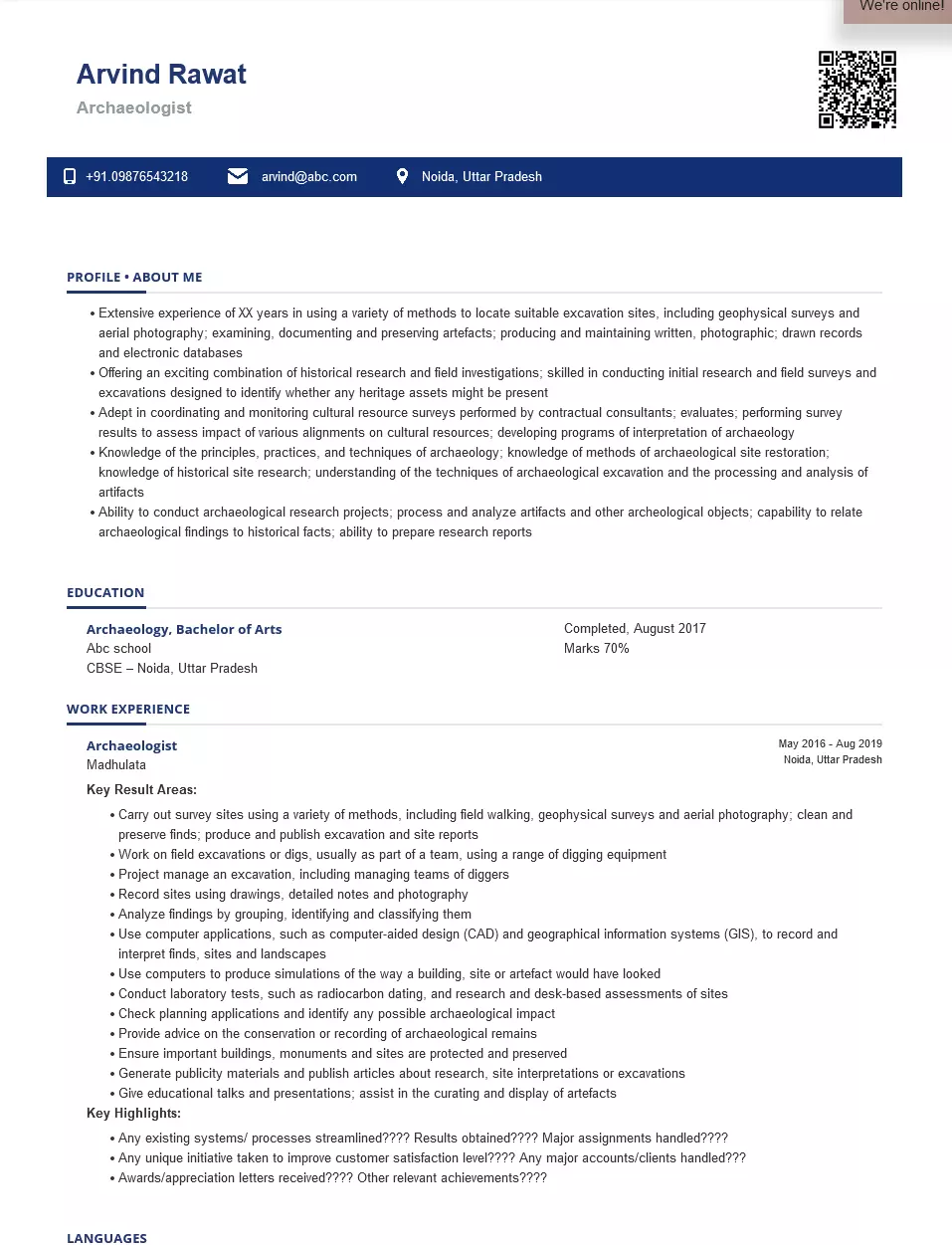
Archaeologist Resume Example for India
Here’s a complete resume example tailored for Indian employers:
Dr. Ananya Krishnamoorthy
Pune, Maharashtra | +91-98XXX-XXXXX | ananya.k.archaeologist@email.com | ORCID: 0000-0000-0000-0000
Professional Summary
Archaeologist with 9+ years of experience in prehistoric and protohistoric archaeology of India. Currently Assistant Superintending Archaeologist at Archaeological Survey of India (ASI) with excavation experience at 15+ sites including Rakhigarhi, Dholavira, and Lothal. Published 18 research papers in peer-reviewed journals including Puratattva, Man and Environment, and Ancient India. Ph.D. from Deccan College with specialisation in Indus Valley Civilisation. Expertise in ceramic analysis, GIS-based site documentation, and heritage management. UGC-NET qualified with strong commitment to archaeological research and heritage preservation.
Key Skills
Archaeological Excavation | Field Survey | Stratigraphy | GIS Mapping | Total Station | Ceramic Analysis | Indus Valley Civilisation | Prehistoric Archaeology | Heritage Conservation | Report Writing | Museum Documentation | Public Outreach | Sanskrit (Basic) | Marathi | Hindi | English
Professional Experience
Assistant Superintending Archaeologist | Archaeological Survey of India | Pune Circle | April 2019 – Present
- Lead excavations at prehistoric and protohistoric sites in Maharashtra and Gujarat
- Conduct systematic site surveys for monument identification
- Prepare detailed excavation reports for ASI headquarters
- Supervise team of 10+ technical assistants and labourers
- Coordinate with state archaeology departments
- Document and catalogue artifacts for ASI museums
- Participate in conservation planning for protected monuments
- Conduct public awareness programmes on archaeological heritage
Key Achievements:
- Led excavation at Junnar revealing early historic Buddhist settlement
- Published 8 research papers during tenure
- Received ASI Excellence Award for Documentation 2022
Research Associate | Deccan College Post-Graduate Research Institute | Pune | June 2016 – March 2019
- Conducted doctoral research on Indus Valley ceramic traditions
- Participated in multi-season excavations at Rakhigarhi
- Analysed ceramic assemblages from Harappan sites
- Published findings in national and international journals
- Taught practical archaeology to M.A. students
- Collaborated on ASI-Deccan College joint projects
Key Achievements:
- ICHR Fellowship for doctoral research
- Best Paper Award at Indian History Congress 2018
Field Archaeologist | ASI (Deputation - Harappan Project) | Rakhigarhi, Haryana | January 2014 – May 2016
- Participated in India’s largest Indus Valley excavation
- Documented burial sites and pottery sequences
- Operated Total Station for site mapping
- Assisted in GIS database development
- Trained junior field staff on excavation techniques
Key Achievements:
- Part of team discovering largest Harappan burial site
- Contributed to 5 joint publications
Education
Ph.D. (Archaeology) | Deccan College Post-Graduate Research Institute, Pune | 2019
- Thesis: Ceramic Traditions of Mature Harappan Phase: A Study from Gujarat Sites
- ICHR Fellowship
- First Division
M.A. (Archaeology) | Deccan College Post-Graduate Research Institute, Pune | 2013
- Specialisation in Protohistoric Archaeology
- First Rank, Gold Medal
- First Division with Distinction
B.A. (Honours) Ancient Indian History | University of Pune | 2011
- First Division with Distinction
Research Publications
- Krishnamoorthy, A. (2023). “Ceramic Technology of Mature Harappan Gujarat: New Evidence from Dholavira.” Puratattva, 53.
- Krishnamoorthy, A. & Sharma, V. (2022). “GIS-based Analysis of Settlement Patterns in Harappan Gujarat.” Man and Environment, 47(2).
- Krishnamoorthy, A. (2021). “Burial Practices at Rakhigarhi: A Reappraisal.” Ancient India (New Series), 6.
- [+15 more peer-reviewed publications]
Book Chapters:
- Krishnamoorthy, A. (2020). “Indus Valley Urban Planning” in Encyclopedia of Indian Archaeology. Aryan Books International.
Fieldwork Experience
- Rakhigarhi, Haryana: 3 seasons, Harappan cemetery excavation
- Dholavira, Gujarat: 2 seasons, urban sector excavation
- Lothal, Gujarat: 1 season, conservation documentation
- Junnar, Maharashtra: 2 seasons, Buddhist cave site survey
- Kuntasi, Gujarat: 1 season, coastal Harappan site
Research Projects
PI: Settlement Archaeology of Vidarbha | ICHR | 2022-2025 | ₹8 Lakhs Co-PI: Digital Documentation of ASI Monuments | Ministry of Culture | 2021-2023 | ₹15 Lakhs Team Member: Rakhigarhi Excavation Project | ASI | 2014-2016
Certifications & Training
- GIS for Archaeologists | IISER Pune | 2021
- Conservation of Archaeological Sites | ASI Training Institute | 2020
- Photogrammetry Workshop | IIIT Hyderabad | 2019
- UGC-NET | Archaeology | 2014
Languages
Marathi (Native) | English (Fluent) | Hindi (Fluent) | Sanskrit (Basic reading)
Top Archaeology Employers in India
India’s archaeology sector offers diverse opportunities.
Archaeological Survey of India (ASI)
- Headquarters: New Delhi
- Regional Circles: Across India (Agra, Aurangabad, Bhopal, etc.)
- Positions: Assistant Archaeologist, Superintending Archaeologist
- Sites: Protected monuments, excavations
- Museums: Site museums across India
State Archaeology Departments
- Maharashtra: Directorate of Archaeology
- Karnataka: Department of Archaeology, Museums & Heritage
- Tamil Nadu: State Archaeology Department
- Gujarat: Department of Archaeology
- Rajasthan: Archaeology & Museums Department
Universities
- Deccan College: Premier archaeology institution
- BHU: Department of Ancient Indian History
- Delhi University: Department of History
- Aligarh Muslim University: Department of History
- MS University Baroda: Department of Archaeology
Research Institutes
- Indian Council of Historical Research (ICHR): Fellowships and projects
- INTACH: Heritage conservation
- National Museum Institute: Museum studies
- Indira Gandhi NCAC: Arts and culture research
- Institute of Archaeology (ASI): Training and research
Museums
- National Museum: Delhi
- Indian Museum: Kolkata
- Prince of Wales Museum (CSMVS): Mumbai
- Salar Jung Museum: Hyderabad
- State Museums: Various states
International and NGO
- UNESCO: World Heritage projects
- ICOMOS India: Conservation
- Foreign Excavation Teams: International collaborations
- Heritage NGOs: Conservation projects
How to Apply
- UPSC for ASI (Combined Geo-Scientist and Geologist Exam)
- State PSC for state archaeology departments
- UGC-NET for university positions
- ICHR portal for research fellowships
- Direct recruitment advertisements
Archaeologist Salary in India
Salaries vary based on experience, employer type, and position.
Salary by Experience Level
| Experience | Annual Salary (INR) |
|---|---|
| JRF/SRF (Research Scholar) | ₹31,000 - ₹35,000/month |
| Assistant Archaeologist (Entry) | ₹6 - ₹10 LPA |
| Archaeologist/Assistant Professor | ₹8 - ₹15 LPA |
| Superintending Archaeologist/Associate Professor | ₹12 - ₹22 LPA |
| Director/Professor | ₹18 - ₹35 LPA |
Note: ASI and university positions follow 7th Pay Commission scales.
Salary by Employer Type
| Employer Type | Salary Range (Mid-Level) |
|---|---|
| ASI (Central Government) | ₹10 - ₹18 LPA + benefits |
| State Archaeology | ₹8 - ₹15 LPA + benefits |
| Central Universities | ₹10 - ₹18 LPA |
| Museums | ₹6 - ₹12 LPA |
| Research Institutes | ₹8 - ₹15 LPA |
| Private/NGO | ₹5 - ₹12 LPA |
Research Fellowships
| Fellowship | Monthly Stipend |
|---|---|
| UGC-JRF | ₹31,000 + HRA |
| ICHR-JRF | ₹28,000 + HRA |
| UGC-SRF | ₹35,000 + HRA |
| ASI Fellowship | ₹25,000 - ₹30,000 |
Salary by City
| City | Salary Range (Mid-Level) |
|---|---|
| Delhi | ₹10 - ₹18 LPA |
| Pune | ₹8 - ₹15 LPA |
| Kolkata | ₹8 - ₹14 LPA |
| Baroda | ₹8 - ₹14 LPA |
| Chennai | ₹8 - ₹14 LPA |
Qualifications for Archaeologists in India
Educational Background
Minimum for ASI:
- M.A. in Archaeology/Ancient Indian History
- UPSC qualification
For University Teaching:
- Ph.D. in Archaeology
- UGC-NET/SLET qualification
- Publications record
Specialisations
- Prehistoric Archaeology: Stone Age studies
- Protohistoric Archaeology: Indus Valley, Chalcolithic
- Historical Archaeology: Maurya to Medieval
- Epigraphy: Inscription studies
- Numismatics: Coin studies
- Conservation: Archaeological conservation
Career Path (ASI)
- Assistant Archaeologist
- Archaeologist
- Deputy Superintending Archaeologist
- Superintending Archaeologist
- Additional Director General
- Director General
Career Path (Academic)
- Junior Research Fellow
- Senior Research Fellow
- Assistant Professor
- Associate Professor
- Professor
- Head of Department
ATS Tips for Your Archaeologist Resume
Government and academic employers use various screening methods:
Keyword Optimization
Include relevant terms like:
- Archaeologist, excavation
- ASI, archaeological survey
- Indus Valley, prehistoric, historical
- Fieldwork, stratigraphy
- GIS, documentation
- Publications, research
Formatting Tips
- Use standard section headings
- List publications in proper citation format
- Include excavation sites and seasons
- Quantify experience (sites, seasons, artifacts)
- Save as PDF for format preservation
Final Tips for Your Archaeologist Resume
✅ Lead with qualifications - Ph.D., UGC-NET, M.A. prominently displayed
✅ Highlight fieldwork - Excavation sites, seasons, specific roles
✅ Show publications - Peer-reviewed papers, reports
✅ Include period specialisation - Prehistoric, Harappan, Historical
✅ Mention technical skills - GIS, Total Station, documentation
✅ Add language skills - Sanskrit, regional languages valuable
✅ Update regularly - Add new excavations and publications
Quick Checklist
- Contact information with academic profiles
- Summary highlights excavation experience
- Skills include fieldwork and technical
- Experience shows specific sites and contributions
- Education with specialisations listed
- Publications in proper citation format
- Fieldwork experience detailed
- Clean, academic format
Ready to create your professional archaeologist resume? Use our resume builder to get started with expert-designed templates.
Looking for more guidance? Check out our resume format guide for additional tips.
Frequently Asked Questions
What is the best resume format for Archaeologists in India?
Use a 2-3 page academic CV format for ASI and university positions. Include summary, skills, experience, education, publications, and fieldwork sections. Emphasise excavation experience, sites worked on, and research output.
What qualifications are needed for archaeology jobs in India?
ASI requires M.A. in Archaeology plus UPSC qualification. University teaching requires Ph.D. with UGC-NET. Publications and fieldwork experience are essential for competitive positions.
What skills should I highlight on an archaeologist resume?
Highlight excavation techniques, stratigraphy, documentation skills, GIS mapping, period specialisations (Harappan, Medieval), report writing, and language skills including Sanskrit for epigraphy work.
How much do Archaeologists earn in India?
JRF/SRF: ₹31,000-35,000/month. Entry-level (ASI/university): ₹6-10 LPA. Mid-level: ₹10-18 LPA. Senior positions (Superintending Archaeologist/Professor): ₹18-35 LPA. Government jobs include benefits.
How do I get a job at ASI (Archaeological Survey of India)?
Apply through UPSC Combined Geo-Scientist and Geologist Examination for scientific posts. Requires M.A. in Archaeology/Ancient Indian History. Written exam followed by interview. Strong academic record and fieldwork experience valued.
Should I include excavation experience on my resume?
Absolutely essential. List each excavation site, number of seasons, your specific role (trench supervisor, documentation, etc.), and key findings. Excavation experience is the most valued qualification after degrees.
What is the scope of archaeology in India?
Good scope with India's rich heritage and ongoing excavations. Opportunities in ASI, state departments, universities, museums, and conservation organisations. Heritage tourism growth creating new opportunities.
Which period specialisation is most valuable?
Protohistoric (Indus Valley) and Historical archaeology have strong demand. Prehistoric archaeology offers niche opportunities. Specialisation in epigraphy, numismatics, or conservation adds value. Choose based on interest and institutional strength.
How important are publications for archaeology jobs?
Very important for university and senior ASI positions. Publish excavation reports, site analyses, and theoretical papers. Journals like Puratattva, Man and Environment, and Ancient India are well-regarded in India.
What is the career growth for archaeologists in India?
ASI path: Assistant Archaeologist → Archaeologist → Deputy Superintending → Superintending → Additional DG → DG. Academic: JRF → SRF → Assistant Professor → Associate → Professor. Both paths offer stability and growth.
Archaeologist Text-Only Resume Templates and Samples
Abhi sandilya
Phone: 9871275111
Email: writer@shriresume.com
Address: Central Delhi
About Me
Archaeologist
Enthusiastic archaeology graduate seeking an entry-level position as an Archaeologist. Eager to apply fieldwork experience, research skills, and a passion for uncovering human history to contribute to archaeological excavations and research projects.
Extra Curricular Activities
Education
Archaeology, Bachelor of Arts, Completed, April 2024
Arya College of Science
State University
Karol Bagh, DL
Certifications
- Certificate in Archaeological Field Methods, Completed , April 2024
- GIS for Archaeologists Certification, Completed , April 2024
Internships
Period: March 2024 - July 2024
Field Archaeology Intern
Delhi Archaeological Project
Barpeta, AS
- Participated in field excavations, including site surveying, excavation, and recording.
- Assisted in the analysis and cataloging of artifacts and ecofacts.
- Conducted preliminary research on the historical context of excavation sites.
- Collaborated with team members to prepare field reports and presentations.
Skills
- Field Excavation and Surveying
- Artifact Analysis and Cataloging
- Research and Data Analysis
- Historical Contextualization
- Strong Written and Verbal Communication
- Critical Thinking and Problem-Solving
Languages
Softwares
Operating System
Personal Interests
- Reading Archaeological Journals and Literature
- Visiting Historical Sites and Museums
- Participating in Fieldwork and Excavations
- Engaging in Cultural Heritage Preservation Efforts
- Exploring Ancient Civilizations and Cultures

Author
Kshama Sharma - Resume, CV and Cover Letter Writing Expert