India's
premier resume service
India's
premier resume service


- Certificate in Organizational Anthropology, Completed , January 2013
- Home

- Resume Samples
- Anthropologist Resume Sample
What's your job?
Anthropologist Resume Samples and Templates for 2026
- Table of Contents
- Downloadable Sample
- Resume Tips from Experts
- Resume Text Version
- Share


Anthropologist Resume Guide for India
A well-crafted anthropologist resume is essential for success in India’s growing research, academic, and applied anthropology sector. Whether you’re pursuing a career with central universities, ICSSR research institutes, ASI (Archaeological Survey of India), tribal welfare departments, museums, or international organisations like UNESCO or UNDP, this guide provides everything you need to create a standout resume.
This comprehensive guide includes:
- Resume format recommendations for anthropology roles in India
- Key skills employers look for in anthropologists
- Complete resume example with Indian context
- Top anthropology employers in India
- Salary insights in INR by experience level
- Required qualifications and certifications
- ATS optimization tips for academic and research job portals
Why Your Anthropologist Resume Matters in India
India’s rich cultural diversity, tribal populations, and archaeological heritage create significant demand for anthropologists. From academic research at universities to applied work in tribal welfare, development projects, and heritage conservation, skilled anthropologists play crucial roles in understanding and preserving India’s human legacy.
A strong anthropologist resume helps you:
- Stand out from competition for academic and research positions
- Showcase your expertise in ethnography, cultural studies, and fieldwork
- Demonstrate your research publications and project experience
- Highlight your understanding of Indian tribal communities and cultural contexts
Research institutions and universities receive many applications. Your resume must immediately communicate your academic credentials, fieldwork experience, and research contributions.
Anthropologist Resume Format for India
Indian academic and research employers prefer professional CV formats that highlight educational qualifications and research output.
Recommended Format
- Length: 2-3 pages for academic/research roles
- Layout: Reverse chronological
- Font: Arial, Calibri, or Times New Roman (11-12pt)
- Sections: Contact, Summary, Skills, Experience, Education, Publications, Fieldwork
Personal Details for Indian Anthropologist Resumes
Include:
- Full name
- Phone number with +91 country code
- Professional email address
- City, State
- ORCID/ResearchGate/Academia.edu profile
What to Avoid
- Personal details like religion or caste
- Confidential fieldwork data or informant details
- Plagiarised or unverified publications
- Salary expectations in resume
Key Skills for Anthropologists in India
Indian employers look for a combination of research expertise and cultural understanding.
Research Skills
- Ethnographic Methods: Participant observation, interviews, life histories
- Qualitative Research: Thematic analysis, grounded theory
- Quantitative Methods: Survey design, statistical analysis (SPSS, R)
- Documentation: Report writing, academic publishing
- Language Skills: Regional and tribal languages
Anthropological Specialisations
- Social/Cultural Anthropology: Community studies, kinship, religion
- Physical/Biological Anthropology: Human evolution, forensics
- Archaeological Anthropology: Excavation, dating methods
- Linguistic Anthropology: Language documentation, dialectology
- Applied Anthropology: Development, public health, tribal welfare
India-Specific Skills
- Tribal Studies: Scheduled Tribe communities, PVTG research
- Development Anthropology: Rural development, livelihood studies
- Medical Anthropology: Traditional healing, public health
- Heritage Studies: Intangible cultural heritage, museum studies
- Visual Anthropology: Documentary filmmaking, photography
Soft Skills
- Cultural Sensitivity: Working with diverse communities
- Communication: Academic writing, presentations
- Adaptability: Fieldwork in remote areas
- Patience: Long-term ethnographic research
- Ethics: Research ethics, informed consent
Anthropologist Resume Example for India
Here’s a complete resume example tailored for Indian employers:
Dr. Kavitha Murugavel
Chennai, Tamil Nadu | +91-98XXX-XXXXX | kavitha.murugavel.anthro@email.com | ORCID: 0000-0000-0000-0000
Professional Summary
Cultural Anthropologist with 8+ years of experience in tribal studies, development anthropology, and ethnographic research. Currently Assistant Professor at University of Madras conducting research on Irula and Kurumba tribal communities of Nilgiris. Published 20+ peer-reviewed papers including in Economic & Political Weekly, Contributions to Indian Sociology, and Man in India. Ph.D. from Delhi University with UGC-NET qualification and postdoctoral experience at JNU. Expertise in participatory research, tribal welfare policy analysis, and intangible cultural heritage documentation. Passionate about bridging academic research with policy interventions for tribal development.
Key Skills
Ethnographic Research | Participant Observation | Qualitative Analysis | Tribal Studies | Development Anthropology | Policy Analysis | Academic Writing | NVivo | SPSS | Tamil & Malayalam Languages | Documentary Photography | Community Engagement | Research Ethics
Professional Experience
Assistant Professor | Department of Anthropology, University of Madras | Chennai | July 2019 – Present
- Teach undergraduate and postgraduate courses in cultural anthropology
- Conduct research on tribal communities of Tamil Nadu and Kerala
- Guide 8 M.Phil. and 3 Ph.D. scholars
- Lead ICSSR-funded project on tribal livelihood transformation
- Publish research in national and international peer-reviewed journals
- Organise national seminars and workshops on tribal studies
- Serve on university research ethics committee
- Collaborate with tribal welfare department on policy inputs
Key Achievements:
- Published 20+ peer-reviewed papers in reputed journals
- Received ICSSR Research Grant of ₹12 Lakhs
- Best Paper Award at Indian Anthropological Association Conference 2022
Postdoctoral Fellow | Centre for the Study of Social Systems, JNU | New Delhi | August 2017 – June 2019
- Conducted postdoctoral research on tribal youth and modernisation
- Published monograph on Toda community of Nilgiris
- Presented research at international conferences
- Contributed to ICHR project on tribal history
- Mentored junior research scholars
Key Achievements:
- UGC-PDF fellowship recipient
- Published book chapter in Cambridge University Press volume
Research Associate | Anthropological Survey of India | Kolkata | June 2015 – July 2017
- Conducted ethnographic surveys for People of India project
- Documented intangible cultural heritage of tribal communities
- Prepared detailed community profiles and reports
- Collaborated on tribal atlas preparation
- Participated in national tribal research network
Key Achievements:
- Authored 3 AnSI monographs on tribal communities
- Fieldwork in 5 states covering 15+ tribal groups
Education
Ph.D. (Anthropology) | University of Delhi | 2015
- Thesis: Livelihood Transitions among Irula Tribe of Tamil Nadu
- UGC-JRF/SRF fellowship
- First Division
M.A. (Anthropology) | University of Delhi | 2010
- Specialisation in Social Anthropology
- Gold Medallist, First Rank
- First Division with Distinction
B.A. (Honours) Anthropology | Lady Shri Ram College, Delhi University | 2008
- First Division with Distinction
Research Publications
- Murugavel, K. (2023). “Forest Rights and Tribal Livelihoods: A Study of Irula Community.” Economic & Political Weekly, 58(12).
- Murugavel, K. & Sharma, R. (2022). “Modernisation and Identity among Toda Youth.” Contributions to Indian Sociology, 56(2).
- Murugavel, K. (2021). “Traditional Ecological Knowledge of Kurumba Tribe.” Man in India, 101(3-4).
- [+17 more peer-reviewed publications]
Books/Chapters:
- Murugavel, K. (2020). The Toda: Continuity and Change. Oxford University Press India.
- Murugavel, K. (2019). “Tribal Development Policy in India” in Handbook of Indian Anthropology. Cambridge University Press.
Research Projects
PI: Tribal Livelihood Transformation in Nilgiris | ICSSR | 2021-2024 | ₹12 Lakhs Co-PI: Documentation of Intangible Cultural Heritage | Ministry of Culture | 2020-2022 | ₹8 Lakhs Team Member: People of India Project | AnSI | 2015-2017
Fieldwork Experience
- Nilgiris, Tamil Nadu: 18 months among Toda, Irula, Kurumba tribes
- Wayanad, Kerala: 6 months among Paniya and Kattunayakan
- Bastar, Chhattisgarh: 3 months among Gond communities
- Andaman Islands: 2 months documentation of Jarawa buffer zone communities
Certifications & Training
- Research Methodology Workshop | ICSSR | 2021
- NVivo Qualitative Analysis | QSR International | 2020
- Ethics in Social Research | UGC-HRDC | 2019
- Visual Anthropology Workshop | CSSS-JNU | 2018
- GIS for Social Scientists | IIIT Hyderabad | 2017
Languages
Tamil (Native) | English (Fluent) | Hindi (Fluent) | Malayalam (Working) | Toda (Basic fieldwork)
Top Anthropology Employers in India
India’s anthropology sector offers diverse opportunities.
Central Universities
- University of Delhi: Department of Anthropology
- Jawaharlal Nehru University: CSSS, SSS
- University of Hyderabad: Department of Anthropology
- University of Calcutta: Department of Anthropology
- Pondicherry University: Department of Anthropology
Research Institutes
- Anthropological Survey of India (AnSI): Kolkata and regional offices
- ICSSR Institutes: Research fellowships and projects
- National Institute of Social Defence: Applied research
- Indian Council of Historical Research: Heritage projects
- Tribal Research Institutes: State-level (TRI)
Government Departments
- Ministry of Tribal Affairs: Policy and research
- State Tribal Welfare Departments: Field research
- Archaeological Survey of India: Archaeology positions
- National Commission for Scheduled Tribes: Research wing
- Ministry of Culture: Heritage documentation
Museums and Heritage
- National Museum: Delhi
- Indian Museum: Kolkata
- State Museums: Ethnographic collections
- Indira Gandhi National Centre for Arts: Documentation
- INTACH: Heritage conservation
International and NGO Sector
- UNESCO: Cultural heritage projects
- UNDP: Development research
- World Bank: Social assessment
- Ford Foundation: Research grants
- Oxfam India: Community research
How to Apply
- UGC-NET for university teaching positions
- UPSC for AnSI Scientist positions
- ICSSR portal for research fellowships
- University recruitment notifications
- NGO and international organisation career portals
Anthropologist Salary in India
Salaries vary based on experience, employer type, and qualifications.
Salary by Experience Level
| Experience | Annual Salary (INR) |
|---|---|
| JRF/SRF (Research Scholar) | ₹31,000 - ₹35,000/month |
| Assistant Professor (0-5 years) | ₹8 - ₹15 LPA |
| Associate Professor (5-12 years) | ₹12 - ₹22 LPA |
| Professor (12+ years) | ₹18 - ₹35 LPA |
Note: Central university positions follow UGC 7th Pay Commission scales.
Salary by Employer Type
| Employer Type | Salary Range (Mid-Level) |
|---|---|
| Central Universities | ₹10 - ₹18 LPA + benefits |
| State Universities | ₹8 - ₹15 LPA + benefits |
| AnSI (Scientist) | ₹10 - ₹20 LPA |
| Museums | ₹6 - ₹12 LPA |
| NGOs/International | ₹8 - ₹20 LPA |
| Private Research | ₹6 - ₹15 LPA |
Research Fellowships
| Fellowship | Monthly Stipend |
|---|---|
| UGC-JRF | ₹31,000 + HRA |
| ICSSR-Doctoral | ₹20,000 - ₹25,000 |
| UGC-PDF | ₹50,000 |
| ICSSR-PDF | ₹50,000 |
Salary by City
| City | Salary Range (Mid-Level) |
|---|---|
| Delhi | ₹10 - ₹18 LPA |
| Kolkata | ₹8 - ₹15 LPA |
| Chennai | ₹8 - ₹14 LPA |
| Hyderabad | ₹8 - ₹14 LPA |
| Pune | ₹8 - ₹14 LPA |
Qualifications for Anthropologists in India
Educational Background
Minimum for Teaching:
- Ph.D. in Anthropology
- UGC-NET/SLET qualification
- Publications record
For Research Positions:
- M.A./M.Sc. in Anthropology
- Fieldwork experience
- Research publications preferred
Specialisations
- Social/Cultural Anthropology: Most common
- Physical Anthropology: Forensics, biological studies
- Archaeological Anthropology: ASI, heritage sector
- Applied Anthropology: Development, policy
- Medical Anthropology: Public health research
Career Path (Academic)
- Junior Research Fellow
- Senior Research Fellow
- Assistant Professor
- Associate Professor
- Professor
- Head of Department/Director
Career Path (Research)
- Research Associate
- Scientist B/C
- Scientist D/E
- Senior Scientist
- Director
ATS Tips for Your Anthropologist Resume
Research institutions and universities use various screening methods:
Keyword Optimization
Include relevant terms like:
- Anthropologist, ethnographer
- Tribal studies, cultural anthropology
- Ethnographic research, fieldwork
- Publications, peer-reviewed
- UGC-NET, Ph.D.
- ICSSR, AnSI
Formatting Tips
- Use standard section headings
- List publications in proper citation format
- Include ORCID and academic profiles
- Quantify research output (papers, projects, funding)
- Save as PDF for format preservation
Final Tips for Your Anthropologist Resume
✅ Lead with qualifications - Ph.D., UGC-NET prominently displayed
✅ Highlight publications - Peer-reviewed papers, books, chapters
✅ Show fieldwork experience - Locations, duration, communities studied
✅ Include research funding - Projects secured, amounts
✅ Mention specialisation - Tribal studies, development, heritage
✅ Add language skills - Regional and tribal languages valuable
✅ Update regularly - Add new publications and projects
Quick Checklist
- Contact information with academic profiles
- Summary highlights research expertise
- Skills include methods and specialisations
- Experience shows quantified results
- Education with specialisations listed
- Publications in proper citation format
- Fieldwork experience detailed
- Clean, academic format
Ready to create your professional anthropologist resume? Use our resume builder to get started with expert-designed templates.
Looking for more guidance? Check out our resume format guide for additional tips.
Frequently Asked Questions
What is the best resume format for Anthropologists in India?
Use a 2-3 page academic CV format for research and teaching positions. Include summary, skills, experience, education, publications, and fieldwork sections. Emphasise research output, specialisations, and communities studied.
What qualifications are needed for anthropology jobs in India?
Teaching positions require Ph.D. with UGC-NET/SLET qualification. Research positions may accept M.A. with fieldwork experience. Publications are essential for academic roles. Specialisation in tribal studies, development, or heritage adds value.
What skills should I highlight on an anthropologist resume?
Highlight ethnographic methods (participant observation, interviews), qualitative analysis (NVivo, thematic analysis), academic writing, regional languages, and fieldwork experience. Include India-specific skills like tribal studies and development anthropology.
How much do Anthropologists earn in India?
JRF/SRF stipend is ₹31,000-35,000/month. Assistant Professors earn ₹8-15 LPA. Associate Professors earn ₹12-22 LPA. Professors earn ₹18-35 LPA. AnSI scientists and international organisation positions may pay competitively.
How do I get an academic position in anthropology?
Complete Ph.D. from recognised university, qualify UGC-NET, and publish in peer-reviewed journals. Apply through university recruitment advertisements. Build strong publication record and fieldwork experience during doctoral research.
Should I include fieldwork experience on my resume?
Absolutely essential. List fieldwork locations, duration, communities studied, and methods used. Ethnographic fieldwork demonstrates practical research skills crucial for anthropology positions. Include language abilities relevant to fieldwork.
What is the scope of anthropology in India?
Good scope with India's diverse tribal populations and cultural heritage. Opportunities in universities, AnSI, tribal welfare departments, museums, and international development organisations. Applied anthropology in development sector is growing.
How important are publications for anthropology jobs?
Very important for academic positions. Publish in journals like EPW, Contributions to Indian Sociology, Man in India, and international journals. Book publications from reputed academic publishers add significant value to your profile.
What regional languages should I learn?
Depends on research focus. For tribal studies, learning regional languages of fieldwork areas is valuable. Tamil, Telugu, Odia for South-East tribal belts; Hindi dialects for Central India; languages of Northeast for that region.
What is the career growth for anthropologists?
Academic path: JRF → SRF → Assistant Professor → Associate Professor → Professor → HoD/Director. Research path: Research Associate → Scientist B → Scientist C/D → Senior Scientist → Director. Policy and applied paths also available.
Anthropologist Text-Only Resume Templates and Samples
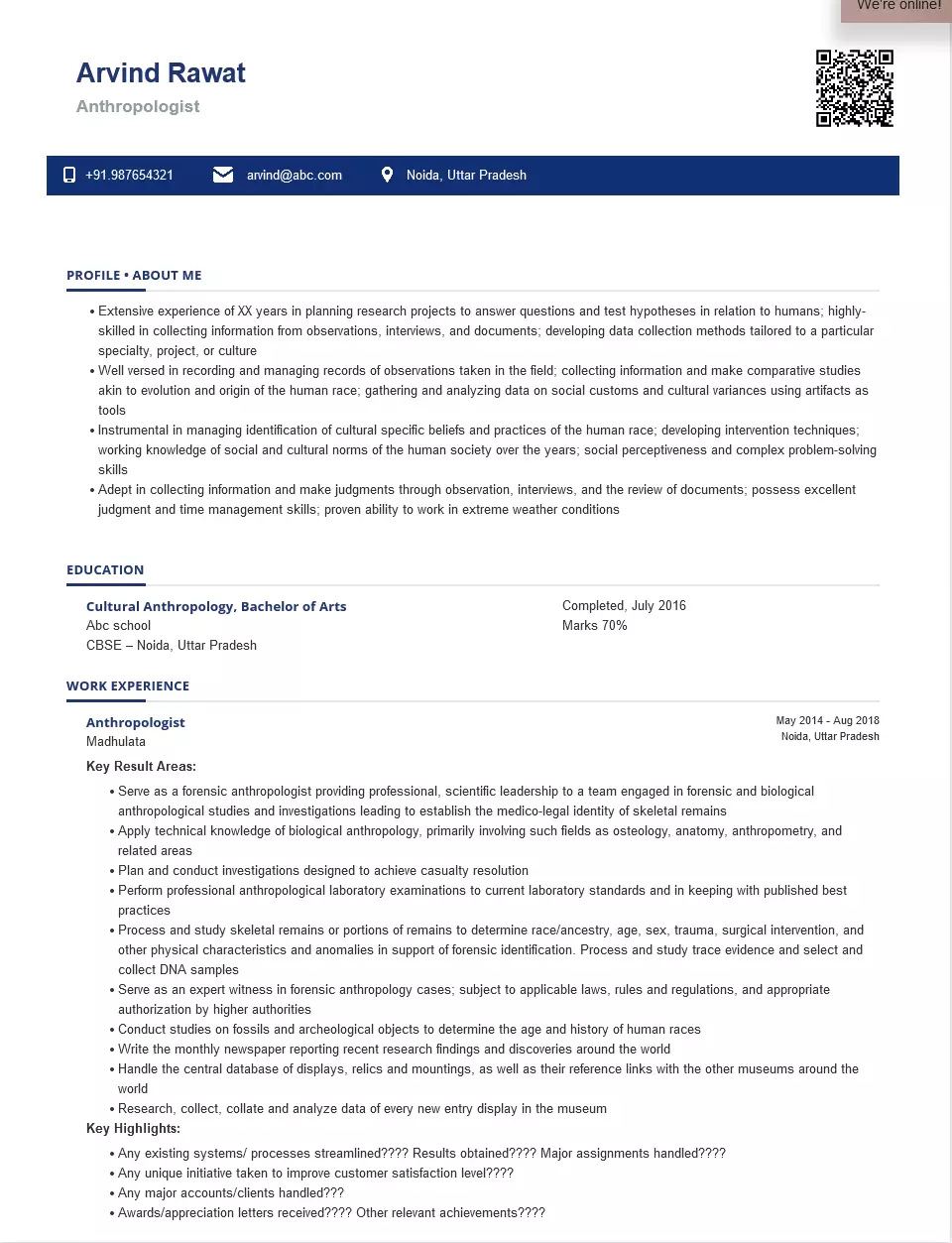
Arvind Rawat
Phone: 987654321
Email: arvind@abc.com
Address: Alpha1 greater noida, Beta 2 greater noida, Noida
About Me
Anthropologist
- An Accomplished Professional - Anthropologist possesses expertise in researching or studying the origins and physical, social, and cultural development and behavior of humans and the cultures and organizations they have created
- Extensive experience of XX years in planning research projects to answer questions and test hypotheses in relation to humans; highly skilled in collecting information from observations, interviews, and documents; developing data collection methods tailored to a particular specialty, project, or culture
- Well-versed in recording and managing records of observations taken in the field; collecting information and making comparative studies akin to the evolution and origin of the human race; gathering and analyzing data on social customs and cultural variances using artifacts as tools
- Instrumental in managing identification of culturally specific beliefs and practices of the human race; developing intervention techniques; working knowledge of social and cultural norms of the human society over the years; social perceptiveness and complex problem-solving skills
- Adept in collecting information and making judgments through observation, interviews, and the review of documents; possess excellent judgment and time management skills; proven ability to work in extreme weather conditions
Education
Cultural Anthropology, Bachelor of Arts, Completed, July 2016
Krishi vidhi College
– Marks 70
Noida, UP
Certifications
Work Experience
Period: May 2020 - Current
Forensic Anthropologist
Redmil Business Mall Private Limited
Noida, UP
- Serve as a forensic anthropologist providing professional, scientific leadership to a team engaged in forensic and biological anthropological studies and investigations leading to establishing the medico-legal identity of skeletal remains
- Apply technical knowledge of biological anthropology, primarily involving such fields as osteology, anatomy, anthropometry, and related areas
- Plan and conduct investigations designed to achieve casualty resolution
- Perform professional anthropological laboratory examinations to current laboratory standards and in keeping with published best practices
- Process and study skeletal remain or portions of remains to determine race/ancestry, age, sex, trauma, surgical intervention, and other physical characteristics and anomalies in support of forensic identification. Process and study trace evidence and select and collect DNA samples
- Serve as an expert witness in forensic anthropology cases; subject to applicable laws, rules, and regulations, and appropriate authorization by higher authorities
- Conduct studies on fossils and archeological objects to determine the age and history of human races
- Write the monthly newspaper reporting recent research findings and discoveries around the world
- Handle the central database of displays, relics, and mountings, as well as their reference links with other museums around the world
- Research, collect, collate, and analyze data from every new entry displayed in the museum
Period: July 2015 - August 2018
Environmental Anthropologist
Ashoka Trust for Research in Ecology and the Environment
Bengaluru, KA
- Developed and designed innovative processes in anthropological research
- Studied the social and cultural development of human beings
- Studied the language, traditions, and beliefs of human races
- Interacted with other anthropologists specializing in physical anthropology, linguistics, and archeology
- Taught and trained students interested in becoming anthropologists
- Studied the origin and biological development of human races
- Conducted research on the evolution of human beings through the study of fossils
- Published scholarly papers on anthropology studies
- Participated and delivered lectures on anthropology in seminars and conferences
- Conducted research on different historical artifacts and findings based on a specific era or eon, and their importance in today’s life and times
- Analyzed and documented data on the development of humans linked to primates
- Planned and conducted methodological research on different behavioral patterns of humans attributed to different demographic factors such as race, class, age, gender, and upbringing
Skills
- Communication
- Research
- Critical thinking
- Problem-solving
- Analytical
- Attention to detail
- Time management
- Analytic reasoning
- Perseverance
- Verbal and written communication
- Oral communication and presentation
Languages
Softwares
Operating System
Personal Interests
- Traveling
- Yoga
- Gardening
Author
Kshama Sharma - Resume, CV and Cover Letter Writing Expert