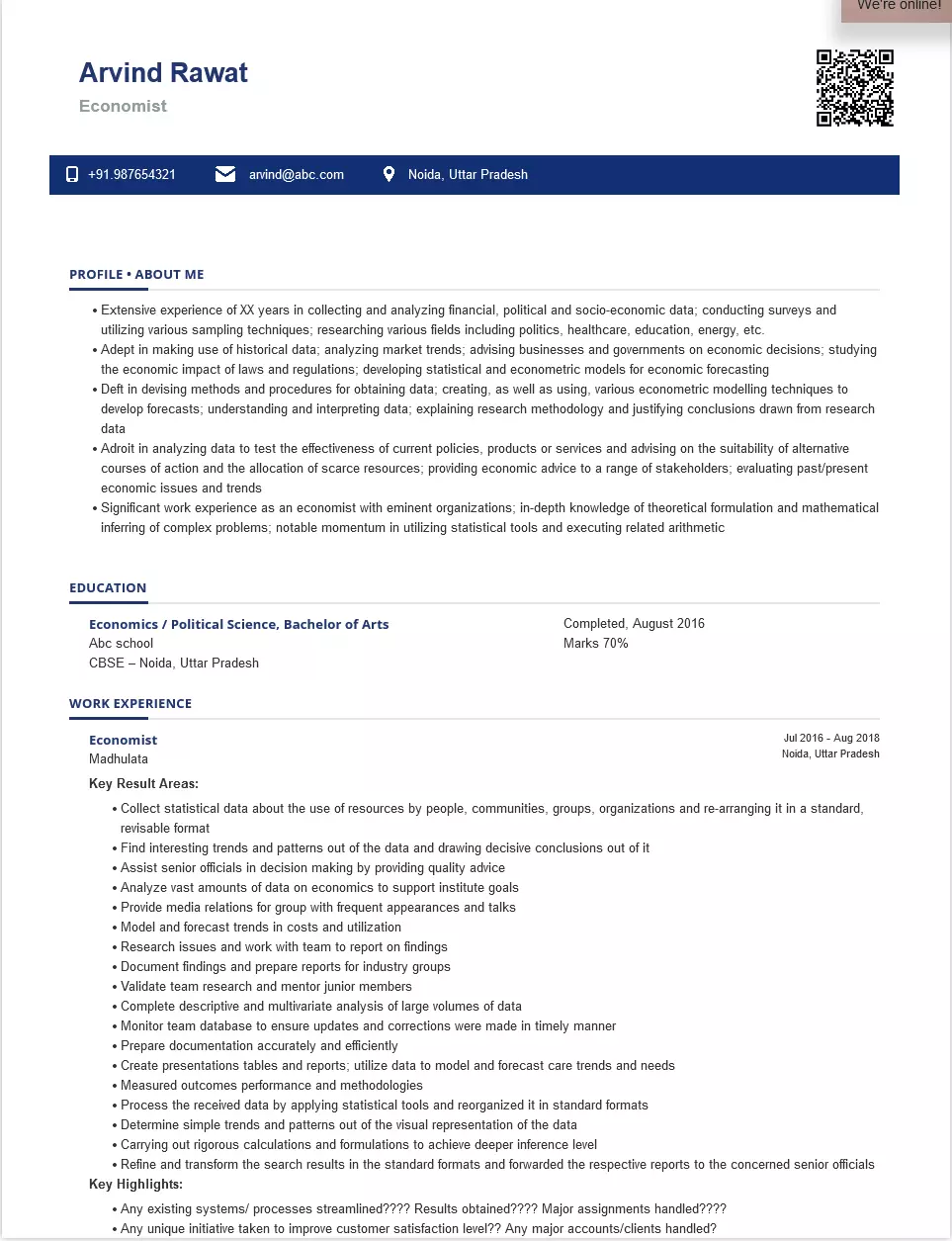
Economist Resume Guide: Research, Data & Analysis Skills
Introduction
Economists play a crucial role in shaping India’s economic policies, business strategies, and financial decisions. From analysing macroeconomic trends at the Reserve Bank of India to providing market insights at leading financial institutions like HDFC and ICICI, economists combine analytical rigour with deep understanding of economic principles to drive informed decision-making. The profession offers intellectually stimulating work at the intersection of research, policy, and business strategy.
India’s growing economy creates strong demand for economists across government institutions, central banks, think tanks, consulting firms, and corporate organisations. Major cities like Mumbai, Delhi, Bangalore, and Hyderabad are home to research institutions, financial services companies, and consulting firms seeking skilled economists. Whether you’re working on fiscal policy analysis, market research, or economic forecasting, economists contribute to critical decisions affecting millions of people.
This comprehensive guide will help you create an economist resume that effectively showcases your analytical expertise, research capabilities, and economic modelling skills. From highlighting your econometric proficiency to demonstrating your policy impact, we’ll cover everything you need to secure your dream economist role in 2025.
Section 1: Understanding the Economist Role in India
Overview of Duties and Responsibilities
Economists in India work across diverse settings including government, academia, financial services, and consulting. Their responsibilities include:
Economic Research: Conducting rigorous research on macroeconomic trends, industry dynamics, and policy implications using quantitative methods.
Data Analysis: Collecting, processing, and analysing economic data to identify patterns, trends, and causal relationships.
Forecasting: Developing econometric models to forecast GDP growth, inflation, employment, and other key economic indicators.
Policy Analysis: Evaluating the impact of government policies, regulations, and economic reforms on various sectors.
Report Writing: Preparing detailed research reports, policy briefs, and economic commentaries for stakeholders.
Presentations: Communicating complex economic concepts and findings to diverse audiences including policymakers and business leaders.
Advisory Services: Providing strategic recommendations based on economic analysis to guide decision-making.
Key Skills and Competencies Employers Look For
Employers in India’s economic research and policy sector value specific capabilities:
Quantitative Skills: Proficiency in econometrics, statistical analysis, and mathematical modelling.
Software Expertise: Command of statistical software including STATA, R, Python, EViews, and MATLAB.
Research Ability: Strong capability in literature review, hypothesis testing, and empirical analysis.
Writing Skills: Ability to communicate complex economic concepts clearly in reports and publications.
Data Handling: Experience with large datasets, data cleaning, and database management.
Economic Theory: Solid foundation in micro and macroeconomic theory and their applications.
Critical Thinking: Ability to evaluate evidence, identify assumptions, and draw sound conclusions.
Diversity of Roles Within Economics
The economics field in India offers various specialisation paths:
Research Economist: Conducts academic or policy-oriented research at think tanks and research institutions.
Financial Economist: Works in banks and financial services analysing markets and economic conditions.
Development Economist: Focuses on poverty, inequality, and development policy at NGOs and multilateral organisations.
Corporate Economist: Provides economic insights and forecasts for business strategy at corporations.
Government Economist: Works in ministries, RBI, or planning commissions on policy formulation.
Consulting Economist: Advises clients on economic issues at management consulting firms.
Section 2: Preparing Your Resume - Essential Components
Contact Information
Your contact section should be professional and easily accessible:
- Full Name: Clearly displayed at the top of your resume
- Phone Number: Include your mobile number with country code (+91)
- Email Address: Use a professional email (e.g., arjun.sharma@email.com)
- Location: City and state (e.g., New Delhi)
- LinkedIn Profile: Essential for professional networking
- Google Scholar/ResearchGate: If you have academic publications
Professional Summary
Your summary should capture your analytical expertise and research focus:
Example for Experienced Professional:
“Senior Economist with 10+ years of experience in macroeconomic research and policy analysis. Led economic research team at ICRIER Delhi analysing trade policy and industrial growth. Expert in econometric modelling, time series analysis, and CGE models. Published 15+ papers in peer-reviewed journals including Economic and Political Weekly. Seeking chief economist position at a leading research institution.”
Example for Mid-Level Professional:
“Economist with 5 years of experience in financial sector research and economic forecasting. Developed quarterly GDP forecasts at CRISIL with 95% accuracy. Proficient in STATA, R, and Python for econometric analysis. Strong background in monetary policy analysis and banking sector research. Looking for senior economist role at a financial institution.”
Example for Fresher:
“MA Economics graduate from Delhi School of Economics with distinction. Completed dissertation on inflation targeting in emerging markets using panel data analysis. Proficient in STATA and R. Interned at NIPFP working on fiscal policy research. Seeking research economist position at a policy research institution.”
Work Experience
Present your experience in reverse chronological order with quantified achievements:
Senior Economist | ICICI Bank | Mumbai | 2021-Present
- Lead economic research team producing monthly economic outlook reports for senior management
- Developed proprietary GDP nowcasting model improving forecast accuracy by 20%
- Published quarterly sectoral analysis reports cited by business media outlets
- Presented economic briefings to board of directors and institutional investors
Economist | Reserve Bank of India | Mumbai | 2018-2021
- Contributed to monetary policy analysis supporting Monetary Policy Committee decisions
- Developed inflation forecasting models using ARIMA and VAR methodologies
- Authored research papers on financial stability published in RBI Bulletin
- Collaborated with international central banks on comparative monetary policy research
Skills Section
Technical Skills:
- Econometrics: Time Series, Panel Data, IV Regression, Difference-in-Differences
- Software: STATA, R, Python, EViews, MATLAB, E-views
- Data Analysis: SQL, Excel Advanced, Tableau, Power BI
- Modelling: CGE Models, DSGE Models, Input-Output Analysis
- Research: Literature Review, Survey Design, Data Collection
- Writing: Policy Briefs, Research Papers, Economic Commentary
Soft Skills:
- Analytical Thinking
- Research Design
- Communication
- Presentation Skills
- Team Collaboration
- Critical Evaluation
Section 3: Resume Formats for Economists
Chronological Resume
Best suited for economists with steady career progression in research or policy roles. Lists work experience from most recent to oldest.
When to use: If you have 3+ years of continuous experience in economic research with clear career growth.
Functional Resume
Focuses on research skills and analytical competencies rather than chronological work history. Useful for career changers.
When to use: If you’re transitioning from academia to industry or from a related field like statistics or finance.
Combination Resume
Blends skills and work history, useful for those with varied experience across sectors.
When to use: If you have experience in both government and private sector, or in multiple specialisation areas.
Section 4: Professional Summary Examples
For Central Bank Economist:
“Monetary Economist with 8 years of experience at Reserve Bank of India. Led inflation forecasting division developing models used in monetary policy decisions. Expert in DSGE modelling, time series econometrics, and policy simulation. Published research in RBI Occasional Papers and international journals. Seeking senior economist role in central banking or monetary policy.”
For Development Economist:
“Development Economist with 7 years of experience at World Bank and UNDP India. Led impact evaluations of rural development programmes using RCT and quasi-experimental methods. Expert in poverty measurement, programme evaluation, and household surveys. Seeking senior researcher position in development organisation.”
For Financial Sector Economist:
“Financial Economist with 6 years of experience in banking and capital markets research. Developed credit risk models at CRISIL and sector analysis frameworks at Kotak Institutional Equities. Expert in financial stability analysis, credit cycles, and macro-financial linkages. Looking for chief economist role at financial services firm.”
For Corporate Economist:
“Corporate Economist with 5 years of experience providing economic intelligence to business strategy. Led economic analysis function at Reliance Industries supporting investment decisions worth ₹10,000 crore. Expert in sector analysis, regulatory impact assessment, and market forecasting. Seeking head of economics role at a major corporation.”
For Fresher:
“M.Phil Economics from JNU with specialisation in international economics. Thesis on trade liberalisation and manufacturing growth using firm-level panel data. Proficient in STATA and R. Research assistant experience at ICRIER. Strong foundation in econometrics and applied microeconomics. Eager to begin research career at a leading institution.”
Section 5: Showcasing Research Achievements
How to Present Accomplishments
Transform job descriptions into compelling achievements:
Instead of: “Conducted economic research”
Write: “Led macroeconomic research programme at NCAER analysing impact of GST on manufacturing sector, producing 12 policy briefs cited by Finance Ministry and influencing tax reform decisions”
Instead of: “Developed forecasting models”
Write: “Developed proprietary GDP nowcasting model at HDFC Bank achieving 95% forecast accuracy, recognised as most accurate among private sector forecasts by Bloomberg survey”
Sample Achievement Entries
Monetary Policy Research | Reserve Bank of India
- Developed DSGE model for Indian economy used in monetary policy simulations
- Contributed to quarterly inflation forecast achieving lowest forecast error among peer models
- Authored 5 research papers published in RBI Bulletin on inflation dynamics
- Presented research at international conferences including NBER and IMF
- Impact: Research contributed to inflation targeting framework adoption
Trade Policy Analysis | ICRIER
- Led research on India-ASEAN trade analysing ₹5 lakh crore bilateral trade flows
- Developed CGE model estimating impact of RCEP on Indian manufacturing
- Published findings in peer-reviewed journals and policy briefs for Commerce Ministry
- Presented analysis to Parliamentary Standing Committee on Commerce
- Impact: Research cited in official government position on trade negotiations
Banking Sector Research | CRISIL
- Developed credit cycle indicators tracking ₹100 lakh crore banking sector credit
- Created proprietary NPA prediction model with 85% accuracy for corporate loans
- Published quarterly banking sector outlook reports for institutional clients
- Advised banks on credit policy based on macroeconomic analysis
- Impact: Model adopted by 3 major banks for credit risk assessment
Entry-Level Project Ideas
For freshers and recent graduates, showcase academic and internship work:
- Dissertation Research - Detailed summary of thesis with methodology and findings
- Internship Projects - Research work completed at think tanks or institutions
- Academic Publications - Working papers, conference presentations, or co-authored papers
- Data Projects - Independent data analysis demonstrating analytical skills
- Policy Briefs - Policy-relevant analysis prepared during coursework
- Research Assistance - Significant contributions to faculty research projects
Section 6: Skills to Include in Your Economist Resume
Technical Skills
- Econometrics: OLS, IV, Panel Data, Time Series, DiD, RDD, Propensity Score Matching
- Statistical Software: STATA, R, Python (pandas, numpy, statsmodels), EViews, MATLAB, SAS
- Data Visualisation: Tableau, Power BI, ggplot2, matplotlib, Excel charts
- Modelling: CGE models, DSGE models, Input-Output analysis, Simulation models
- Database: SQL, MySQL, data extraction from economic databases
- Survey Methods: Survey design, sampling, questionnaire development
- GIS Tools: QGIS, ArcGIS for spatial economic analysis
- Writing Tools: LaTeX, BibTeX, reference management software
- Data Sources: CMIE, NSS, ASI, PLFS, World Bank databases, IMF IFS
- Presentation: PowerPoint, presenting complex data effectively
Soft Skills
- Analytical Thinking: Systematic approach to complex economic problems
- Research Design: Developing robust methodologies for empirical analysis
- Communication: Explaining technical concepts to non-technical audiences
- Writing: Clear, concise writing for academic and policy audiences
- Critical Evaluation: Assessing evidence quality and identifying limitations
- Collaboration: Working effectively in research teams
- Time Management: Managing multiple research projects simultaneously
- Attention to Detail: Accuracy in data handling and analysis
Section 7: Certifications and Professional Development
Essential Qualifications for Economists
MA/M.Sc. in Economics
- Issued by: Universities and institutions
- Value: Standard qualification for economist positions
M.Phil/Ph.D. in Economics
- Issued by: Universities (JNU, DSE, IGIDR, ISI)
- Value: Required for senior research and academic positions
CFA (Chartered Financial Analyst)
- Issued by: CFA Institute
- Value: Valuable for financial sector economist roles
FRM (Financial Risk Manager)
- Issued by: GARP
- Value: Useful for risk-focused economic analysis
Indian Institution Qualifications
- MA Economics - Delhi School of Economics, JNU, Presidency College
- M.Phil/Ph.D. - IGIDR, ISI Kolkata, ISI Delhi, TERI University
- Post Graduate Programme - IIFT, ISI Business Analytics
- Executive Programme in Applied Economics - NIPFP
- Certificate in Econometrics - ISI
Professional Development
- Advanced Econometrics workshops (ISI, IGIDR)
- Machine Learning for Economics (online courses)
- Policy research methodology workshops (NCAER, CPR)
- Statistical software training (STATA, R)
- Writing for policy audiences workshops
Section 8: Tips by Experience Level
Entry-Level (0-3 Years)
- Highlight Education: Emphasise MA/M.Phil degree and dissertation topic
- Technical Skills: Showcase software proficiency and econometric methods
- Research Experience: Detail internships, RA positions, and academic projects
- Publications: Include working papers, conference presentations
- Coursework: Highlight relevant advanced courses
- Recommendations: Strong faculty recommendations important
Mid-Level (4-8 Years)
- Research Output: Quantify publications, policy briefs, and research impact
- Specialisation: Demonstrate expertise in specific areas (monetary, trade, development)
- Team Leadership: Experience leading research teams or projects
- Policy Impact: How research influenced decisions or policy
- External Recognition: Media citations, invited talks, expert consultations
- Professional Network: Affiliations with research networks and institutions
Senior-Level (10+ Years)
- Thought Leadership: Recognised expertise in specific domains
- Institution Building: Experience establishing research programmes or units
- Strategic Impact: Major policy contributions and advisory roles
- Publication Record: Books, influential papers, editorial roles
- Mentoring: Supervising junior economists and PhD students
- Public Engagement: Media presence, public policy debates
Section 9: ATS Optimisation Tips
Understanding ATS in Research Institutions
Major organisations and financial institutions use Applicant Tracking Systems. Academic job portals also use keyword matching.
Keyword Optimisation
Include relevant keywords from the job description:
- Job titles: Economist, Research Economist, Senior Economist, Economic Analyst
- Skills: Econometrics, Economic Modelling, Policy Analysis, Forecasting
- Software: STATA, R, Python, EViews, MATLAB
- Methods: Time Series, Panel Data, CGE, DSGE, Impact Evaluation
Formatting Best Practices
- Use standard fonts (Arial, Calibri, Times New Roman)
- Avoid tables, graphics, and complex formatting
- Use standard section headings (Experience, Education, Skills, Publications)
- Save as PDF or .docx as specified
- Keep file size under 2MB
- Include both acronyms and full forms (CGE - Computable General Equilibrium)
Common Mistakes to Avoid
- Spelling errors in technical terms or methodology names
- Missing publication details or incomplete references
- Not specifying econometric methods used
- Generic research descriptions without specific contributions
- Inconsistent date formats
- Not highlighting policy or business impact
Conclusion
Creating a compelling economist resume requires showcasing your analytical expertise, research output, and ability to translate complex economic analysis into actionable insights. By following this guide, you can craft a resume that effectively communicates your methodological skills, publication record, and policy impact to employers in India’s diverse economic research landscape.
The economics field in India offers rewarding opportunities across central banks, think tanks, financial institutions, and consulting firms. Whether you’re a fresher starting your research career, a mid-level economist seeking advancement, or a senior professional targeting leadership roles, a well-crafted resume is essential for making a positive impression on employers.
Remember to quantify your achievements with specific metrics (publications, policy citations, forecast accuracy), highlight your software and methodological expertise, and demonstrate the real-world impact of your research. Include links to your Google Scholar profile or published papers to showcase your academic contributions.
Ready to create your professional economist resume? Use our resume builder to get started with professionally designed templates, or explore more resume samples for inspiration. For personalised guidance, our expert resume writers are here to help you craft a document that opens doors to your dream economist role.
Frequently Asked Questions
What should an economist's resume include?
An economist's resume should include your contact information, a concise professional summary, key economic skills and tools, detailed work experience showing results and impact, education, and relevant certifications. It's also valuable to list publications, policy work, and quantifiable achievements where possible.
How do I write a strong professional summary for an economist's resume?
Your summary should be 2–3 lines that highlight your experience in economic analysis, forecasting, or research, along with your strongest skills (like econometrics or data modeling) and what you can bring to the role. Using language from the job description helps both recruiters and applicant tracking systems see your fit.
What skills are most important to list on an economist's resume?
Key skills include economic analysis, forecasting, statistical modeling, econometrics, data interpretation, policy analysis, and proficiency with software like Stata, R, or Python. Soft skills like communication, problem-solving, and report writing strengthen your resume too.
How long should an economist resume be?
Most economist resumes are 1–2 pages. Keep it concise while making sure you highlight your most relevant experience, tools you've mastered, and quantifiable results or research impact.
Should I include publications or research on my resume?
Yes — listing published research, policy briefs, reports, or significant academic or field studies shows your credibility and expertise. Include titles, publication venues, and dates to make this section informative.
What resume format works best for economist roles?
A reverse-chronological format generally works best because it highlights your most recent, relevant experience first. Use clear section headings like Skills, Experience, and Education, and avoid overly complex formatting so Applicant Tracking Systems can read your resume easily.
How can I make my economist resume ATS-friendly?
Use relevant keywords — such as macroeconomics, policy analysis, econometrics, forecasting, and data modeling — directly from job descriptions. Keep the layout simple, avoid graphics or tables, and use standard section titles so the resume parses well in applicant tracking systems.
What certifications or training should I include on my resume?
List certifications like advanced econometrics training, International trade or policy certificates, CFA (if relevant), or specialized courses from recognized institutions. These help show professional development and commitment to your field.
How do I describe my work experience on an economist's resume?
Use concise bullet points that show what you did and the impact, such as "Conducted econometric modeling using Stata to forecast GDP trends, improving forecast accuracy by 15%." Quantifying your contributions helps recruiters understand your real value.
What keywords should I use to improve my economist resume?
Useful keywords include economic analysis, forecasting, econometrics, policy evaluation, data analysis, GDP trends, inflation, research reporting, and economic modeling — particularly if they match terms in the job posting.
How should fresh graduates write their economist resume?
If you're early in your career, emphasize relevant coursework, internships, research projects, training, and software tools you've used. Highlight your analytical and quantitative skills, and tailor your resume for the roles you're applying to.
How do I tailor my economist resume for different industries (e.g., policy, finance, consulting)?
Match your resume to the job focus: for policy roles, emphasize policy analysis and impact studies; for finance roles, highlight economic forecasting and risk analysis; for consulting, underline quantitative modeling and client communication skills. Using job-specific keywords boosts relevance.
 India's
premier resume service
India's
premier resume service