India's
premier resume service
India's
premier resume service


- Assisted in establishing and maintaining community gardens.
- Educated community members on sustainable gardening practices and soil health.
- Home

- Resume Samples
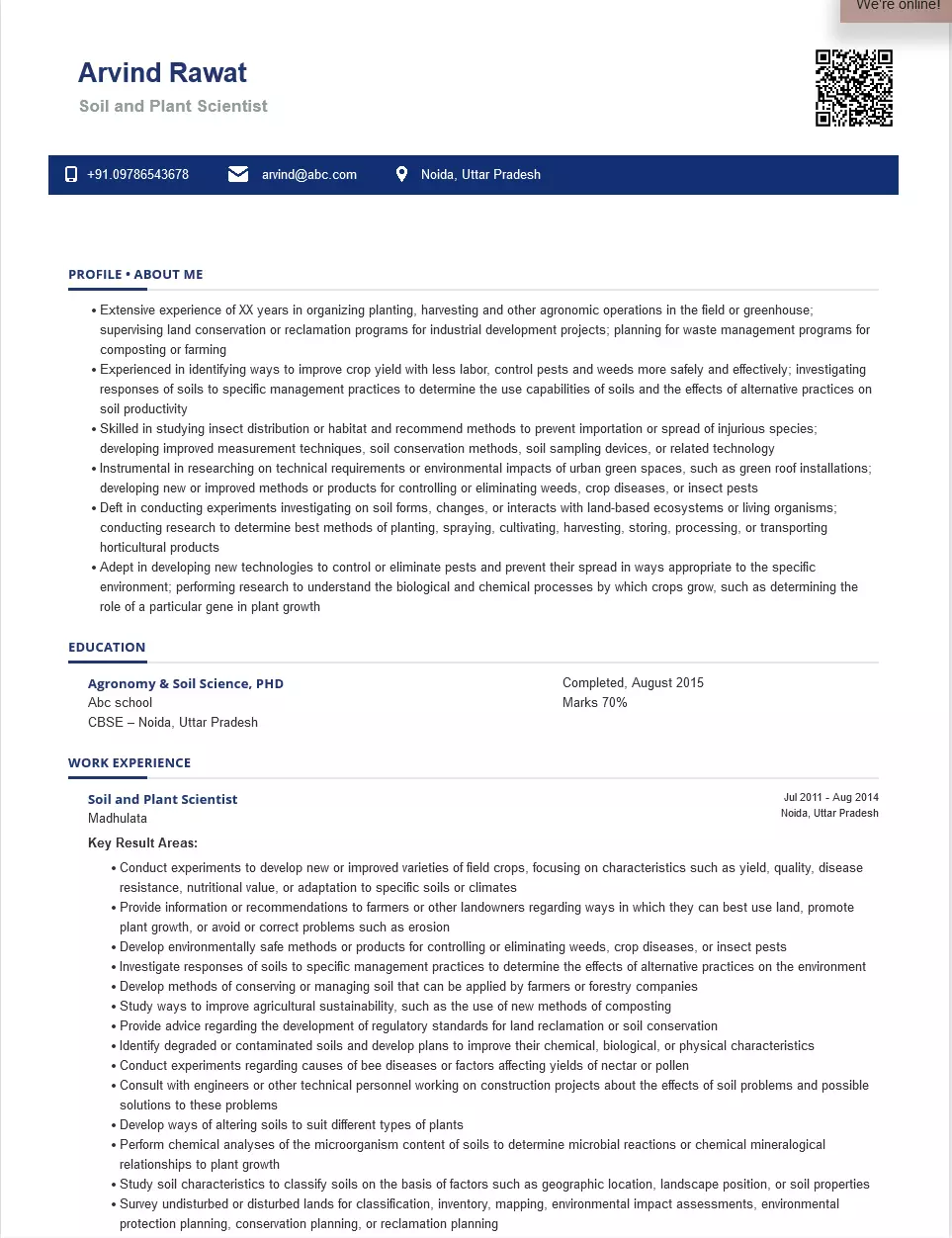
- Soil and Plant Scientists Resume Sample
What's your job?
Soil and Plant Scientists Resume Samples and Templates for 2026
- Table of Contents
- Downloadable Sample
- Resume Tips from Experts
- Resume Text Version
- Share


Soil and Plant Scientist Resume Guide for India
A well-crafted soil and plant scientist resume is essential for success in India’s agricultural research and development sector. Whether you’re pursuing a career with ICAR, state agricultural universities, IARI, ICRISAT, or private agribusiness companies like Bayer, Syngenta, UPL, this guide provides everything you need to create a standout resume.
This comprehensive guide includes:
- Resume format recommendations for agricultural research roles in India
- Key skills employers look for in soil and plant scientists
- Complete resume example with Indian context
- Top agricultural research employers in India
- Salary insights in INR by experience level
- Required qualifications and research focus areas
- ATS optimization tips for research job portals
Why Your Soil and Plant Scientist Resume Matters in India
India’s agricultural sector employs millions of researchers and scientists working on soil health, crop improvement, and sustainable farming. With government initiatives like Soil Health Card Scheme and focus on food security, skilled agricultural scientists are in high demand.
A strong soil and plant scientist resume helps you:
- Stand out from competition for research scientist positions
- Showcase expertise in soil science, plant physiology, and crop research
- Demonstrate research publications and project contributions
- Highlight specialized skills in analytical techniques and field research
Research institutions receive numerous applications. Your resume must immediately communicate your research expertise, academic credentials, and practical experience.
Soil and Plant Scientist Resume Format for India
Indian research institutions prefer detailed academic resume formats that highlight research experience and publications.
Recommended Format
- Length: 2-3 pages (academic CV style)
- Layout: Reverse chronological
- Font: Times New Roman or Arial (11-12pt)
- Sections: Contact, Summary, Education, Research Experience, Publications, Skills, Awards
Personal Details for Indian Agricultural Science Resumes
Include:
- Full name
- Phone number with +91 country code
- Professional email address
- City, State
- ORCID ID (for researchers)
- Google Scholar profile (if applicable)
What to Avoid
- Personal details like religion or marital status
- Irrelevant coursework
- Generic descriptions of common techniques
- Salary expectations in resume
Key Skills for Soil and Plant Scientists in India
Indian employers look for a combination of research expertise, analytical skills, and practical knowledge.
Soil Science Skills
- Soil Analysis: Physical, chemical, and biological properties
- Soil Fertility: Nutrient management and fertilizer recommendations
- Soil Classification: Taxonomy and mapping
- Soil Health Assessment: Soil health cards, quality indicators
- Soil Conservation: Erosion control, watershed management
- Soil Microbiology: Microbial communities, biofertilizers
Plant Science Skills
- Plant Physiology: Growth, development, stress responses
- Plant Breeding: Hybridization, selection, variety development
- Crop Production: Agronomy, cropping systems
- Plant Pathology: Disease identification and management
- Plant Biotechnology: Tissue culture, molecular markers
- Genetics: Inheritance, genomics, QTL mapping
Analytical Techniques
- Spectrophotometry (UV-Vis, AAS, ICP)
- Chromatography (HPLC, GC)
- Molecular techniques (PCR, DNA extraction)
- Soil texture analysis
- Nutrient estimation methods
- Statistical analysis (ANOVA, regression)
Software & Tools
- Statistical: SAS, SPSS, R, GenStat
- GIS: ArcGIS, QGIS, Remote sensing
- Data Analysis: MS Excel, Origin, GraphPad
- Documentation: MS Office, LaTeX
- Image Analysis: ImageJ, IDRISI
Soft Skills
- Research Design: Experiment planning and execution
- Scientific Writing: Publications and report writing
- Communication: Presenting research findings
- Field Work: Extensive fieldwork capability
- Teamwork: Collaborative research projects
Soil and Plant Scientist Resume Example for India
Here’s a complete resume example tailored for Indian research institutions:
Dr. Priya Sharma
New Delhi, Delhi | +91-98XXX-XXXXX | priya.sharma.agri@email.com | ORCID: 0000-0002-XXXX-XXXX | Google Scholar: [Profile Link]
Professional Summary
Agricultural Scientist with Ph.D. in Soil Science and 8+ years of research experience in soil fertility management and sustainable agriculture. Expertise in soil health assessment, nutrient cycling, and precision agriculture. Published 15+ research papers in peer-reviewed journals with 200+ citations. Currently working as Scientist at ICAR-IARI, leading research on soil carbon sequestration and climate-smart agriculture. Recipient of ICAR Young Scientist Award 2022.
Education
Ph.D. (Soil Science) | ICAR-Indian Agricultural Research Institute, New Delhi | 2019
- Thesis: “Soil Carbon Dynamics Under Different Land Use Systems in Indo-Gangetic Plains”
- Advisor: Dr. [Name]
- CGPA: 8.5/10
M.Sc. (Soil Science) | Punjab Agricultural University, Ludhiana | 2015
- Thesis: “Effect of Long-Term Fertilization on Soil Microbial Properties”
- Gold Medalist
- CGPA: 8.8/10
B.Sc. (Agriculture) | G.B. Pant University of Agriculture and Technology, Pantnagar | 2013
- First Class with Distinction
- CGPA: 8.2/10
Professional Experience
Scientist | ICAR-Indian Agricultural Research Institute | New Delhi | July 2019 – Present
- Lead research projects on soil carbon sequestration and climate change mitigation
- Manage research grants worth ₹1.5 Cr from DST and ICAR
- Supervise 4 Ph.D. and 6 M.Sc. students
- Conduct field experiments across 5 states on conservation agriculture
- Develop soil health recommendations for farmer advisory services
- Collaborate with international research institutes (CIMMYT, ICRISAT)
- Published 12 research papers in SCI journals during tenure
- Organized 5 farmer training programs on soil health management
Senior Research Fellow | ICAR-IARI | New Delhi | July 2015 – June 2019
- Conducted Ph.D. research on soil carbon dynamics
- Performed extensive soil sampling and laboratory analysis
- Used advanced techniques including stable isotope analysis
- Presented research at 8 national and international conferences
- Assisted in undergraduate and postgraduate teaching
Research Intern | International Crops Research Institute (ICRISAT) | Hyderabad | May 2014 – July 2014
- Worked on soil fertility mapping in semi-arid tropics
- Learned GIS-based soil analysis techniques
- Contributed to watershed development project
Research Projects
Principal Investigator:
- “Soil Carbon Sequestration Potential of Conservation Agriculture” - DST-SERB funded (₹45 Lakhs) - 2021-2024
- “Bio-fortification of Wheat through Soil-Plant Nutrient Management” - ICAR Network Project - 2020-2023
Co-Investigator:
- “Climate-Smart Agriculture for Food Security” - World Bank funded
- “Digital Soil Mapping of India” - ICAR consortium project
Publications
Peer-Reviewed Journal Articles (Selected - Total: 15):
- Sharma, P., et al. (2023). “Carbon sequestration under conservation tillage in Indo-Gangetic Plains.” Soil & Tillage Research. IF: 6.5
- Sharma, P., et al. (2022). “Long-term fertilization effects on soil organic carbon pools.” Agriculture, Ecosystems & Environment. IF: 6.0
- Sharma, P., et al. (2021). “Soil health indicators for sustainable intensification.” Field Crops Research. IF: 5.8
Book Chapters: 3 Conference Papers: 12 Technical Bulletins: 5
Awards & Honors
- ICAR Young Scientist Award | Indian Council of Agricultural Research | 2022
- Best Ph.D. Thesis Award | Indian Society of Soil Science | 2020
- INSPIRE Fellowship | Department of Science & Technology | 2015-2019
- Gold Medal | Punjab Agricultural University | 2015
- ICAR-JRF (All India Rank 12) | 2015
Key Skills
Soil Fertility Management | Carbon Sequestration | Conservation Agriculture | Soil Health Assessment | Nutrient Cycling | Stable Isotope Analysis | GIS & Remote Sensing | Statistical Analysis (SAS, R) | Scientific Writing | Research Project Management | Farmer Training | Team Leadership
Professional Memberships
- Indian Society of Soil Science (Life Member)
- Indian Society of Agronomy (Life Member)
- International Union of Soil Sciences
Languages
Hindi (Native) | English (Fluent) | Punjabi (Conversational)
Top Soil and Plant Scientist Employers in India
India’s agricultural research sector offers diverse opportunities across government, private, and international organizations.
Government Research Institutions
- ICAR (Indian Council of Agricultural Research): Umbrella organization for 100+ institutes
- ICAR-IARI (Indian Agricultural Research Institute): Premier research institute
- ICAR-IISS (Indian Institute of Soil Science): Soil research focus
- State Agricultural Universities (SAUs): 70+ universities nationwide
- ICAR-NBSS&LUP: Soil survey and land use planning
- ICAR-CRIDA: Dryland agriculture research
- ICAR-CSSRI: Salinity research
International Research Centers
- ICRISAT: Crops for semi-arid tropics
- CIMMYT-India: Wheat and maize research
- IRRI-India: Rice research
- ICARDA: Dryland systems
- IWMI: Water management
Private Sector
- Bayer Crop Science: Crop protection and seeds
- Syngenta India: Agricultural inputs
- UPL Limited: Agrochemicals
- Rallis India: Crop care
- PI Industries: Agri-inputs
- Coromandel International: Fertilizers
- IFFCO: Fertilizer cooperative
Environmental Consultancies
- ERM India: Environmental consulting
- GHD: Infrastructure and environment
- Tata Consulting Engineers: Environmental services
- IL&FS Environment: Environmental solutions
How to Apply
- ICAR-ASRB recruitment portal for scientist positions
- University recruitment notifications
- International center career portals
- Private company career pages
- ResearchGate and academic networks
Soil and Plant Scientist Salary in India
Salaries vary based on organization type, experience, and qualifications.
Salary by Position (Government/ICAR)
| Position | Annual Salary (INR) |
|---|---|
| Scientist (Entry) | ₹57,700 - ₹1,82,400 (Level 10) |
| Senior Scientist | ₹67,700 - ₹2,08,700 (Level 11) |
| Principal Scientist | ₹78,800 - ₹2,09,200 (Level 12) |
| Head/Division Head | ₹1,18,500 - ₹2,14,100 (Level 13) |
| Director | ₹1,44,200 - ₹2,18,200 (Level 14) |
Note: 7th Pay Commission scale with DA and other allowances.
Salary by Sector
| Sector | Salary Range (Mid-Level) |
|---|---|
| ICAR Research Institutes | ₹10 - ₹18 LPA |
| State Agricultural Universities | ₹8 - ₹15 LPA |
| International Research Centers | ₹15 - ₹30 LPA |
| Private Sector (R&D) | ₹8 - ₹25 LPA |
| Environmental Consultancies | ₹6 - ₹15 LPA |
Additional Benefits (Government)
- Housing Allowance (HRA): 24-30% of basic
- Dearness Allowance (DA): As per revision
- Research Contingency: For research expenses
- Leave Travel Concession (LTC): Travel benefits
- Medical Benefits: CGHS coverage
- Pension: National Pension System
Qualifications for Soil and Plant Scientist Jobs in India
Educational Requirements
Scientist Position (ICAR/SAUs):
- Ph.D. in Soil Science, Agronomy, Plant Sciences, or related discipline
- NET/ASRB qualification (for ICAR positions)
- B.Sc. (Ag) + M.Sc. + Ph.D. pathway preferred
Research Associate/SRF:
- M.Sc. in relevant agricultural discipline
- NET/GATE qualification preferred
Technical Officer:
- B.Sc. (Agriculture) with relevant experience
- M.Sc. preferred for higher grades
Key Examinations
- ICAR-NET: For JRF and Lecturership
- ASRB-NET: For ICAR scientist positions
- GATE (Agricultural Engineering): For M.Tech admissions
- State PSC exams: For state agricultural officer positions
Research Focus Areas in Demand
- Soil carbon and climate change
- Precision agriculture and digital farming
- Soil health and microbiome
- Sustainable intensification
- Water-use efficiency
- Organic farming
- Biofortification
ATS Tips for Your Agricultural Science Resume
Research institutions increasingly use online portals with keyword filtering:
Keyword Optimization
Include relevant terms like:
- Soil Science, Plant Science, Agronomy
- Soil fertility, nutrient management
- Conservation agriculture, sustainable farming
- Research publications, peer-reviewed
- Statistical analysis, experimental design
- GIS, remote sensing, precision agriculture
- ICAR, NET, Ph.D.
Formatting Tips
- Use standard academic CV format
- List publications in proper citation format
- Include ORCID and Google Scholar links
- Quantify research impact (citations, h-index)
- Highlight funded projects with values
- Keep formatting clean and consistent
Final Tips for Your Soil and Plant Scientist Resume
✅ Lead with qualifications - Ph.D., NET, awards prominently displayed
✅ Highlight publications - Impact factor, citations, h-index
✅ Show funded research - Grant amounts and funding agencies
✅ Include field experience - Extensive fieldwork capability
✅ List technical skills - Specific analytical techniques and software
✅ Mention collaborations - International and national partnerships
✅ Update publication list - Keep current with new publications
Quick Checklist
- Education with thesis titles and advisors
- Contact information with ORCID ID
- Summary highlights research expertise and impact
- Publications listed in proper citation format
- Research projects with funding details
- Skills include specific techniques and software
- Awards and recognitions listed
- Professional memberships mentioned
Ready to create your professional soil and plant scientist resume? Use our resume builder to get started with expert-designed templates.
Looking for more guidance? Check out our resume format guide for additional tips.
Frequently Asked Questions
What is the best resume format for Soil and Plant Scientists in India?
Use an academic CV format (2-3 pages) with sections for education, research experience, publications, projects, skills, and awards. Include thesis titles, advisor names, and research funding details. List publications in proper citation format.
Is Ph.D. mandatory for scientist positions in ICAR?
Yes, Ph.D. in relevant discipline is mandatory for Scientist positions in ICAR and most research institutes. Additionally, you need NET/ASRB qualification. For technical positions, M.Sc. may be sufficient.
What skills should I highlight on an agricultural science resume?
Highlight research skills (experimental design, data analysis), analytical techniques (spectrophotometry, chromatography), software (SAS, R, GIS), fieldwork experience, and scientific writing. Include specific crops or soil types you've worked with.
How much do Soil and Plant Scientists earn in India?
ICAR Scientists earn ₹10-18 LPA at entry level (7th Pay Commission). International research centers pay ₹15-30 LPA. Private sector R&D pays ₹8-25 LPA. Salary increases significantly with experience and position.
Should I include publications on my resume?
Absolutely. Publications are crucial for research positions. List them in proper citation format with impact factors. Include peer-reviewed papers, book chapters, and conference papers. Mention your h-index and total citations if significant.
How important is ICAR-NET for agricultural science careers?
ICAR-NET is essential for JRF (Junior Research Fellowship) and for eligibility to ICAR scientist positions. It's conducted by ASRB (Agricultural Scientists Recruitment Board). Qualifying NET significantly improves job prospects.
What research areas are in high demand?
Currently high-demand areas include: climate-smart agriculture, soil carbon sequestration, precision farming, digital agriculture, soil microbiome, organic farming, water management, and biofortification. Align your research focus with national priorities.
Should I include funded research projects?
Yes, definitely include research projects with funding source and amount. Mention your role (PI, Co-PI). Funded projects demonstrate your ability to secure competitive grants and manage research programs.
How do I transition from academia to private sector?
Highlight practical applications of your research, industry-relevant skills (product development, field trials), and any industry collaboration experience. Private companies value Ph.D.s with practical orientation and problem-solving abilities.
What international opportunities are available?
CGIAR centers (ICRISAT, CIMMYT, IRRI) offer excellent opportunities. International postdocs, visiting scientist positions, and collaborative research programs are available. Strong publication record and international exposure enhance competitiveness.
Soil and Plant Scientists Text-Only Resume Templates and Samples
Abhi sandilya
Phone: 9871275111
Email: writer@shriresume.com
Address: Arwal
About Me
Soil and Plant Scientist
Dedicated and knowledgeable Soil and Plant Scientist with expertise in soil chemistry, plant physiology, and sustainable agriculture. Proficient in using advanced laboratory techniques and software to conduct research and analyze data. Seeking a position where I can apply my skills to contribute to agricultural research and environmental sustainability.
Extra Curricular Activities
Education
Soil Science, Master of Science, Completed, July 2024
IIT Madras
State University
Dimapur, NL
Certifications
- Certified Professional Soil Scientist (CPSS), Completed , July 2024
- Certified Crop Advisor (CCA), Completed , July 2024
Internships
Period: February 2024 - July 2024
Soil Science Research Intern
Bombay Research Centre
Aheri, MH
- Conducted soil sampling and analysis to study soil properties and fertility.
- Utilized laboratory techniques to measure soil pH, nutrient levels, and organic matter.
- Assisted in designing and implementing field experiments to test soil amendments and crop management practices.
- Prepared and presented research findings at academic conferences and lab meetings.
Skills
- Soil Sampling and Analysis
- Plant Physiology and Biochemistry
- Agricultural Research and Experimentation
- Data Collection and Statistical Analysis
- GIS and Remote Sensing
- Sustainable Agriculture Practices
- Scientific Writing and Presentation
- Problem Solving and Critical Thinking
- Effective Communication and Team Collaboration
Languages
Softwares
Operating System
Personal Interests
- Sustainable Agriculture and Food Systems
- Reading Scientific Journals and Books
- Gardening and Horticulture
- Environmental Conservation and Restoration
- Volunteering in Community Outreach Programs

Author
Kshama Sharma - Resume, CV and Cover Letter Writing Expert
Check Out Related Resume Samples
Epidemiologists Resume Example
Statisticians Resume Example
Molecular Biologists Resume Example
Atmospheric and Space Scientists Resume Example
Soil and Plant Scientists Resume Example
Physicists Resume Example
Mathematicians Resume Example
Chemists Resume Example
Geneticists Resume Example
Biologists Resume Example