India's
premier resume service
India's
premier resume service


- Organized seminars and workshops on epidemiological research and public health.
- Participated in journal clubs and research discussions.
- Home

- Resume Samples
- Epidemiologists Resume Sample
What's your job?
Epidemiologists Resume Samples and Templates for 2026
- Table of Contents
- Downloadable Sample
- Resume Tips from Experts
- Resume Text Version
- Share


Comprehensive Guide to Building a Career in Epidemiology in India
Epidemiologists are the detectives of public health, investigating disease patterns, tracking outbreaks, and developing strategies to protect communities. In a world increasingly focused on pandemic preparedness, infectious disease surveillance, and health data analytics, epidemiologists play a crucial role in safeguarding population health.
India’s public health sector has grown significantly following the COVID-19 pandemic, with increased investment in disease surveillance systems, health research institutions, and data-driven public health programmes. Whether you’re working with ICMR (Indian Council of Medical Research), state health departments, WHO India, or private healthcare organisations like Apollo or Fortis, your resume must demonstrate your expertise in epidemiological methods, data analysis, and public health impact.
This comprehensive guide provides detailed epidemiologist resume examples and templates, practical tips, and strategies to help you create a professional resume that captures attention and showcases your qualifications for India’s expanding public health sector.
Section 1: Understanding the Epidemiologist Role
What Does an Epidemiologist Do?
Epidemiologists investigate the causes and patterns of diseases and health conditions in populations. Their work spans multiple domains:
Core Responsibilities:
- Disease Surveillance: Monitoring and tracking disease incidence, prevalence, and trends
- Outbreak Investigation: Identifying sources of disease outbreaks and implementing control measures
- Data Collection and Analysis: Designing studies, collecting health data, and performing statistical analysis
- Research Design: Developing epidemiological studies (cohort, case-control, cross-sectional)
- Report Writing: Preparing technical reports, research papers, and policy briefs
- Public Health Recommendations: Advising government agencies and healthcare organisations on disease prevention
- Health Programme Evaluation: Assessing effectiveness of public health interventions
Types of Epidemiologist Roles in India
- Infectious Disease Epidemiologist: Focus on communicable diseases like TB, malaria, dengue, COVID-19
- Chronic Disease Epidemiologist: Study non-communicable diseases like diabetes, cardiovascular disease, cancer
- Environmental Epidemiologist: Investigate health effects of environmental exposures
- Nutritional Epidemiologist: Study relationship between diet and disease
- Field Epidemiologist: Work on outbreak response and emergency health situations
- Molecular Epidemiologist: Combine laboratory and epidemiological methods
- Pharmacoepidemiologist: Study drug safety and effectiveness in populations
Key Employers in India
- Government: ICMR, National Centre for Disease Control (NCDC), Ministry of Health and Family Welfare, State Health Departments
- International Organisations: WHO India, CDC India, UNICEF, Bill & Melinda Gates Foundation
- Research Institutions: AIIMS, PGIMER, NIMHANS, PHFI (Public Health Foundation of India)
- Private Healthcare: Apollo, Fortis, Max Healthcare, Narayana Health
- Academic: IITs, IISc, Schools of Public Health
- NGOs: PATH, IPHA, IPHS, Population Council
Section 2: Preparing to Write Your Epidemiologist Resume
Gathering Essential Information
Before writing your resume, compile:
- Educational qualifications: MPH, MD (Community Medicine), PhD in Epidemiology, relevant degrees
- Research experience: Studies conducted, methodologies used, publications
- Technical skills: Statistical software (STATA, SAS, R, SPSS), GIS, database management
- Field experience: Outbreak investigations, surveillance activities, programme evaluations
- Publications: Peer-reviewed papers, conference presentations, reports
- Certifications: FETP (Field Epidemiology Training Programme), biostatistics courses
- Grants and funding: Research grants secured or contributed to
Understanding What Employers Seek
Public health employers look for:
- Strong foundation in epidemiological methods and biostatistics
- Experience with disease surveillance and outbreak response
- Proficiency in data analysis software and health informatics
- Ability to communicate complex findings to diverse audiences
- Research experience with published work
- Familiarity with Indian public health systems and programmes
Indian Public Health Context
Highlight your understanding of:
- National Health Mission (NHM) and its components
- Integrated Disease Surveillance Programme (IDSP)
- AYUSHMAN Bharat and health insurance schemes
- India’s disease burden (TB, malaria, NCDs)
- National Health Policy and programme frameworks
- District-level health systems and primary healthcare
Section 3: Choosing the Right Resume Format
Chronological Format
Best for epidemiologists with 5+ years of progressive experience in public health. Highlights career growth from research assistant to senior epidemiologist or programme manager.
Functional Format
Suitable for those transitioning from clinical medicine to epidemiology or fresh graduates with strong project experience but limited work history.
Combination Format
Ideal for mid-career professionals with diverse experience across research, field epidemiology, and programme management.
Recommended Format by Experience Level
| Experience Level | Recommended Format | Resume Length |
|---|---|---|
| Fresh Graduate/Entry-Level | Chronological | 1-2 pages |
| Mid-Level (3-7 years) | Combination | 2 pages |
| Senior (8+ years) | Chronological | 2-3 pages |
| Academic/Research | CV format | 3+ pages |
Section 4: Writing a Compelling Professional Summary
Your summary should capture your specialisation, experience, and key achievements in 3-4 sentences.
Senior Epidemiologist Summary
Experienced Epidemiologist with 12+ years in infectious disease surveillance, outbreak investigation, and public health research across India. Led COVID-19 surveillance programme in Maharashtra covering 12 crore population, achieving 95% reporting compliance from districts. Published 25+ peer-reviewed papers in international journals including Lancet Infectious Diseases and BMJ Global Health. Expert in STATA, R, and GIS-based spatial epidemiology with extensive field experience under ICMR and WHO India.
Field Epidemiologist Summary
Dynamic Field Epidemiologist trained under India’s Field Epidemiology Training Programme (FETP) with 5 years of experience in outbreak investigation and disease surveillance. Investigated 30+ outbreaks including dengue, chikungunya, and acute encephalitis syndrome across multiple states. Skilled in rapid response, contact tracing, and real-time data analysis using EpiInfo and STATA. Passionate about strengthening India’s public health emergency response capacity.
Entry-Level Epidemiologist Summary
MPH graduate from PHFI Delhi with specialisation in Epidemiology and Biostatistics, seeking to contribute to public health research and disease surveillance. Completed dissertation on tuberculosis treatment outcomes in urban slums, analysing data from 2,500 patients. Proficient in R, SPSS, and Epi Info. Eager to apply epidemiological methods to address India’s public health challenges.
Research Epidemiologist Summary
Research Epidemiologist with 8 years of experience designing and conducting population-based studies on non-communicable diseases in India. Principal Investigator for ₹2.5 crore ICMR-funded cohort study on diabetes risk factors involving 15,000 participants. Published 18 peer-reviewed papers with h-index of 12. Expert in advanced statistical methods including survival analysis, multilevel modelling, and causal inference.
Section 5: Showcasing Your Epidemiologist Experience
Senior Epidemiologist Experience Example
Deputy Director (Epidemiology) National Centre for Disease Control (NCDC), Delhi | April 2018 – Present
- Lead the Integrated Disease Surveillance Programme (IDSP) at national level, coordinating disease reporting from 736 districts across India
- Developed COVID-19 surveillance framework adopted by 15 states, enabling real-time tracking of cases, testing, and mortality
- Investigate major disease outbreaks including Nipah virus (Kerala 2018, 2019), Zika virus, and acute encephalitis syndrome
- Supervise team of 12 epidemiologists and 25 surveillance officers, providing technical guidance on outbreak response
- Authored national guidelines for vector-borne disease surveillance, cited by WHO and adopted by neighbouring countries
- Published 15 peer-reviewed papers during tenure, including 3 in Lancet and NEJM journals
- Train state and district surveillance officers through FETP, having mentored 50+ public health professionals
State Epidemiologist Directorate of Health Services, Maharashtra | June 2014 – March 2018
- Managed epidemiological surveillance for Maharashtra (population 12 crore), achieving 98% weekly reporting compliance
- Coordinated response to H1N1 influenza outbreak in 2015, implementing containment measures that limited cases to 5,000
- Established sentinel surveillance system for antimicrobial resistance in collaboration with ICMR
- Developed district-level health dashboards using GIS, enabling targeted interventions in high-burden areas
- Partnered with WHO and UNICEF on polio eradication and measles-rubella vaccination campaigns
Research Epidemiologist Experience Example
Scientist C (Epidemiology) ICMR – National Institute of Epidemiology, Chennai | January 2019 – Present
- Principal Investigator for multi-site cohort study on cardiovascular disease risk factors among 20,000 participants across 4 states
- Lead biostatistics team providing analytical support for 10+ research projects valued at ₹15 crore
- Designed cluster-randomised trial evaluating community health worker intervention for diabetes management
- Published 12 peer-reviewed papers including publications in International Journal of Epidemiology and Epidemiology & Infection
- Mentor 8 PhD scholars and 15 MPH students on thesis research and epidemiological methods
- Serve as statistical reviewer for Indian Journal of Medical Research and Indian Journal of Public Health
Research Fellow Public Health Foundation of India, Delhi | July 2015 – December 2018
- Conducted secondary data analysis of National Family Health Survey (NFHS-4) on maternal and child health indicators
- Contributed to PHFI’s Centre for Chronic Disease Control, analysing data from 50,000 participants in CARRS cohort
- Developed research protocols and data collection instruments for health systems research projects
- Co-authored 8 publications and presented findings at international conferences including World Congress of Epidemiology
Field Epidemiologist Experience Example
Epidemiologist (FETP Graduate) Indian Council of Medical Research, Delhi | March 2020 – Present
- Deploy to investigate disease outbreaks across India, having responded to 35+ outbreaks in 3 years
- Led contact tracing operations during COVID-19 pandemic in Delhi, supervising team of 100 field workers
- Investigated Nipah virus outbreak in Kerala (2023), identifying index case and recommending containment zone
- Conduct training workshops on outbreak investigation for state surveillance officers in 8 states
- Developed mobile-based surveillance app for real-time outbreak reporting, now used in 12 states
- Published rapid communications in MMWR, Emerging Infectious Diseases, and Eurosurveillance
Section 6: Essential Skills for Epidemiologist Resumes
Technical/Hard Skills
- Statistical Software: STATA, SAS, R, SPSS, Epi Info, OpenEpi
- Epidemiological Methods: Study design, sampling, surveillance, outbreak investigation
- Biostatistics: Regression analysis, survival analysis, multilevel modelling, meta-analysis
- Data Management: REDCap, ODK, CSPro, MS Access, SQL
- GIS and Mapping: ArcGIS, QGIS, spatial epidemiology, disease mapping
- Programming: R programming, Python for data analysis, SAS macros
- Survey Design: Questionnaire development, sampling strategies, field protocols
- Laboratory Coordination: Specimen collection, diagnostic test interpretation
- Health Informatics: DHIS2, HMIS, electronic health records
Soft Skills
- Analytical and critical thinking
- Scientific writing and communication
- Project management and coordination
- Team leadership and mentoring
- Stakeholder engagement and collaboration
- Presentation skills for diverse audiences
- Attention to detail and accuracy
- Adaptability in field situations
- Ethical conduct in research
Domain Knowledge
- Infectious disease epidemiology (TB, HIV, vector-borne diseases)
- Non-communicable disease epidemiology (diabetes, CVD, cancer)
- Maternal and child health
- Vaccine-preventable diseases and immunisation
- Environmental and occupational health
- Global health and disease surveillance systems
- Indian public health programmes and policies
Section 7: Education and Certifications
Educational Qualifications
Preferred Degrees:
- MPH (Master of Public Health) with Epidemiology specialisation
- MD in Community Medicine / Preventive and Social Medicine
- PhD in Epidemiology or Public Health
- MBBS with public health training
Prestigious Programmes in India:
- AIIMS Delhi – MD Community Medicine
- PGIMER Chandigarh – MD Community Medicine
- PHFI – MPH in Epidemiology
- CMC Vellore – MPH Programme
- NIMHANS – MPH in Epidemiology
- IIPH Hyderabad/Gandhinagar/Bhubaneswar – MPH
International Programmes (Valued in India):
- London School of Hygiene & Tropical Medicine – MSc Epidemiology
- Johns Hopkins Bloomberg School – MPH/DrPH
- Harvard T.H. Chan School of Public Health – MPH
Professional Certifications
| Certification | Issuing Body | Value |
|---|---|---|
| Field Epidemiology Training Programme (FETP) | ICMR-NCDC | Essential for field epidemiology |
| FETP-Advanced | India EIS/CDC | Advanced outbreak investigation |
| Biostatistics Certificate | Various universities | Statistical analysis expertise |
| Good Clinical Practice (GCP) | CDSCO/ICH | Clinical research ethics |
| Research Ethics | ICMR-BERD | Ethical conduct in research |
| Data Science for Public Health | Coursera/edX | Health data analytics |
| Geospatial Analysis | ESRI/Various | Spatial epidemiology |
Section 8: Tips for Different Experience Levels
Entry-Level Epidemiologists (0-2 years)
- Highlight MPH/MD thesis work and key findings
- Include internships and field placements during training
- Showcase software proficiency: R, STATA, SPSS, Epi Info
- Mention any publications, conference presentations, or posters
- Include volunteer work with public health organisations
- Highlight FETP or equivalent training programme participation
- Keep resume to 1-2 pages with clear focus on potential
Mid-Level Epidemiologists (3-7 years)
- Lead with quantifiable achievements: outbreaks investigated, studies conducted, publications
- Highlight specialisation area (infectious disease, NCDs, field epidemiology)
- Showcase progression from research assistant to independent investigator
- Include grants secured or contributed to
- Demonstrate leadership: team supervision, training conducted
- Mention collaborations with national and international organisations
- Include professional society memberships (IPHA, IAPSM)
Senior Epidemiologists (8+ years)
- Emphasise leadership roles: programme direction, policy influence
- Include h-index and publication metrics if impressive
- Highlight major grants as PI or Co-PI (with amounts)
- Showcase international collaborations and recognition
- Mention advisory roles: government committees, WHO consultancies
- Include media engagement and public health communication
- Highlight mentorship: students supervised, careers influenced
- Demonstrate impact: policies influenced, guidelines developed
Section 9: ATS Optimisation for Epidemiologist Resumes
Keywords to Include
Technical Keywords:
- Epidemiology, epidemiological methods, study design
- Surveillance, disease surveillance, outbreak investigation
- Biostatistics, statistical analysis, regression
- STATA, SAS, R, SPSS, Epi Info
- Public health, population health, health research
Role-Specific Keywords:
- Field epidemiology, outbreak response, contact tracing
- Cohort study, case-control, cross-sectional
- Infectious disease, non-communicable disease
- Data analysis, data management, health informatics
- Research design, protocol development, manuscript writing
Programme Keywords:
- IDSP, FETP, NHM, RNTCP
- ICMR, WHO, CDC, NCDC
- Surveillance system, reporting compliance
- Disease burden, mortality, morbidity
ATS Best Practices
- Use standard section headers that ATS systems recognise
- Include both spelled-out terms and acronyms (Master of Public Health/MPH)
- Match keywords from job description naturally
- Avoid tables, graphics, and complex formatting
- Use simple bullet points rather than nested structures
- List software and tools as standalone items for better parsing
Conclusion
Epidemiologists are essential to protecting population health, from investigating outbreaks to designing studies that inform public health policy. As India strengthens its disease surveillance systems and public health infrastructure, opportunities for epidemiologists continue to grow across government, research institutions, international organisations, and the private sector.
Your resume should demonstrate not just your technical skills in epidemiological methods and data analysis, but also your ability to translate findings into actionable public health recommendations. Highlight your field experience, publications, and contributions to disease control programmes.
Whether you’re a field epidemiologist responding to outbreaks, a research epidemiologist conducting population studies, or an academic training the next generation, your resume should reflect your passion for public health and your track record of making a difference.
Use the examples and templates in this guide to create a compelling resume that positions you for success in epidemiology. Focus on quantifiable achievements, relevant certifications like FETP, and expertise in statistical software to stand out in a competitive field.
Pro Tip: Leverage ShriResume’s AI Resume Builder to create an ATS-optimised epidemiologist resume with professional formatting tailored to India’s public health sector.
Frequently Asked Questions
What sections should a strong epidemiologists resume include?
At minimum, include contact information, a professional summary, work experience, key skills, and education. Depending on your experience level, you may also add certifications, achievements, projects, or industry-specific sections that highlight your expertise.
How do I write a professional summary for an epidemiologists role?
Keep it concise — two to three sentences highlighting your experience level, core competencies, and a key achievement or strength that shows why you're right for the job. Tailor it to match the specific role you're applying for.
What skills are most important to list on an epidemiologists resume?
Include a mix of technical skills specific to epidemiologists roles and soft skills like communication, problem-solving, and teamwork. Research job postings in your target companies to identify the most commonly requested skills.
How detailed should my work experience be?
Use bullet points to describe your roles, focusing on specific results, tools used, and the impact you made. Quantify achievements where possible — numbers and percentages help recruiters quickly understand your contributions.
Do I need certifications on my epidemiologists resume?
Certifications aren't always required, but they can strengthen your application — especially if they demonstrate advanced training or specialised expertise. List the certification name, issuing organisation, and year obtained.
What's the best resume format for an epidemiologists?
Most epidemiologists professionals benefit from a reverse-chronological format that lists your most recent experience first. If you're changing careers or have gaps, a functional or combination format might work better.
How long should my epidemiologists resume be?
Aim for one page if you're early in your career. Experienced professionals with extensive achievements can use two pages — just ensure every section adds value and remains relevant to the role.
Should I tailor my resume for each job application?
Yes. Customising your resume with keywords and responsibilities from the job posting improves your chances of passing Applicant Tracking Systems (ATS) and resonating with recruiters. Focus on relevant experience and skills for each role.
Epidemiologists Text-Only Resume Templates and Samples
Abhi sandilya
Phone: 9871275111
Email: writer@shriresume.com
Address: Basar
About Me
Epidemiologist
Analytical Epidemiologist with expertise in data analysis, public health research, and disease surveillance. Proficient in utilizing statistical software and epidemiological methods to investigate health patterns and contribute to public health initiatives. Seeking a position where I can apply my skills to advance epidemiological research and improve public health outcomes.
Extra Curricular Activities
Education
Epidemiology, Bachelor of Homoeopathic Medicine and Surgery, Completed, April 2024
AIMS
State University
East Delhi, DL
Certifications
- Certification in Epidemiology and Biostatistics, Completed , July 2024
- SAS Certified Specialist: Base Programming, Completed , July 2024
Internships
Period: January 2024 - July 2024
Epidemiology Research Intern
WHO Public Health Organization
Adoni, AP
- Conducted research on disease outbreaks and public health interventions.
- Collected, cleaned, and analyzed epidemiological data using statistical software.
- Assisted in designing and implementing epidemiological studies.
- Prepared and presented research findings at public health conferences and meetings.
Skills
- Epidemiological Research and Study Design
- Data Collection and Statistical Analysis
- Disease Surveillance and Outbreak Investigation
- Public Health Program Evaluation
- Scientific Writing and Presentation
- Problem Solving and Critical Thinking
- Effective Communication and Team Collaboration
Languages
Softwares
Operating System
Personal Interests
- Global Health and Infectious Diseases
- Reading Public Health Journals and Books
- Hiking and Outdoor Activities
- Science Communication and Public Outreach
- Volunteering in Health Education Programs
Author
Kshama Sharma - Resume, CV and Cover Letter Writing Expert
Check Out Related Resume Samples
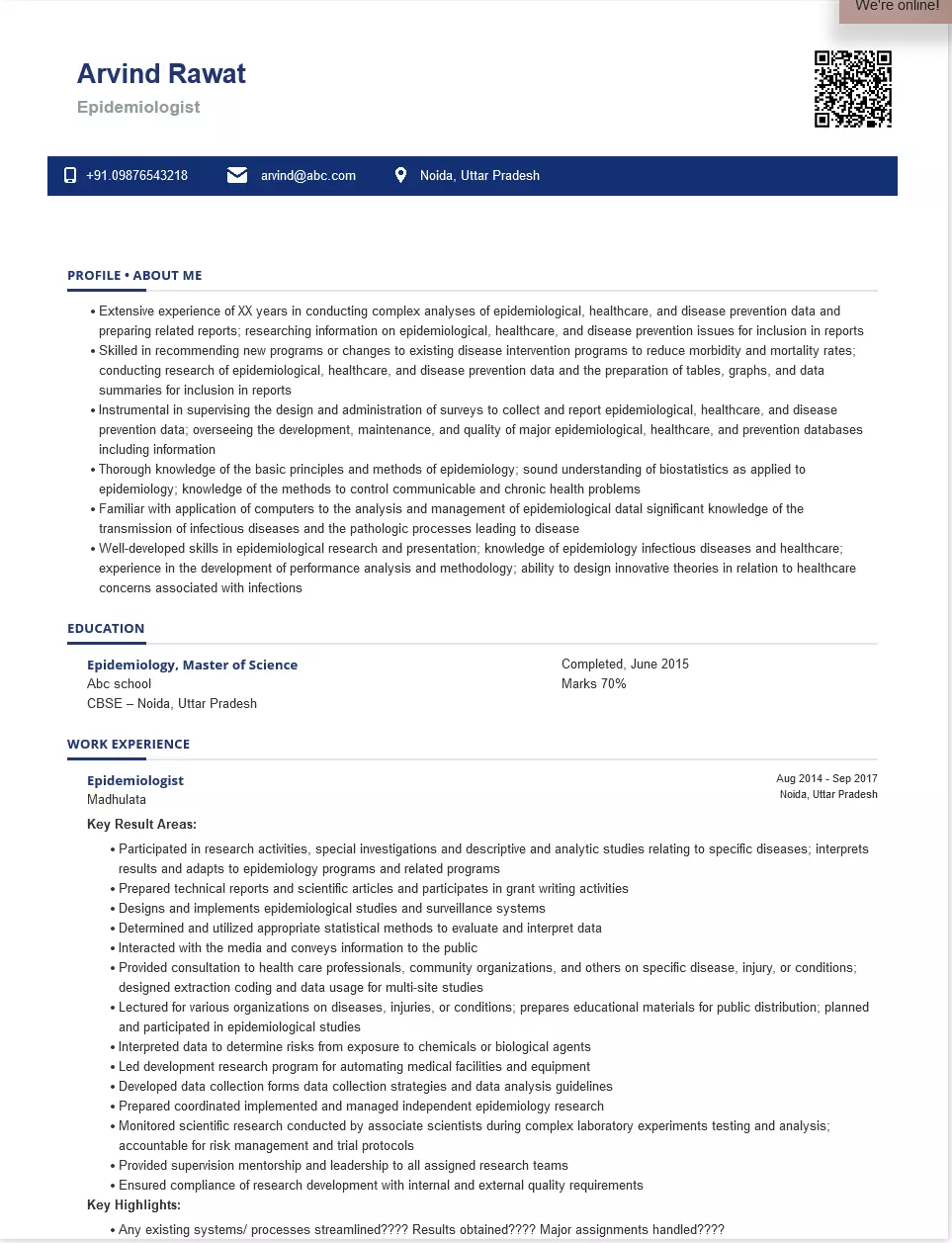
Epidemiologists Resume Example
Statisticians Resume Example
Molecular Biologists Resume Example
Atmospheric and Space Scientists Resume Example
Soil and Plant Scientists Resume Example
Physicists Resume Example
Mathematicians Resume Example
Chemists Resume Example
Geneticists Resume Example
Biologists Resume Example