India's
premier resume service
India's
premier resume service


- Participated in national and regional conferences.
- Collaborated on community outreach programs promoting weather safety.
- Home

- Resume Samples
- Atmospheric and Space Scientists Resume Sample
What's your job?
Atmospheric and Space Scientists Resume Samples and Templates for 2026
- Table of Contents
- Downloadable Sample
- Resume Tips from Experts
- Resume Text Version
- Share


Atmospheric and Space Scientist Resume Guide for India
A well-crafted atmospheric and space scientist resume is essential for success in India’s growing space research and meteorological sector. Whether you’re pursuing a career with ISRO, Indian Meteorological Department (IMD), IITM Pune, National Remote Sensing Centre, NCAOR, or academic institutions, this guide provides everything you need to create a standout resume.
This comprehensive guide includes:
- Resume format recommendations for atmospheric and space science roles in India
- Key skills employers look for in scientists
- Complete resume example with Indian context
- Top atmospheric and space science employers in India
- Salary insights in INR by experience level
- Required qualifications and certifications
- ATS optimization tips for research and government job portals
Why Your Atmospheric and Space Scientist Resume Matters in India
India’s space programme and meteorological services are among the world’s most active, with ISRO launching numerous satellites and IMD providing critical weather services. From satellite development to climate research, atmospheric and space scientists play crucial roles in advancing India’s scientific capabilities and addressing climate challenges.
A strong atmospheric and space scientist resume helps you:
- Stand out from competition for ISRO and research positions
- Showcase your expertise in atmospheric modelling, remote sensing, and space science
- Demonstrate your research publications and project contributions
- Highlight your experience with Indian satellite data and research programmes
Research institutions and space agencies receive many applications. Your resume must immediately communicate your technical expertise, research output, and contributions to Indian science.
Atmospheric and Space Scientist Resume Format for India
Indian research institutions prefer professional CV formats that highlight academic credentials and research output.
Recommended Format
- Length: 2-3 pages for research roles
- Layout: Reverse chronological
- Font: Arial, Calibri, or Times New Roman (11-12pt)
- Sections: Contact, Summary, Skills, Experience, Education, Publications, Projects
Personal Details for Indian Scientist Resumes
Include:
- Full name
- Phone number with +91 country code
- Professional email address
- City, State
- ORCID/ResearchGate/Google Scholar profile
What to Avoid
- Personal details like religion or caste
- Confidential project data
- Classified information
- Salary expectations in resume
Key Skills for Atmospheric and Space Scientists in India
Indian employers look for a combination of research expertise and technical skills.
Atmospheric Science Skills
- Atmospheric Modelling: WRF, RegCM, CESM
- Climate Analysis: Temperature, precipitation, monsoon studies
- Air Quality: Pollution modelling, aerosol studies
- Weather Forecasting: NWP models, ensemble techniques
- Tropical Meteorology: Monsoon dynamics, cyclones
Space Science Skills
- Remote Sensing: Satellite data analysis, image processing
- Satellite Instruments: Payload design, calibration
- Space Weather: Solar-terrestrial physics
- Planetary Science: Mars, Moon missions
- Orbital Mechanics: Trajectory analysis, mission planning
Technical Skills
- Programming: Python, MATLAB, Fortran, R, IDL
- Data Analysis: NCL, CDO, GrADS, Pandas
- GIS/Remote Sensing: ERDAS, ENVI, QGIS, Google Earth Engine
- High Performance Computing: Linux, parallel processing
- Visualisation: Matplotlib, NCL graphics, Ferret
Research Skills
- Experimental Design: Field campaigns, data collection
- Statistical Analysis: Time series, regression, machine learning
- Scientific Writing: Research papers, technical reports
- Data Management: NetCDF, HDF, large dataset handling
- Collaboration: Multi-institutional projects
Soft Skills
- Analytical Thinking: Complex problem solving
- Communication: Presentations, publications
- Teamwork: Research collaborations
- Attention to Detail: Data quality, validation
- Persistence: Long-term research projects
Atmospheric and Space Scientist Resume Example for India
Here’s a complete resume example tailored for Indian employers:
Dr. Arun Krishnan
Pune, Maharashtra | +91-98XXX-XXXXX | arun.krishnan.scientist@email.com | ORCID: 0000-0000-0000-0000
Professional Summary
Atmospheric Scientist with 10+ years of experience in monsoon dynamics, climate modelling, and satellite data analysis. Currently Scientist E at Indian Institute of Tropical Meteorology (IITM) leading research on Indian Summer Monsoon variability and prediction. Published 35+ peer-reviewed papers including in Nature Climate Change, JGR-Atmospheres, and Climate Dynamics. Ph.D. from IIT Delhi with postdoctoral experience at NCEP (USA). Expertise in WRF modelling, INSAT/IMDAA data analysis, and ensemble forecasting. PI of DST-funded project on extended range prediction. Passionate about improving monsoon forecasting for Indian agriculture and disaster management.
Key Skills
Atmospheric Modelling (WRF, CESM) | Climate Analysis | Monsoon Dynamics | Remote Sensing | Satellite Data Analysis | Python | MATLAB | Fortran | NCL/CDO | Machine Learning | High Performance Computing | Scientific Writing | Statistical Analysis | INSAT Data | IMD Collaboration
Professional Experience
Scientist E | Indian Institute of Tropical Meteorology (IITM) | Pune | April 2018 – Present
- Lead research group on monsoon dynamics and predictability
- Develop and validate WRF model configurations for Indian region
- Analyse INSAT and IMDAA reanalysis datasets
- Contribute to IITM’s Extended Range Prediction System
- Guide 5 Ph.D. and 8 M.Tech students
- Collaborate with IMD on operational forecasting improvements
- Coordinate international collaborations (NOAA, ECMWF)
- Publish research in high-impact international journals
Key Achievements:
- Published 35+ peer-reviewed papers (h-index: 18)
- DST-SERB project PI (₹65 Lakhs)
- IITM Research Excellence Award 2022
- Invited speaker at AMS, EGU conferences
Scientist C | IITM | Pune | June 2014 – March 2018
- Conducted research on Indian Ocean influence on monsoon
- Developed regional climate projections for India
- Analysed satellite observations from INSAT-3D
- Supported extended range prediction research
- Published 12 research papers during tenure
- Guided M.Tech dissertation students
Key Achievements:
- INSA Young Scientist Award 2017
- First author publication in Nature Climate Change
Postdoctoral Research Associate | NCEP/NOAA | College Park, USA | August 2012 – May 2014
- Worked on global ensemble forecasting systems
- Analysed monsoon prediction in CFSv2 model
- Collaborated with IITM-NCEP joint research programme
- Developed bias correction methods for seasonal prediction
Key Achievements:
- Co-authored 5 publications
- Presented at AMS Annual Meeting
Junior Research Fellow | IIT Delhi | New Delhi | July 2007 – July 2012
- Conducted doctoral research on monsoon intraseasonal variability
- Developed WRF model setup for Indian region
- Analysed NCEP/NCAR reanalysis and IMD station data
- Published thesis findings in peer-reviewed journals
Education
Ph.D. (Atmospheric Sciences) | IIT Delhi | 2012
- Thesis: Intraseasonal Variability of Indian Summer Monsoon: Modelling and Analysis
- CSIR-JRF/SRF fellowship
- First Division
M.Tech (Atmospheric Science) | Cochin University of Science and Technology (CUSAT) | 2007
- Specialisation in Meteorology
- First Rank
- First Division with Distinction
B.Sc. (Physics) | University of Kerala | 2005
- First Division with Distinction
Research Publications
- Krishnan, A. et al. (2023). “Enhanced Predictability of Indian Monsoon Active-Break Cycles.” Nature Climate Change, 13(4).
- Krishnan, A. & Rajeevan, M. (2022). “IMDAA Reanalysis for Monsoon Research.” JGR-Atmospheres, 127(8).
- Krishnan, A. et al. (2021). “WRF Model Performance over Indian Region.” Climate Dynamics, 56(3-4).
- [+32 more peer-reviewed publications]
Research Projects
PI: Extended Range Prediction of Monsoon Active-Break | DST-SERB | 2021-2024 | ₹65 Lakhs Co-PI: IITM-NCEP Joint Monsoon Research | MoES | 2019-2022 | ₹45 Lakhs Team Member: Coupled Model Development | MoES-IITM | 2018-Present
Certifications & Training
- Advanced Numerical Weather Prediction | ECMWF Training | 2020
- Machine Learning for Climate Science | NCAR | 2021
- Satellite Meteorology | ISRO/SAC | 2015
- High Performance Computing | CDAC | 2014
Languages
Malayalam (Native) | English (Fluent) | Hindi (Working)
Top Atmospheric and Space Science Employers in India
India’s space and atmospheric science sector offers diverse opportunities.
Space Research
- ISRO: Indian Space Research Organisation
- VSSC: Vikram Sarabhai Space Centre, Thiruvananthapuram
- SAC: Space Applications Centre, Ahmedabad
- NRSC: National Remote Sensing Centre, Hyderabad
- IIRS: Indian Institute of Remote Sensing, Dehradun
- URSC: U R Rao Satellite Centre, Bangalore
- PRL: Physical Research Laboratory, Ahmedabad
- IIA: Indian Institute of Astrophysics, Bangalore
Meteorology and Climate
- IMD: India Meteorological Department (Multiple centres)
- IITM: Indian Institute of Tropical Meteorology, Pune
- NCMRWF: National Centre for Medium Range Weather Forecasting, Noida
- INCOIS: Indian National Centre for Ocean Information Services, Hyderabad
- NCAOR: National Centre for Antarctic and Ocean Research, Goa
Research Institutes
- IITs: Atmospheric science departments
- IISc Bangalore: CAOS (Centre for Atmospheric and Oceanic Sciences)
- ARIES: Aryabhatta Research Institute, Nainital
- NARL: National Atmospheric Research Laboratory, Tirupati
- NPL: National Physical Laboratory, Delhi
Universities
- Cochin University: School of Marine Sciences
- Andhra University: Meteorology department
- BHU: Geophysics department
- Punjab University: Physics/Atmospheric Science
- Central Universities: Various departments
Private Sector
- Skymet: Weather services
- IBM Weather: Weather analytics
- Tomorrow.io: Weather technology
- Aerospace companies: DRDO, HAL collaboration
How to Apply
- ISRO recruitment through centralised exams
- IITM/IMD through direct recruitment
- UGC-NET for university positions
- Research fellowships (DST, CSIR, ISRO)
- Direct applications to research institutes
Atmospheric and Space Scientist Salary in India
Salaries vary based on experience, employer type, and position.
Salary by Experience Level
| Experience | Annual Salary (INR) |
|---|---|
| JRF/SRF (Research Scholar) | ₹31,000 - ₹35,000/month |
| Scientist B/C (Entry) | ₹8 - ₹15 LPA |
| Scientist D/E (Mid) | ₹12 - ₹22 LPA |
| Scientist F/G (Senior) | ₹18 - ₹35 LPA |
| Director/Head | ₹25 - ₹45 LPA |
Note: ISRO, IITM follow government pay scales with allowances.
Salary by Employer Type
| Employer Type | Salary Range (Mid-Level) |
|---|---|
| ISRO | ₹12 - ₹22 LPA + benefits |
| IITM/NCMRWF | ₹12 - ₹20 LPA + benefits |
| IMD | ₹10 - ₹18 LPA + benefits |
| IITs/IISc | ₹12 - ₹25 LPA |
| Private Sector | ₹10 - ₹25 LPA |
Research Fellowships
| Fellowship | Monthly Stipend |
|---|---|
| CSIR-JRF | ₹31,000 + HRA |
| DST-INSPIRE | ₹25,000 - ₹35,000 |
| ISRO-JRF | ₹25,000 - ₹28,000 |
| IITM-JRF | ₹31,000 + HRA |
Salary by City
| City | Salary Range (Mid-Level) |
|---|---|
| Bangalore (ISRO) | ₹12 - ₹22 LPA |
| Pune (IITM) | ₹12 - ₹20 LPA |
| Ahmedabad (SAC/PRL) | ₹12 - ₹22 LPA |
| Hyderabad (NRSC/INCOIS) | ₹12 - ₹20 LPA |
| Delhi (IMD/NPL) | ₹10 - ₹18 LPA |
Qualifications for Atmospheric and Space Scientists in India
Educational Background
Minimum for Scientist Positions:
- M.Sc./M.Tech in Atmospheric Science, Physics, or related field
- GATE/NET qualification often preferred
For Senior Positions:
- Ph.D. in Atmospheric Science, Space Science, Physics
- Strong publication record
- Research project experience
Specialisations
- Atmospheric Science: Climate, monsoon, weather
- Space Science: Satellite, planetary, space weather
- Remote Sensing: Earth observation, GIS
- Oceanography: Ocean-atmosphere interaction
- Aeronomy: Upper atmosphere, ionosphere
Career Path (Research Institutes)
- Junior Research Fellow
- Senior Research Fellow
- Scientist B/C
- Scientist D/E
- Scientist F/G
- Scientist H
- Director
Career Path (Academic)
- Postdoctoral Fellow
- Assistant Professor
- Associate Professor
- Professor
- Head of Department
ATS Tips for Your Scientist Resume
Research institutions use various screening methods:
Keyword Optimization
Include relevant terms like:
- Atmospheric scientist, space scientist
- ISRO, IITM, IMD
- Climate modelling, remote sensing
- Monsoon, satellite data
- WRF, Python, MATLAB
- Publications, research projects
Formatting Tips
- Use standard section headings
- List publications in proper citation format
- Include h-index and citation metrics
- Quantify research output (papers, projects, funding)
- Save as PDF for format preservation
Final Tips for Your Scientist Resume
✅ Lead with qualifications - Ph.D., M.Tech prominently displayed
✅ Highlight publications - High-impact papers, h-index
✅ Show research funding - Projects secured, amounts
✅ Include technical skills - Models, programming languages, tools
✅ Mention collaborations - International, multi-institutional
✅ Add presentations - Conferences, invited talks
✅ Update regularly - Add new publications and projects
Quick Checklist
- Contact information with academic profiles
- Summary highlights research expertise
- Skills include technical and domain
- Experience shows quantified results
- Education with specialisations listed
- Publications in proper citation format
- Projects with funding details
- Clean, academic format
Ready to create your professional atmospheric and space scientist resume? Use our resume builder to get started with expert-designed templates.
Looking for more guidance? Check out our resume format guide for additional tips.
Frequently Asked Questions
What is the best resume format for Atmospheric and Space Scientists in India?
Use a 2-3 page academic CV format for research positions. Include summary, skills, experience, education, publications, and projects. Emphasise research output, technical skills, and contributions to Indian science programmes.
What qualifications are needed for ISRO/IITM jobs?
Scientist positions require M.Sc./M.Tech in relevant field with GATE/NET. Ph.D. preferred for senior roles. Strong academic record, publication record, and research experience are essential for competitive positions.
What skills should I highlight on a scientist resume?
Highlight atmospheric/climate modelling (WRF, CESM), programming (Python, MATLAB, Fortran), remote sensing, satellite data analysis, statistical methods, and scientific writing. Include experience with Indian datasets (IMD, INSAT, IMDAA).
How much do Atmospheric and Space Scientists earn in India?
JRF/SRF: ₹31,000-35,000/month. Entry-level (Scientist B/C): ₹8-15 LPA. Mid-level (D/E): ₹12-22 LPA. Senior (F/G): ₹18-35 LPA. ISRO, IITM follow government pay scales with allowances.
How do I get a scientist position at ISRO?
Apply through ISRO centralised recruitment when advertised. Requires M.Sc./M.Tech with GATE score or Ph.D. Written test followed by interview. Strong academic record and research aptitude essential. Check ISRO website for notifications.
Should I include publications on my resume?
Absolutely essential for research positions. List peer-reviewed publications with full citations. Mention impact factors, h-index, and citation counts. Include papers under review or in press. For scientists, publications are primary evaluation criteria.
What is the scope of atmospheric and space science in India?
Excellent scope with India's active space programme and climate research needs. ISRO, IITM, IMD, NCMRWF actively recruit. Climate change research, weather services, and satellite programmes are expanding. International collaborations provide global opportunities.
Which programming languages are most important?
Python is essential for data analysis and machine learning. MATLAB widely used in atmospheric science. Fortran for numerical models. R for statistical analysis. NCL/CDO for climate data. Knowledge of multiple languages adds value.
Should I mention experience with Indian satellites?
Yes, highly valuable. Experience with INSAT, Oceansat, Resourcesat, IMDAA reanalysis, and IMD data shows understanding of Indian context. Mention specific products and applications used in research.
What is the career growth for scientists in India?
Research path: JRF → SRF → Scientist B → C → D → E → F → G → H → Director. Academic: Postdoc → Assistant Professor → Associate → Professor. Promotions based on publications, projects, and performance. Senior positions require Ph.D. and strong research record.
Atmospheric and Space Scientists Text-Only Resume Templates and Samples
Abhi sandilya
Phone: 9871275111
Email: writer@shriresume.com
Address: Chuari Khas
About Me
Atmospheric and Space Scientists
Dedicated Atmospheric and Space Scientist with a strong foundation in atmospheric science, remote sensing, and data analysis. Seeking to leverage academic background and practical experience to contribute to cutting-edge research and innovation in atmospheric and space science.
Extra Curricular Activities
Education
Atmospheric Science, Master of Science, Completed, May 2024
SSV Degree College
State University
Chuari Khas, HP
Certifications
- Certified Broadcast Meteorologist (CBM), Completed , July 2024
- Certified Remote Sensing Professional (CRSP), Completed , July 2024
Internships
Period: April 2024 - July 2024
Atmospheric Research Intern
Bhabha Research Center
Chandigarh, CH
- Conducted data analysis on atmospheric patterns using MATLAB and Python.
- Assisted in the development and validation of climate models.
- Participated in field research collecting atmospheric data using remote sensing equipment.
Skills
- Atmospheric Data Analysis
- Remote Sensing Techniques
- Climate Modeling
- Weather Forecasting
- Statistical Analysis
- Field Research
- Technical Writing
- Public Speaking
Languages
Softwares
Operating System
Personal Interests
- Storm Chasing and Severe Weather Photography
- Astronomy and Space Exploration
- Hiking and Outdoor Activities
- Science Communication and Outreach
- Environmental Advocacy

Author
Kshama Sharma - Resume, CV and Cover Letter Writing Expert
Check Out Related Resume Samples
Epidemiologists Resume Example
Statisticians Resume Example
Molecular Biologists Resume Example
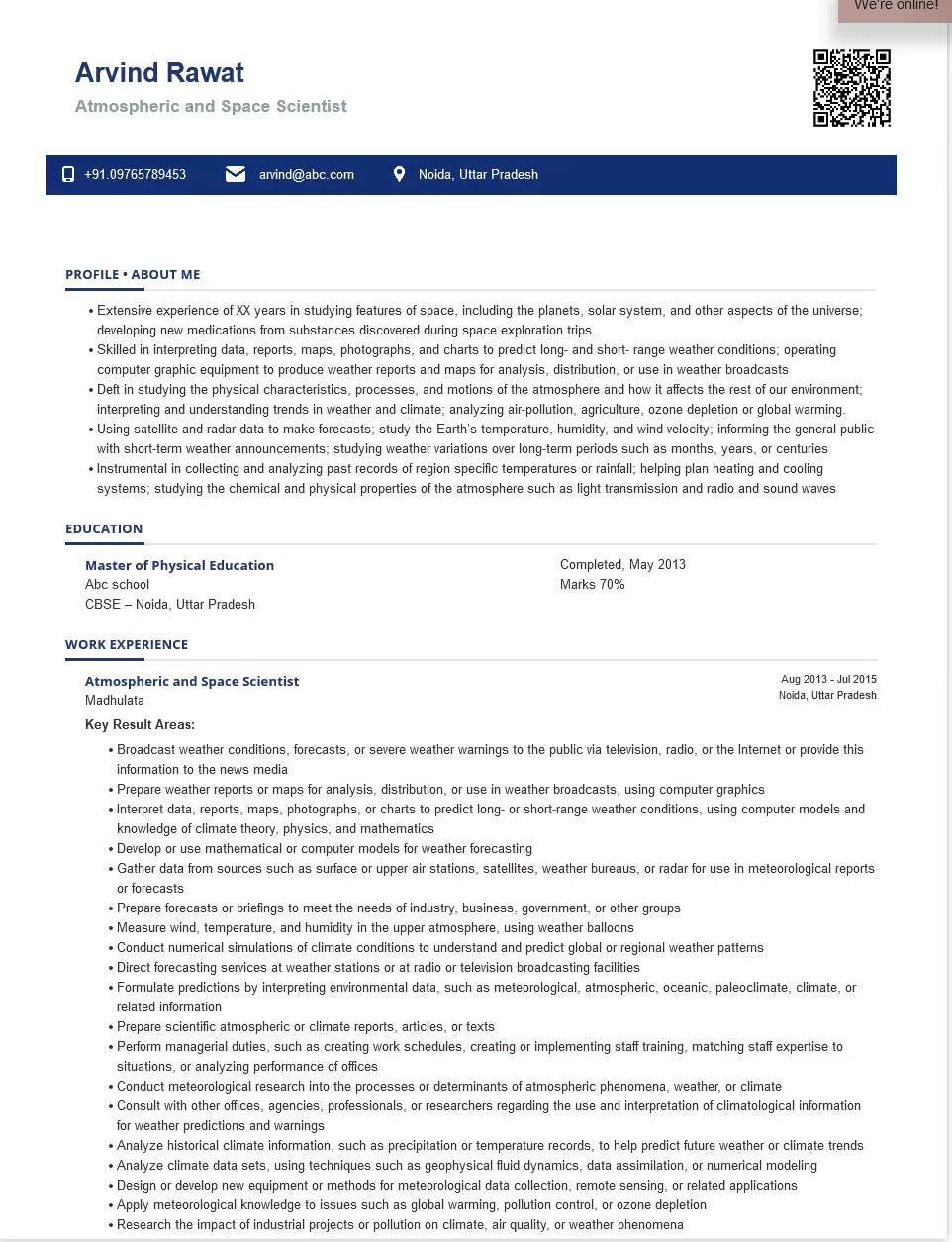
Atmospheric and Space Scientists Resume Example
Soil and Plant Scientists Resume Example
Physicists Resume Example
Mathematicians Resume Example
Chemists Resume Example
Geneticists Resume Example
Biologists Resume Example