India's
premier resume service
India's
premier resume service


- Certificate in Cutting & Tailoring, Completed , January 2018
- Home

- Resume Samples
- Tailor Resume Sample
What's your job?
Tailor Resume Samples and Templates for 2026
- Table of Contents
- Downloadable Sample
- Resume Tips from Experts
- Resume Text Version
- Share


Tailor Resume Guide for India
A well-crafted tailor resume is essential for success in India’s massive garment and fashion industry. Whether you’re a fresher starting your career after completing a tailoring course or an experienced professional seeking growth at premium boutiques, fashion houses like FabIndia or Manyavar, garment export units, or theatrical costume houses, this guide provides everything you need to create a standout resume that impresses Indian employers and passes ATS screening on portals like Naukri and LinkedIn.
This comprehensive guide includes:
- Resume format recommendations for India
- Key skills Indian employers look for
- Complete resume example with Indian context
- Top tailor employers in India
- Salary insights in INR by experience level
- Certification guidance
- ATS optimization tips for Indian job portals
Why Your Tailor Resume Matters in India
India’s textile and garment industry is one of the world’s largest, employing over 4.5 crore people, with companies like Raymond, Arvind Limited, FabIndia, Manyavar, and export houses actively hiring skilled tailors. A strong resume helps you:
- Stand out from thousands of applicants on Naukri and job boards
- Pass ATS screening used by larger garment companies and export houses
- Showcase skills that Indian employers value, including traditional Indian tailoring techniques
- Demonstrate your expertise in both Indian and Western garment construction
Indian employers in the garment industry value both skill demonstration and documented experience. Your tailor resume must immediately communicate your specializations, garment types expertise, and relevant training. With India’s growing demand for quality tailoring in both domestic and export markets, a well-optimized resume is your ticket to landing interviews at top establishments.
Tailor Resume Format for India
Indian employers prefer clean, professional resume formats that clearly present your skills. Here’s what works best:
Recommended Format
- Length: 1-2 pages (freshers: 1 page, experienced: 2 pages max)
- Layout: Reverse chronological (most recent first)
- Font: Clean fonts like Calibri or Arial (11-12pt)
- Sections: Contact, Summary, Skills, Experience, Education, Certifications
Portfolio Importance
In India, a physical or digital portfolio of your work significantly strengthens your application. Include photos of your best work if possible, or mention availability of work samples.
Personal Details for Indian Tailor Resumes
Indian resumes typically include:
- Full name
- Phone number with country code (+91)
- Professional email address or WhatsApp number
- City, State (full address not required)
What to Avoid
- Complex formatting
- Personal information like religion, caste, or father’s name (outdated practice)
- Salary expectations (discuss during interview)
- References (provide when requested)
Key Skills for Tailors in India
Indian employers look for a combination of traditional craftsmanship and modern techniques.
Core Tailoring Skills
- Measurement Taking: Accurate body measurements
- Pattern Making: Drafting and cutting patterns
- Cutting: Precision fabric cutting
- Stitching: Hand and machine stitching
- Fitting: Garment fitting and adjustments
- Alterations: Modification of existing garments
- Finishing: Final touches and pressing
Indian Garment Specializations
- Saree blouse stitching
- Salwar kameez and kurta
- Lehenga and choli
- Sherwani and achkan
- Traditional embroidery integration
- Wedding and festive wear
Western Garment Skills
- Suits and blazers
- Trousers and shirts
- Dresses and gowns
- Formal wear
- Casual wear alterations
Technical Skills
- Industrial sewing machines
- Overlock/serger machines
- Computerized embroidery machines
- CAD for pattern design (advanced)
- Different fabric handling (silk, cotton, wool, synthetic)
Soft Skills Valued in Indian Workplaces
- Attention to Detail: Precision in measurements and stitching
- Customer Service: Understanding client requirements
- Time Management: Meeting delivery deadlines
- Communication: Clear discussion with customers
- Patience: Handling intricate work
How to Present Skills
List technical tailoring skills prominently. Use exact keywords from job postings to improve ATS matching. Mention specific garment types you specialize in and machines you can operate.
Tailor Resume Example for India
Here’s a complete resume example tailored for Indian employers:
Ramesh Kumar
Mumbai, Maharashtra | +91-98XXX-XXXXX | ramesh.tailor@email.com | WhatsApp: +91-98XXX-XXXXX
Professional Summary
Experienced Master Tailor with 12+ years of expertise in Indian ethnic wear and Western formal garments. Proven track record of delivering high-quality custom tailoring for premium boutiques with 98% customer satisfaction. Specialization in wedding wear including sherwanis, lehengas, and designer blouses. Proficient in both hand craftsmanship and industrial machine operation with ability to train junior staff.
Key Skills
Custom Tailoring | Pattern Making | Sherwani Stitching | Lehenga Construction | Saree Blouse | Western Suits | Alterations | Industrial Machines | Hand Embroidery Integration | Quality Control
Professional Experience
Master Tailor | Manyavar Exclusive Store | Mumbai | March 2019 – Present
- Execute 100+ custom orders monthly for wedding and festive wear
- Specialize in sherwanis, Indo-Western suits, and kurta sets
- Maintain 98% customer satisfaction rating with minimal alterations required
- Train and supervise team of 5 junior tailors
- Handle VIP and celebrity orders requiring specialized attention
- Reduced delivery time by 20% through improved workflow
Senior Tailor | Raymond Custom Tailoring | Delhi | June 2015 – February 2019
- Crafted premium formal suits, trousers, and shirts for corporate clients
- Handled 80+ garments monthly with consistent quality standards
- Specialized in fitting adjustments for diverse body types
- Collaborated with designers on custom wedding collections
- Received “Best Craftsman” recognition 2017-2018
Tailor | Local Boutique (Sharma Fashion House) | Jaipur | July 2011 – May 2015
- Stitched traditional Rajasthani wear and modern Indian attire
- Handled saree blouses, salwar suits, and children’s ethnic wear
- Managed customer consultations and measurements
- Built loyal customer base through quality work
Education
Diploma in Cutting & Tailoring | ITI Jaipur | 2011
- 2-year program in garment construction
- Specialization: Traditional and Western Wear
- Distinction grade
Higher Secondary (10th) | Government School, Jaipur | 2009
Certifications
- Advanced Pattern Making | NIFT Extension Program | 2018
- Industrial Machine Operation | Singer Training Center | 2016
- Embroidery Integration Course | Handloom Board | 2014
Garment Specializations
Indian Wear: Sherwani, Kurta, Lehenga Choli, Saree Blouse, Salwar Kameez, Anarkali Western Wear: Formal Suits, Blazers, Trousers, Dress Shirts, Gowns
Machines Proficiency
Juki Industrial | Brother Overlock | Singer Embroidery | Bernina | Usha Janome
Work Samples
Portfolio available upon request. Featured work includes:
- Designer sherwani collection for Manyavar
- Celebrity wedding order (50+ pieces)
- Corporate bulk orders for Raymond
Languages
Hindi (Native) | English (Working) | Marathi (Conversational)
Declaration
I hereby declare that the information provided above is true to the best of my knowledge.
Ramesh Kumar Mumbai, December 2024
Note: Declaration statements are common in Indian resumes.
Top Tailor Employers in India
India’s garment industry offers excellent opportunities for skilled tailors. Here are the top employers:
Premium Retail Brands
- Manyavar-Mohey: Ethnic wear leader
- Raymond: Premium menswear
- FabIndia: Traditional Indian garments
- Biba: Contemporary ethnic
- W (TCNS): Modern Indian wear
Luxury & Designer Houses
- Sabyasachi: Couture and bridal
- Anita Dongre: Premium ethnic
- Manish Malhotra: Celebrity fashion
- Tarun Tahiliani: Bridal couture
- Boutique designer stores: Local luxury
Garment Export Houses
- Gokaldas Exports: Largest apparel exporter
- Shahi Exports: Global manufacturing
- Arvind Limited: Integrated textile company
- Orient Craft: Export manufacturing
- Laguna Clothing: Premium exports
Tailoring Shops & Boutiques
- Local boutiques: Independent businesses
- Wedding specialists: Bridal wear shops
- Alteration services: Mall-based services
- Corporate tailoring: B2B services
- Custom tailoring studios: Premium individual clients
Film & Theatre
- Bollywood costume departments: Film industry
- Theatre companies: Stage costumes
- TV production houses: Serial costumes
- Event management companies: Show costumes
How to Apply
- Visit store locations directly with portfolio
- Apply through Naukri.com and LinkedIn
- Register with garment industry associations
- Network through local tailor communities
- Apply through ITI placement cells
Tailor Salary in India
Salaries vary based on experience, specialization, and employer type.
Salary by Experience Level
| Experience | Monthly Salary (INR) |
|---|---|
| Fresher (0-1 years) | ₹8,000 - ₹15,000 |
| Junior (2-4 years) | ₹15,000 - ₹25,000 |
| Experienced (5-8 years) | ₹25,000 - ₹45,000 |
| Master Tailor (8+ years) | ₹45,000 - ₹80,000+ |
Note: Premium boutiques and export houses pay higher; piece-rate work can significantly increase earnings.
Salary by City
| City | Salary Range (Experienced) |
|---|---|
| Mumbai | ₹30,000 - ₹60,000/month |
| Delhi NCR | ₹25,000 - ₹55,000/month |
| Bangalore | ₹25,000 - ₹50,000/month |
| Chennai | ₹20,000 - ₹40,000/month |
| Kolkata | ₹18,000 - ₹35,000/month |
| Jaipur | ₹15,000 - ₹35,000/month |
Self-Employment Rates
- Basic alterations: ₹100 - ₹500 per piece
- Blouse stitching: ₹300 - ₹2,000
- Kurta/Suit set: ₹500 - ₹3,000
- Sherwani: ₹3,000 - ₹15,000
- Wedding lehenga: ₹5,000 - ₹25,000+
Factors Affecting Salary
- Specialization: Bridal and couture command premium
- Speed and quality: High output with consistent quality valued
- Location: Metro cities pay significantly more
- Brand: Premium brands pay better than local shops
Salary data based on Glassdoor India, AmbitionBox, and industry surveys.
Training & Certification for Tailors in India
Professional training enhances your skills and employability.
Government Training
- ITI (Industrial Training Institute): 2-year diploma programs
- NIFT: Fashion technology courses
- Textile Ministry Schemes: Skill development programs
- PMKVY (Skill India): Short-term courses
- ATDC (Apparel Training & Design Centre): Industry-linked training
Private Training
- Local tailoring institutes: City-based training
- Brand training programs: Raymond, Manyavar academies
- Online courses: YouTube and Udemy tutorials
- Apprenticeships: Learning under master tailors
Specialized Certifications
- Pattern making certification
- Industrial machine operation
- CAD for garment design
- Embroidery and embellishment
How to List Training
Include institute name, course name, and year. ITI diplomas are well-recognized. Mention any awards or distinctions received during training.
ATS Tips for Your Tailor Resume
Larger garment companies use Applicant Tracking Systems (ATS) to screen resumes. Optimize yours:
For Naukri.com
- Use keywords from the job description (tailoring, stitching, pattern making)
- Keep formatting simple—ATS can’t read complex layouts
- Use standard section headings (Experience, Education, Skills)
- Upload in .docx or .pdf format
For LinkedIn Applications
- Match your resume to your profile
- Use industry-standard job titles (Tailor, Master Tailor)
- Include relevant keywords in your skills section
General ATS Tips
- DO: Use clean fonts, clear headings, bullet points
- DO: Include exact keywords from job postings (sherwani, lehenga, alterations)
- DO: List specific machines and garment types
- DON’T: Use headers/footers, text boxes, or graphics
- DON’T: Use creative section titles
Keyword Strategy for Indian Tailoring Roles
Review 5-10 job postings. Common keywords include:
- Tailor, master tailor, stitching
- Pattern making, cutting, fitting
- Specific garment types (sherwani, blouse, suit)
- Machine names (Juki, Brother, overlock)
- Alterations, customization
Final Tips for Your Tailor Resume
✅ Show specialization: Highlight your expertise in specific garment types
✅ Quantify output: Include number of pieces handled monthly
✅ List machines: Mention all machines you can operate
✅ Include both Indian and Western: Show versatility
✅ Portfolio helps: Offer to show work samples in interview
✅ Training matters: List ITI or other formal training
Quick Checklist
- Contact information with +91 phone number
- Professional summary highlights specialization
- Skills section includes garment types and machines
- Experience shows output quantities and quality metrics
- Education includes tailoring diploma/training
- Certifications listed
- Languages mentioned
- Formatting is clean and simple
- Length is appropriate (1-2 pages)
Ready to create your professional tailor resume? Use our resume builder to get started with expert-designed templates optimized for Indian job portals and ATS systems.
Looking for more guidance? Check out our resume format guide for additional tips on structuring your tailoring resume for the Indian job market.
Frequently Asked Questions
What should a tailor resume include?
A good tailor resume includes your contact details, a brief professional summary, a skills section highlighting sewing and fitting expertise, detailed work experience, training or certifications, and — if available — a link to your portfolio or photos of your work.
How do I write a professional summary for a tailor resume?
Keep it short and specific — 2–3 lines that describe your years of experience, what kind of tailoring you specialize in (e.g., custom suits, bridal, alterations), and your strongest skills (like precision fitting or pattern adjustment). Tailor this to the job you're targeting.
What key skills should I list on my tailor resume?
Include technical skills like garment construction, pattern reading, alterations, hemming, fitting adjustments, use of industrial sewing machines, and any tools you're comfortable with. Also list soft skills like attention to detail, time management, and good communication.
How long should a tailor resume be?
Aim for 1–2 pages. One page works well if you're early in your career. If you have years of experience, advanced skills, and notable accomplishments, two pages are fine — as long as you keep the content relevant and concise.
How can I make my tailor resume ATS-friendly?
Use clear section headings such as Professional Summary, Skills, Experience, and Education. Include relevant keywords from the job ad (like tailoring, garment fitting, alterations, pattern making) and avoid fancy graphics or layouts that Applicant Tracking Systems might not read.
Should I include a portfolio on my resume?
Yes — a portfolio is very helpful for tailor roles. Include a link to a website, Instagram, or PDF showing examples of your work: custom garments, before/after alterations, fittings, etc. This gives employers a visual sense of your quality and style.
How do I describe my work experience as a tailor?
Use bullet points to explain your responsibilities and achievements — for example: "Performed alterations and fittings for 30+ clients per week," "Constructed custom garments based on client measurements with 99% fit accuracy," or "Managed fabric selection and pattern adjustments to meet design specs." Focus on what you did and the impact.
What keywords should I use in a tailor resume?
Useful keywords include tailoring, alterations, garment construction, pattern adjustment, fitting, hemming, sewing machine operation, fabric knowledge, customer fittings, and quality control. Align these with the job description.
Should I list certifications or training on my resume?
Yes — include any tailoring or fashion training, diplomas, sewing certifications, or workshops you've completed. Even short specialized courses (e.g., pattern making or advanced tailoring techniques) add credibility.
How should fresh graduates write a tailor resume?
If you're just starting out, emphasize relevant coursework, internships, apprenticeships, or workshop training. Include any hands-on projects — like garments you made during training — and highlight your readiness to learn and grow.
Can tailor skills apply to other roles?
Absolutely. Skills like pattern making, garment fitting, customer consultation, fabric knowledge, and sewing techniques are useful in roles like alterations specialist, costume maker, fashion technician, or production tailor in apparel and fashion production.
How do I tailor my resume for different tailoring jobs (shop vs custom work)?
Match your resume to the role: for shop or production tailoring, emphasize speed, consistency, and handling high volume. For custom or bridal tailoring, highlight fitting precision, client consultation, and bespoke garment construction.
Tailor Text-Only Resume Templates and Samples
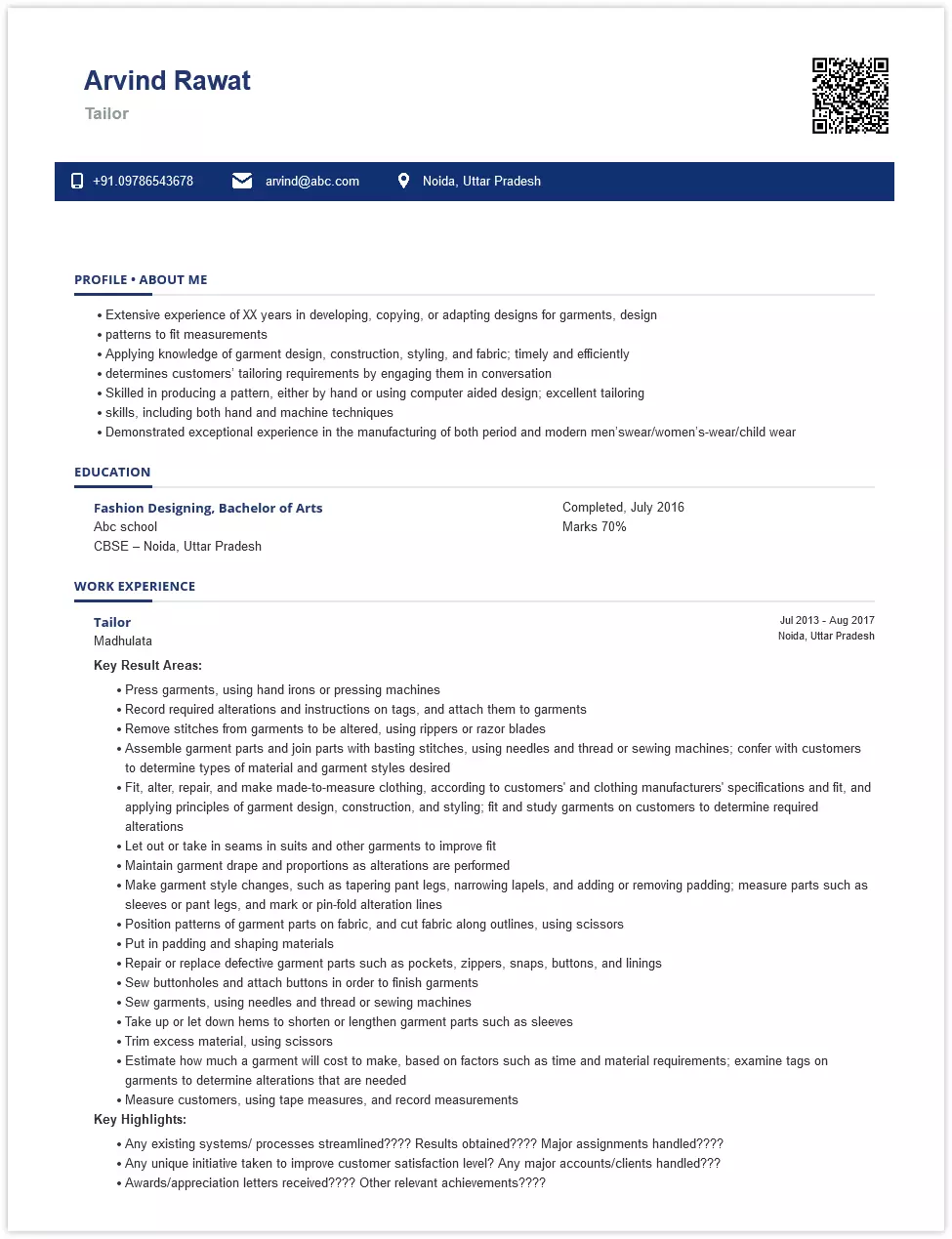
Arvind Rawat
Phone: 09786543678
Email: arvind@abc.com
Address: Alpha1 greater noida, Beta 2 greater noida, Noida
About Me
Tailor
- Extensive experience of XX years in developing, copying, or adapting designs for garments, design patterns to fit measurements
- Applying knowledge of garment design, construction, styling, and fabric; in a timely and efficient determines customers’ tailoring requirements by engaging them in conversation
- Skilled in producing a pattern, either by hand or using computer-aided design; excellent tailoring skills, including both hand and machine techniques
- Demonstrated exceptional experience in the manufacturing of both period and modern menswear / women’s-wear/child wear
Education
Fashion Designing, Bachelor of Arts, Completed, July 2016
Government Polytechnic
– Marks 70
Noida, UP
Certifications
Work Experience
Period: July 2019 - Current
Tailor
TA Shipping Pvt Ltd
Noida, UP
- Press garments, using hand irons or pressing machines
- Record required alterations and instructions on tags, and attach them to garments
- Remove stitches from garments to be altered, using rippers or razor blades
- Assemble garment parts and join parts with basting stitches, using needles and thread or sewing machines; confer with customers to determine types of material and garment styles desired
- Fit, alter, repair, and make made-to-measure clothing, according to customers' and clothing manufacturers' specifications and fit, and applying principles of garment design, construction, and styling; fit and study garments on customers to determine required alterations
- Let out or take in seams in suits and other garments to improve the fit
- Maintain garment drape and proportions as alterations are performed
- Make garment style changes, such as tapering pant legs, narrowing lapels, and adding or removing padding; measure parts such as sleeves or pant legs, and mark or pin-fold alteration lines
- Position patterns of garment parts on fabric, and cut fabric along outlines, using scissors
- Put in padding and shaping materials
- Repair or replace defective garment parts such as pockets, zippers, snaps, buttons, and linings
- Sew buttonholes and attach buttons in order to finish garments
- Sew garments, using needles and thread or sewing machines
- Take up or let down hems to shorten or lengthen garment parts such as sleeves
- Trim excess material, using scissors
- Estimate how much a garment will cost to make, based on factors such as time and material requirements; examine tags on garments to determine alterations that are needed
- Measure customers, using tape measures, and record measurements
Period: June 2017 - October 2018
Tailor
St. Regis Hotels
Thane, MH
- Fabricated patterns for specific actors through the use of tailor "block" or flat patternmaking
- Manufactured menswear costumes including, but not limited to coats, vests, pants, and shirts
- Cut fabrics and appropriate linings and interfacing; supervised assistants and finishers as necessary
- Created shape into coats or jackets by means of interfacing manipulation
- Facilitated alterations of patterns or garments as necessary
- Engaged customers in conversation to determine their garment style and type requirements
- Assisted customers in determining the right kind of style and cut that will suit them best
- Provided suggestions for tailored garments, based on current and future fashion trends
- Measured and cut the fabric according to predetermined designs and sew garments using needles, threads, and sewing machines
- Handled required alterations on tailored suits, remove stitches, and re-stitch garments as required
Skills
- Measurement Protocols
- Dress Fitting
- Alterations
- Pattern Positioning
- Garment Cost Estimates
- Garments Parts Assembly
- Design Adaptation
- Style Changes
- Sewing Machine Operations
- Fabric Shaping
- Vendor Relations
- Made-to-measure
- Clothing
Languages
Softwares
Operating System
Personal Interests
- Sketching
- Yoga
- Swimming
Author
Kshama Sharma - Resume, CV and Cover Letter Writing Expert