India's
premier resume service
India's
premier resume service


- Master Alteration Specialist (MAS) Certification, Completed , January 2019
- Home

- Resume Samples
- Dressmaker (Modiste) Resume Sample
What's your job?
Dressmaker (Modiste) Resume Samples and Templates for 2026
- Table of Contents
- Downloadable Sample
- Resume Tips from Experts
- Resume Text Version
- Share


Dressmaker & Modiste Resume: Skills, Experience & Examples
Introduction
Dressmakers and modistes are the artisans behind India’s vibrant fashion and garment industry, transforming fabric into beautiful garments through skilled craftsmanship. From creating designer outfits for boutiques in Mumbai to crafting traditional wear in Delhi’s fashion hubs, dressmakers play an essential role in bringing fashion designs to life. The profession combines traditional tailoring skills with contemporary fashion sensibilities to meet the diverse clothing needs of Indian consumers.
India’s fashion industry continues to grow rapidly, driven by increasing demand for both traditional and western wear. Major fashion centres like Mumbai, Delhi, Bangalore, and Jaipur are home to boutiques, fashion houses, and garment manufacturers seeking skilled dressmakers. Whether you’re working with a designer label, running your own tailoring shop, or seeking positions in export houses, the demand for quality craftsmanship remains strong.
This comprehensive guide will help you create a dressmaker/modiste resume that effectively showcases your tailoring expertise, design skills, and experience with different garment types. From highlighting your proficiency with various fabrics to demonstrating your understanding of fashion trends, we’ll cover everything you need to secure your dream dressmaking position in 2025.
Section 1: Understanding the Dressmaker/Modiste Role in India
Overview of Duties and Responsibilities
Dressmakers and modistes in India work across various settings, creating garments from scratch or altering existing clothing. Their responsibilities include:
Garment Construction: Creating complete garments from fabric including cutting, stitching, and finishing to meet design specifications.
Pattern Making: Developing patterns from design sketches or measurements for accurate garment construction.
Alterations: Modifying existing garments for better fit, style updates, or customer preferences.
Client Consultations: Meeting with customers to understand requirements, take measurements, and discuss design options.
Fabric Selection: Advising clients on appropriate fabrics, linings, and materials for different garments.
Fitting Sessions: Conducting multiple fittings to ensure proper fit and making adjustments as needed.
Quality Control: Inspecting finished garments for stitching quality, finish, and overall presentation.
Key Skills and Competencies Employers Look For
Employers in India’s fashion and garment industry value specific capabilities in dressmakers:
Technical Skills: Proficiency in cutting, stitching, and finishing various types of garments.
Pattern Making: Ability to create and modify patterns for different body types and styles.
Fabric Knowledge: Understanding of different fabric types, their properties, and appropriate handling.
Machine Operation: Expertise with industrial and domestic sewing machines, overlock machines, and other equipment.
Hand Sewing: Skills in hand finishing, embroidery, and decorative stitching techniques.
Fashion Awareness: Knowledge of current fashion trends, traditional styles, and customer preferences.
Attention to Detail: Precision in measurements, stitching, and finishing.
Diversity of Roles Within Dressmaking
The dressmaking field in India offers various career paths:
Boutique Dressmaker: Creates custom garments for individual clients at fashion boutiques.
Bridal Specialist: Focuses on wedding wear including lehengas, sherwanis, and bridal gowns.
Master Tailor: Supervises tailoring operations and handles complex garments.
Alteration Specialist: Focuses on modifying and adjusting existing garments.
Production Tailor: Works in garment manufacturing creating samples or production pieces.
Costume Designer: Creates garments for film, television, or theatre productions.
Section 2: Preparing Your Resume - Essential Components
Contact Information
Your contact section should be clear and professional:
- Full Name: Clearly displayed at the top of your resume
- Phone Number: Include your mobile number with country code (+91)
- Email Address: Use a professional email (e.g., meera.patel@email.com)
- Location: City and area (e.g., Santacruz, Mumbai)
- WhatsApp: If different from primary number
- Portfolio: Link to photos of your work if available online
Professional Summary
Your summary should highlight your tailoring expertise and specialisation:
Example for Experienced Professional: “Senior Dressmaker with 12+ years of experience in haute couture and bridal wear. Created custom garments for 500+ clients at leading Mumbai boutiques including designer collections for celebrity clientele. Expert in lehenga construction, gown draping, and intricate hand embroidery. Familiar with both traditional Indian and western fashion styles. Seeking master tailor position at a premium fashion house.”
Example for Mid-Level Professional: “Skilled Dressmaker with 5 years of experience in women’s ethnic and western wear. Crafted designer outfits at Fabindia retail stores handling 20+ orders monthly. Proficient in kurta, saree blouse, and dress construction. Strong knowledge of fabric handling and finishing techniques. Looking for boutique position with creative design opportunities.”
Example for Fresher: “Fashion Design diploma holder from NIFT with specialisation in garment construction. Completed 6-month internship at export house learning industrial tailoring. Skilled in pattern making, cutting, and machine stitching. Eager to apply skills in a boutique or fashion house environment.”
Work Experience
Present your experience with specific details:
Senior Dressmaker | Ensemble Designer Boutique | Mumbai | 2020-Present
- Create custom bridal lehengas, gowns, and occasion wear for high-end clientele
- Handle 15+ orders monthly with price points ranging from ₹50,000 to ₹5 lakh
- Develop patterns from designer sketches ensuring accurate construction
- Conduct fittings and make alterations achieving 100% customer satisfaction
Dressmaker | Biba Stores | Delhi | 2017-2020
- Provided alteration services for ready-to-wear ethnic collection
- Handled 30+ alterations daily maintaining quality and quick turnaround
- Trained 5 junior tailors on company stitching standards
- Achieved highest customer feedback scores among store tailoring staff
Skills Section
Technical Skills:
- Garment Construction: Lehengas, Blouses, Dresses, Suits
- Pattern Making: Drafting, Grading, Modifications
- Machine Skills: Industrial, Domestic, Overlock, Buttonhole
- Hand Work: Embroidery, Beading, Finishing
- Alterations: Fitting, Resizing, Style Modifications
- Fabric Handling: Silk, Cotton, Georgette, Velvet, Net
Soft Skills:
- Attention to Detail
- Customer Communication
- Time Management
- Creative Problem Solving
- Team Collaboration
- Quality Consciousness
Section 3: Resume Formats for Dressmakers
Chronological Resume
Best suited for dressmakers with steady career progression in tailoring. Lists work experience from most recent to oldest.
When to use: If you have 3+ years of continuous experience in tailoring or fashion.
Functional Resume
Focuses on skills and specialisations rather than work history. Useful for those with varied experience.
When to use: If you’ve worked in multiple settings (boutiques, export houses, self-employment) and want to highlight diverse skills.
Combination Resume
Blends skills and work history, useful for those transitioning from related fields.
When to use: If you’re transitioning from embroidery, textile work, or other crafts to dressmaking.
Section 4: Professional Summary Examples
For Bridal Specialist: “Bridal Wear Specialist with 8 years of experience creating designer lehengas and wedding outfits. Crafted bridal wear for 200+ weddings at Shantanu & Nikhil atelier. Expert in heavy embroidery work, cancan construction, and blouse draping. Known for perfect fitting and on-time delivery. Seeking senior position at a bridal wear brand.”
For Boutique Dressmaker: “Creative Dressmaker with 6 years of experience in custom women’s wear. Designed and constructed fusion outfits at W boutique handling contemporary Indian styles. Proficient in indo-western patterns, asymmetric cuts, and modern draping. Looking for lead dressmaker role in a designer boutique.”
For Production Tailor: “Production Tailor with 4 years of experience in garment manufacturing. Worked at Arvind Mills export division stitching samples and production pieces. Experienced in maintaining quality at high volume with target of 50+ pieces daily. Familiar with international quality standards and buyer specifications. Seeking production role in garment export company.”
For Alteration Specialist: “Expert Alteration Specialist with 10 years of experience in premium retail. Managed alteration department at Shoppers Stop handling 100+ alterations weekly. Specialist in wedding outfit modifications and designer wear adjustments. Excellent fitting skills with ability to work with all body types. Available for senior alteration role.”
For Fresher: “Fashion Technology graduate from Pearl Academy with practical training in garment construction. Completed industrial training at garment export unit. Proficient in pattern making, cutting, and stitching of western wear. Quick learner with strong attention to detail. Ready to begin career in fashion or garment industry.”
Section 5: Showcasing Dressmaking Achievements
How to Present Accomplishments
Transform job descriptions into compelling achievements:
Instead of: “Made dresses for customers” Write: “Created 200+ custom gowns and lehengas annually at designer boutique, generating ₹50 lakh in annual revenue with 95% customer satisfaction and repeat clientele”
Instead of: “Did alterations” Write: “Managed alteration services for premium department store handling 100+ weekly alterations with average turnaround of 48 hours and zero quality complaints”
Sample Achievement Entries
Bridal Wear Excellence | Designer Boutique Mumbai
- Crafted bridal lehengas for 100+ weddings with designs ranging from traditional to contemporary
- Specialised in heavy zardozi and sequin work completing pieces valued at ₹3-5 lakh
- Developed signature draping techniques adopted by boutique as standard style
- Achieved 100% on-time delivery record for all wedding orders
- Impact: Contributed to boutique becoming preferred bridal destination in South Mumbai
Production Excellence | Garment Export House
- Stitched 60+ pieces daily maintaining export quality standards
- Achieved 98% quality pass rate in first inspection reducing rework time
- Trained 10 junior tailors on production techniques and quality requirements
- Developed efficiency improvements reducing per-piece time by 15%
- Impact: Promoted to line supervisor within 2 years
Retail Alteration Management | Premium Store
- Managed team of 5 tailors handling alterations for entire store
- Processed 500+ alterations monthly with 24-48 hour turnaround
- Implemented tracking system reducing lost items to zero
- Achieved highest customer satisfaction scores in regional stores
- Impact: Store became training centre for alteration teams
Entry-Level Project Ideas
For freshers and students, showcase relevant work:
- College Projects - Garments created during fashion design course
- Internship Work - Pieces completed during industrial training
- Personal Portfolio - Self-designed and constructed garments
- Competition Entries - Fashion design competition submissions
- Freelance Work - Any custom orders completed independently
- Skill Certifications - Tailoring or fashion technology certificates
Section 6: Skills to Include in Your Dressmaker Resume
Technical Skills
- Garment Types: Lehengas, sarees blouses, kurtis, gowns, dresses, suits, sherwanis
- Construction Techniques: Cutting, stitching, finishing, lining, interlining
- Pattern Making: Drafting, draping, grading, modifications, custom patterns
- Machine Skills: Industrial sewing, overlock, buttonhole, embroidery machines
- Hand Work: Hand stitching, embroidery, beading, sequin work, hand finishing
- Fabric Knowledge: Silk, cotton, georgette, crepe, velvet, net, brocade, lace
- Fittings: Body measurements, fitting adjustments, alterations
- Design Elements: Necklines, sleeves, hemlines, closures, decorative details
- Quality Standards: Finishing, pressing, packaging, inspection
- Tools: Scissors, measuring tape, chalk, patterns, dress forms
Soft Skills
- Attention to Detail: Precision in measurements and stitching
- Customer Service: Understanding client needs and preferences
- Time Management: Meeting deadlines for orders and alterations
- Problem Solving: Finding solutions for fitting issues and design challenges
- Communication: Discussing designs with clients and team members
- Creativity: Developing design ideas and modifications
- Patience: Handling intricate work and multiple fittings
- Teamwork: Collaborating with designers, embroiderers, and other artisans
Section 7: Certifications and Professional Development
Essential Certifications for Dressmakers
Fashion Design Diploma
- Issued by: NIFT, Pearl Academy, or recognised institutes
- Value: Formal qualification in garment design and construction
Tailoring Certification
- Issued by: ITI or government skill centres
- Value: Validated tailoring skills and techniques
Pattern Making Course
- Issued by: Fashion institutes or training centres
- Value: Specialised pattern drafting expertise
Embroidery and Hand Work
- Issued by: Craft training institutes
- Value: Additional decorative skills
Indian Institution Qualifications
- Diploma in Fashion Design - NIFT
- B.Des in Fashion Design - Pearl Academy
- Certificate in Tailoring - ITI
- Diploma in Garment Technology - Polytechnic
- Short courses from National Small Industries Corporation (NSIC)
Professional Development
- Advanced pattern making workshops
- CAD for fashion design courses
- Draping and couture techniques training
- Fabric technology and textile courses
- Fashion trend and styling workshops
Section 8: Tips by Experience Level
Entry-Level (0-2 Years)
- Highlight Training: Emphasise formal education or ITI certification
- Portfolio: Include photos of garments you’ve created
- Internship Experience: Detail work done during training
- Technical Skills: List all machines and techniques you know
- Willingness to Learn: Express eagerness to develop skills
- Flexibility: Note availability for different shift timings
Mid-Level (3-7 Years)
- Specialisation: Highlight expertise in specific garment types
- Volume: Quantify number of garments or clients handled
- Quality Record: Mention customer satisfaction and quality metrics
- Training Others: Any experience mentoring junior staff
- Design Contribution: Creative input to designs or modifications
- Client Relationships: Experience with repeat customers
Senior-Level (8+ Years)
- Leadership: Experience managing tailoring teams or departments
- High-Value Work: Celebrity clients, designer collaborations, or premium work
- Business Development: Contribution to revenue or client acquisition
- Training: Developing training programmes or standard procedures
- Innovation: New techniques or processes introduced
- Industry Recognition: Awards, features, or industry acknowledgment
Section 9: ATS Optimisation Tips
Understanding ATS in Fashion Industry
Larger fashion companies and retail chains use Applicant Tracking Systems. Job portals also use keyword matching.
Keyword Optimisation
Include relevant keywords from the job description:
- Job titles: Dressmaker, Tailor, Modiste, Garment Maker, Seamstress
- Skills: Stitching, Pattern Making, Alterations, Cutting, Draping
- Garment types: Lehenga, Blouse, Dress, Gown, Kurta, Suit
- Fabrics: Silk, Cotton, Georgette, Velvet, Net
Formatting Best Practices
- Use standard fonts (Arial, Calibri, Times New Roman)
- Avoid tables, graphics, and complex formatting
- Use standard section headings (Experience, Education, Skills)
- Save as PDF or .docx as specified
- Keep file size under 2MB
- Include portfolio link or note availability of samples
Common Mistakes to Avoid
- Spelling errors in fabric names or techniques
- Missing contact information
- Not specifying garment types handled
- Generic descriptions without specifics
- Not mentioning volume or scale of work
- Forgetting to include portfolio information
Conclusion
Creating a compelling dressmaker/modiste resume requires showcasing your tailoring expertise, specialisation areas, and commitment to quality craftsmanship. By following this guide, you can craft a resume that effectively communicates your skills, experience, and passion for fashion to employers in India’s growing fashion and garment industry.
The dressmaking field in India offers diverse opportunities across boutiques, designer labels, retail stores, and garment manufacturing. Whether you’re a fresher starting your career, a skilled tailor seeking advancement, or a senior dressmaker targeting leadership roles, a well-crafted resume is essential for making a positive impression on employers.
Remember to quantify your achievements with specific metrics (orders handled, customer satisfaction rates), highlight your specialisation in particular garment types, and mention your expertise with different fabrics and techniques. A portfolio of your work significantly strengthens your application and demonstrates your capabilities.
Ready to create your professional dressmaker resume? Use our resume builder to get started with professionally designed templates, or explore more resume samples for inspiration. For personalised guidance, our expert resume writers are here to help you craft a document that opens doors to your next fashion industry role.
Frequently Asked Questions
What sections should a strong dressmaker modiste resume include?
At minimum, include contact information, a professional summary, work experience, key skills, and education. Depending on your experience level, you may also add certifications, achievements, projects, or industry-specific sections that highlight your expertise.
How do I write a professional summary for a dressmaker modiste role?
Keep it concise — two to three sentences highlighting your experience level, core competencies, and a key achievement or strength that shows why you're right for the job. Tailor it to match the specific role you're applying for.
What skills are most important to list on a dressmaker modiste resume?
Include a mix of technical skills specific to dressmaker modiste roles and soft skills like communication, problem-solving, and teamwork. Research job postings in your target companies to identify the most commonly requested skills.
How detailed should my work experience be?
Use bullet points to describe your roles, focusing on specific results, tools used, and the impact you made. Quantify achievements where possible — numbers and percentages help recruiters quickly understand your contributions.
Do I need certifications on my dressmaker modiste resume?
Certifications aren't always required, but they can strengthen your application — especially if they demonstrate advanced training or specialised expertise. List the certification name, issuing organisation, and year obtained.
What's the best resume format for a dressmaker modiste?
Most dressmaker modiste professionals benefit from a reverse-chronological format that lists your most recent experience first. If you're changing careers or have gaps, a functional or combination format might work better.
How long should my dressmaker modiste resume be?
Aim for one page if you're early in your career. Experienced professionals with extensive achievements can use two pages — just ensure every section adds value and remains relevant to the role.
Should I tailor my resume for each job application?
Yes. Customising your resume with keywords and responsibilities from the job posting improves your chances of passing Applicant Tracking Systems (ATS) and resonating with recruiters. Focus on relevant experience and skills for each role.
Dressmaker (Modiste) Text-Only Resume Templates and Samples
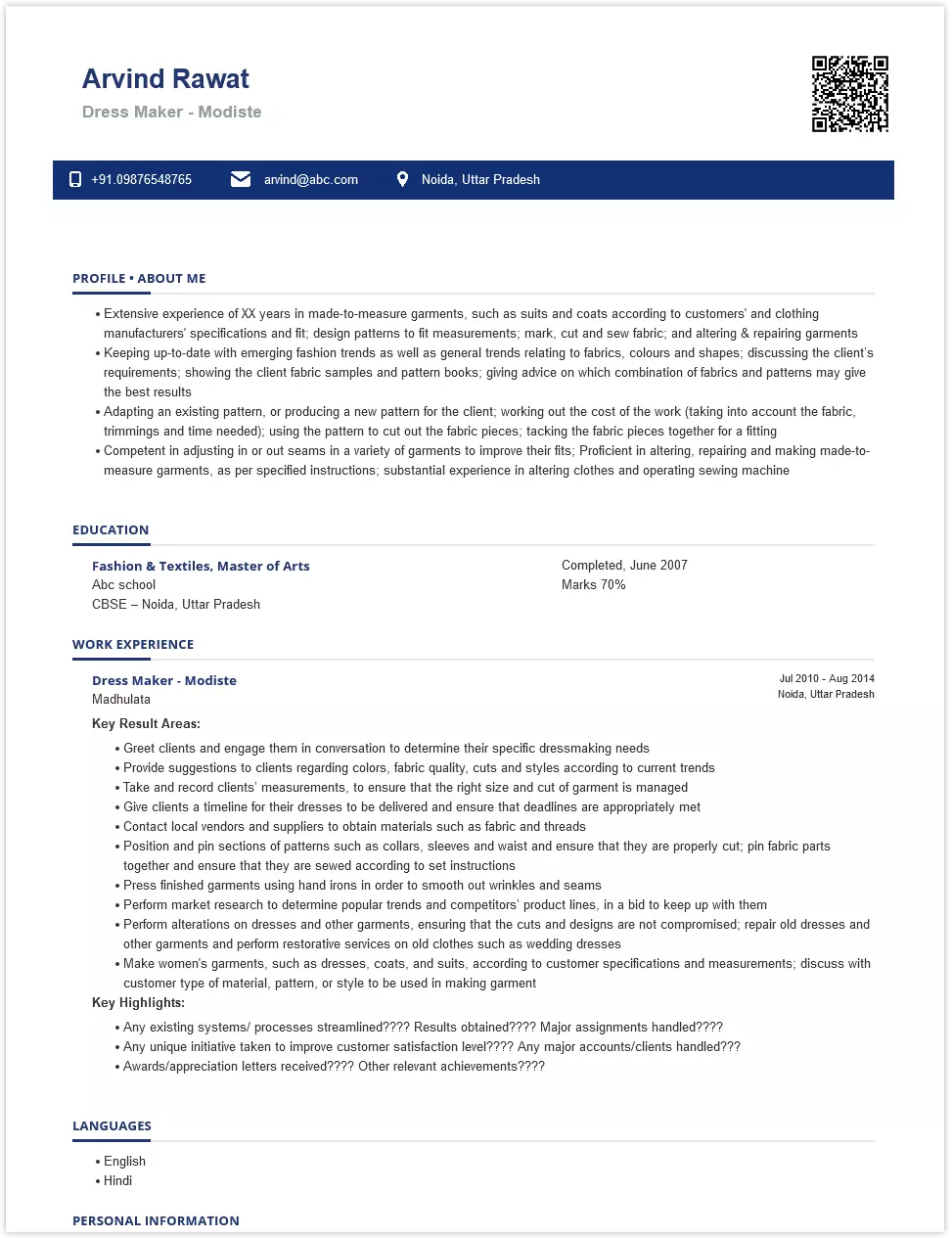
Arvind Rawat
Phone: 09876548765
Email: arvind@abc.com
Address: Alpha1 greater noida, Beta 2 greater noida, Noida
About Me
Dress Maker - Modiste
- Highly experienced in creating new patterns, and sewing garments following detailed instructions; extensive comprehension of current trends and styles
- Solutions-focused innovator known for pioneering new dress designs. Skillfully assemble and join garment parts using needles and threads, along with threading and sewing machines.
- Extensive experience of XX years in made-to-measure garments, such as suits and coats according to customers' and clothing manufacturers' specifications and fit; design patterns to fit measurements; marking, cutting, and sewing fabric; and altering & repairing garments
- Keeping up-to-date with emerging fashion trends as well as general trends relating to fabrics, colors, and shapes; discussing the client’s requirements; showing the client fabric samples and pattern books; giving advice on which combination of fabrics and patterns may give the best results
- Adapting an existing pattern, or producing a new pattern for the client; working out the cost of the work (taking into account the fabric, trimmings, and time needed); using the pattern to cut out the fabric pieces; tacking the fabric pieces together for a fitting
- Competent in adjusting in or out seams in a variety of garments to improve their fits; Proficient in altering, repairing, and making made-to-measure garments, as per specified instructions; substantial experience in altering clothes and operating sewing machine
Education
Fashion & Textiles, Master of Arts, Completed, June 2007
Meerut College
– Marks 70
Meerut, UP
Certifications
Work Experience
Period: July 2018 - Current
Dress Maker - Modiste
Boutique Ethnic
Noida, UP
- Greet clients and engage them in conversation to determine their specific dressmaking needs
- Provide suggestions to clients regarding colors, fabric quality, cuts, and styles according to current trends
- Take and record clients’ measurements, to ensure that the right size and cut of the garment are managed
- Give clients a timeline for their dresses to be delivered and ensure that deadlines are appropriately met
- Contact local vendors and suppliers to obtain materials such as fabric and threads
- Position and pin sections of patterns such as collars, sleeves, and waist and ensure that they are properly cut; pin fabric parts together and ensure that they are sewed according to set instructions
- Press finished garments using hand irons in order to smooth out wrinkles and seams
- Perform market research to determine popular trends and competitors’ product lines, in a bid to keep up with them
- Perform alterations on dresses and other garments, ensuring that the cuts and designs are not compromised; repair old dresses and other garments and perform restorative services on old clothes such as wedding dresses
- Make women's garments, such as dresses, coats, and suits, according to customer specifications and measurements; discuss with the customer type of material, pattern, or style to be used in making the garment
Period: November 2010 - August 2016
Dress Maker
House of Ardo
Delhi,
- Positioned and pined pattern sections, such as collar, sleeve, or waist, on fabric, and cuts fabric with scissors following pattern edge
- Pined or basted together fabric parts in preparation for final sewing
- Sew fabric parts by hand or operates a single-needle sewing machine that joins fabric parts to form a garment
- Sew felling stitch in the hem of the garment by hand to conceal thread
- Pressed garment, using a hand iron, to smooth seams and remove wrinkles
- Drafted standard pattern according to measurements of the customer and adapt the pattern to obtain specified style; made garment according to picture furnished by the customer
- Provided accurate instructions to the workroom and ensured compliance with standards
- Maintained records of all alterations on garments and mentioned it on the tag
- Analyzed customer’s comments and ensured alterations according to the same
Skills
- Customer Service
- Punctuality
- Industrial Sewing Machines
- Stitching
- Embroidery
- Inventory Control
- Creative
- Machine Operation
- Fabric
- Garment Construction
- Costumes
- Double Needle
- Assembly Line
- Straight Stitch
- Teamwork
- Detect Problems
- Serger
- Machine Guides
- Commercial Sewing Machines
Languages
Softwares
Operating System
Personal Interests
- Yoga
- Sketch
- Drawing
Author
Kshama Sharma - Resume, CV and Cover Letter Writing Expert