India's
premier resume service
India's
premier resume service


- Certificate in Dress Designing, Completed , January 2017
- Home

- Resume Samples
- Pattern Cutters Resume Sample
What's your job?
Pattern Cutters Resume Samples and Templates for 2026
- Table of Contents
- Downloadable Sample
- Resume Tips from Experts
- Resume Text Version
- Share


Pattern Cutter Resume Examples and Templates: A Complete Guide
A professional pattern cutter resume is essential for standing out in India’s thriving textile and garment manufacturing sector. Whether you’re applying for positions at leading apparel companies like Raymond, Arvind Limited, or Aditya Birla Fashion, export houses, fashion design studios, or garment manufacturing units, your resume should highlight your pattern cutting skills, technical expertise, and commitment to precision in garment production.
This guide walks you through pattern cutter resume examples and templates, formatting tips, and keywords to help you write a resume that stands out to recruiters at leading textile organisations in India.
Understanding the Pattern Cutter Role in India
Pattern cutters are skilled garment industry professionals who create and cut fabric patterns for clothing production. From interpreting design sketches and creating master patterns to grading sizes and cutting fabric with precision, pattern cutters in India work across garment factories, export houses, fashion studios, and textile companies to ensure accurate and efficient garment production.
Key responsibilities include:
- Creating patterns from design specifications
- Cutting fabric according to patterns
- Grading patterns across sizes
- Ensuring material efficiency and minimal wastage
- Maintaining quality standards in cutting
- Operating cutting machines and equipment
- Coordinating with production teams
- Following safety and quality protocols
India’s position as a global textile manufacturing hub, growing fashion industry, and large garment export sector create strong demand for skilled pattern cutters across apparel, textile, and fashion sectors.
Preparing to Write Your Pattern Cutter Resume
Before drafting your resume, gather all relevant information:
Professional details to compile:
- Complete employment history in garment industry
- Types of garments and patterns worked on
- Fabric types and cutting techniques mastered
- Training and certifications obtained
- Equipment and software expertise
- Production volumes handled
- Awards and recognition received
- Professional development completed
Research target employers:
- Review requirements from garment manufacturers
- Understand expectations at export houses
- Note specific qualifications mentioned in job descriptions
Choosing the Best Resume Format
Select a format that best presents your pattern cutter experience:
Chronological Format
Best for pattern cutters with steady career progression in the garment industry. Highlights your work at organisations in reverse chronological order.
Functional Format
Suitable for freshers or those transitioning from related roles who want to emphasise cutting skills and technical training.
Combination Format
Ideal for experienced pattern cutters with diverse experience across different garment types or manufacturing environments.
Format recommendations by experience: | Experience Level | Recommended Format | Resume Length | |-----------------|-------------------|---------------| | Entry-level (0-2 years) | Chronological | 1 page | | Mid-level (2-5 years) | Combination | 1-2 pages | | Senior (5+ years) | Chronological | 2 pages |
Professional Summary Examples
Your professional summary should immediately communicate your pattern cutting expertise:
Entry-Level Pattern Cutter
ITI graduate seeking pattern cutter position at reputable garment manufacturing company. Completed diploma in garment technology with hands-on training in pattern making, fabric cutting, and grading techniques. Strong knowledge of different fabric types, cutting equipment, and quality standards. Completed internship at export house. Good attention to detail and manual dexterity. Eager to develop pattern cutting career while learning advanced techniques.
Pattern Cutter
Skilled pattern cutter with 4+ years of experience in garment manufacturing at leading export houses. Currently Pattern Cutter at Arvind Limited handling men’s formal wear patterns with production of 5,000+ pieces monthly. Expertise in manual and CAD pattern cutting, grading, and marker making. Achieved 95% fabric utilisation efficiency. Diploma in Garment Technology with strong technical skills. Known for precision cutting and meeting production deadlines.
Senior Pattern Cutter
Experienced garment industry professional with 8+ years in pattern cutting and production at premier textile companies. Currently Senior Pattern Cutter at Raymond managing cutting operations for formal and casual wear lines. Expertise in complex pattern development, multi-size grading, and cutting room supervision. Led team handling ₹10 crore annual production. Diploma with advanced CAD certification. Known for technical excellence and team leadership.
Pattern Cutting Supervisor
Seasoned textile industry leader with 12+ years of experience managing pattern cutting operations at major garment manufacturers. Currently Cutting Room Supervisor at leading export house overseeing team of 25 cutters producing 50,000+ garments monthly. Expertise in production planning, quality control, and process optimisation. Achieved 98% cutting accuracy with 15% waste reduction. Diploma with supervisory training. Known for operational excellence and efficiency improvements.
Showcasing Your Work Experience
Present your pattern cutter experience with specific achievements and metrics:
Cutting Room Supervisor
Leading Export House | Gurgaon April 2018 – Present
- Supervise cutting team of 25 workers
- Manage monthly production of 50,000+ garments
- Achieve 98% cutting accuracy rate
- Reduce fabric wastage by 15%
- Implement CAD-based marker making
- Coordinate with production planning
- Train and evaluate cutting staff
- Ensure safety compliance in cutting room
- Manage equipment maintenance
- Receive “Best Supervisor Award” (2022)
Senior Pattern Cutter
Raymond Limited | Thane June 2014 – March 2018
- Developed patterns for formal wear line
- Handled 10,000+ pieces monthly production
- Achieved 96% fabric utilisation efficiency
- Operated CAD software for pattern making
- Trained 8 junior cutters
- Maintained quality standards
- Promoted from Pattern Cutter to Senior level
- Received “Quality Excellence” recognition (2017)
Pattern Cutter
Arvind Limited | Ahmedabad July 2011 – May 2014
- Cut patterns for men’s shirting and trousers
- Achieved monthly production targets consistently
- Operated manual and automatic cutting machines
- Graded patterns across size ranges
- Maintained cutting accuracy
- Followed safety protocols
- Completed diploma during employment
- Received positive feedback from supervisors
Essential Skills for Pattern Cutters
Technical Skills
- Pattern making and cutting
- Fabric knowledge and handling
- Grading and size scaling
- Marker making and layout
- Manual cutting techniques
- Automatic cutting machine operation
- CAD software (Gerber, Lectra, Optitex)
- Quality inspection
- Measurement and precision
- Fabric utilisation optimisation
Equipment Skills
- Straight knife cutting machines
- Band knife cutting machines
- Round knife cutters
- Die cutting machines
- Laser cutting equipment
- Spreading machines
- CAD plotters
- Measuring tools
- Pattern making instruments
- Pressing equipment
Soft Skills
- Attention to detail
- Manual dexterity
- Time management
- Problem-solving
- Team collaboration
- Following instructions
- Quality consciousness
- Safety awareness
- Patience and precision
- Adaptability
Qualifications for Pattern Cutters
Educational Qualifications
| Qualification | Institution Type | Relevance |
|---|---|---|
| Diploma in Garment Technology | Polytechnics, NIFT | Preferred qualification |
| ITI (Dress Making/Cutting) | Industrial Training Institutes | Standard qualification |
| B.Sc. in Fashion Technology | Universities | Higher qualification |
| Certificate in Pattern Making | Training institutes | Skill certification |
| 10th/12th Pass | Schools | Minimum requirement |
| Apprenticeship Certificate | Companies | Practical training |
Professional Certifications
- Diploma in Garment Technology
- ITI Dress Making Certificate
- CAD Pattern Making Certification (Gerber, Lectra)
- Apparel Production Certification
- Textile Technology Certificate
- Quality Control Certification
- Industrial Safety Training
Additional Training
- Advanced pattern cutting techniques
- CAD software operation
- Fabric technology and handling
- Quality control in garment industry
- Production planning and control
- Safety in cutting room
- Equipment maintenance training
Tips by Experience Level
Entry-Level Pattern Cutters (0-2 years)
- Highlight diploma or ITI qualification
- Include internship experience
- Emphasise cutting techniques learned
- Showcase manual dexterity skills
- Include any certification
Target employers: Garment factories, export houses, textile companies
Mid-Level Pattern Cutters (2-5 years)
- Quantify production volumes handled
- Highlight fabric utilisation rates
- Showcase accuracy achievements
- Demonstrate CAD software proficiency
- Include training of juniors
Target positions: Senior Pattern Cutter, Cutting Room In-charge
Senior Pattern Cutters (5+ years)
- Emphasise supervisory experience
- Highlight process improvements
- Showcase team management skills
- Demonstrate quality achievements
- Include efficiency improvements
Target positions: Cutting Room Supervisor, Production Manager, Quality Head
ATS Optimisation for Pattern Cutter Resumes
Ensure your resume passes Applicant Tracking Systems:
Essential keywords to include:
- Pattern cutter, pattern maker
- Garment cutting, fabric cutting
- Grading, marker making
- CAD software, Gerber, Lectra
- Export house, garment factory (if applicable)
- Diploma, ITI, certified
- Quality control, fabric utilisation
- Production, manufacturing
- Cutting machines, equipment
- Apparel, textile, fashion
ATS-friendly formatting:
- Use standard section headings (Summary, Experience, Skills, Education)
- List certifications and training clearly
- Avoid tables, graphics, and complex formatting
- Use standard fonts (Arial, Calibri, Times New Roman)
- Include production volumes and quality metrics
Conclusion
A professional pattern cutter resume is essential for success in India’s thriving textile and garment manufacturing sector. Whether you’re targeting positions at export houses, garment factories, or fashion companies, your resume must demonstrate your cutting skills, technical expertise, and track record of quality production.
Focus on quantifying your achievements—production volumes, fabric utilisation rates, and accuracy metrics. Highlight your diploma or ITI qualification and CAD certifications that validate your expertise. With India’s strong position in global textile manufacturing, skilled pattern cutters have excellent career opportunities across apparel, fashion, and textile sectors.
Use our resume builder to create an ATS-optimised pattern cutter resume, or explore our professional templates designed specifically for garment industry professionals in India.
Frequently Asked Questions
What sections should a strong pattern cutters resume include?
At minimum, include contact information, a professional summary, work experience, key skills, and education. Depending on your experience level, you may also add certifications, achievements, projects, or industry-specific sections that highlight your expertise.
How do I write a professional summary for a pattern cutters role?
Keep it concise — two to three sentences highlighting your experience level, core competencies, and a key achievement or strength that shows why you're right for the job. Tailor it to match the specific role you're applying for.
What skills are most important to list on a pattern cutters resume?
Include a mix of technical skills specific to pattern cutters roles and soft skills like communication, problem-solving, and teamwork. Research job postings in your target companies to identify the most commonly requested skills.
How detailed should my work experience be?
Use bullet points to describe your roles, focusing on specific results, tools used, and the impact you made. Quantify achievements where possible — numbers and percentages help recruiters quickly understand your contributions.
Do I need certifications on my pattern cutters resume?
Certifications aren't always required, but they can strengthen your application — especially if they demonstrate advanced training or specialised expertise. List the certification name, issuing organisation, and year obtained.
What's the best resume format for a pattern cutters?
Most pattern cutters professionals benefit from a reverse-chronological format that lists your most recent experience first. If you're changing careers or have gaps, a functional or combination format might work better.
How long should my pattern cutters resume be?
Aim for one page if you're early in your career. Experienced professionals with extensive achievements can use two pages — just ensure every section adds value and remains relevant to the role.
Should I tailor my resume for each job application?
Yes. Customising your resume with keywords and responsibilities from the job posting improves your chances of passing Applicant Tracking Systems (ATS) and resonating with recruiters. Focus on relevant experience and skills for each role.
Pattern Cutters Text-Only Resume Templates and Samples
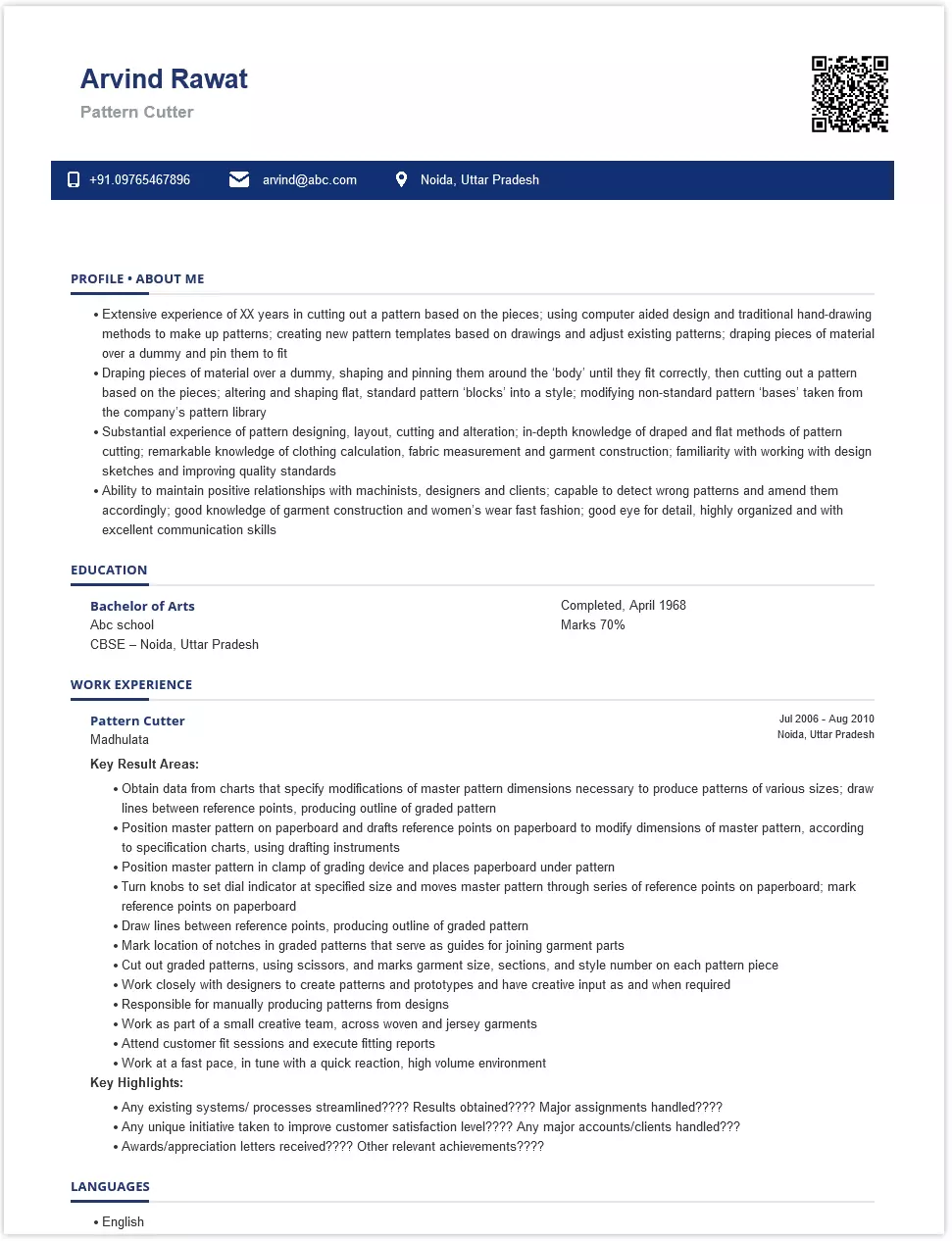
Arvind Rawat
Phone: 09765467896
Email: arvind@abc.com
Address: Alpha1 greater noida, Beta 2 greater noida, Noida
About Me
Pattern Cutter
- Extensive experience of XX years in cutting out a pattern based on the pieces; using computer-aided design and traditional hand-drawing methods to make up patterns; creating new pattern templates based on drawings and adjusting existing patterns; draping pieces of material over a dummy and pinning them to fit
- Draping pieces of material over a dummy, shaping and pinning them around the ‘body’ until they fit correctly, then cutting out a pattern based on the pieces; altering and shaping flat, standard pattern ‘blocks’ into a style; modifying non-standard pattern ‘bases’ taken from the company’s pattern library
- Substantial experience in pattern designing, layout, cutting, and alteration; in-depth knowledge of draped and flat methods of pattern cutting; remarkable knowledge of clothing calculation, fabric measurement, and garment construction; familiarity with working with design sketches and improving quality standards
- Ability to maintain positive relationships with machinists, designers, and clients; capable to detect wrong patterns and amend them accordingly; good knowledge of garment construction and women’s wear fast fashion; a good eye for detail, highly organized and with excellent communication skills
Education
Drawing, Bachelor of Arts, Completed, April 2010
Nift
– Marks 70
Navi mumbai, UP
Certifications
Work Experience
Period: July 2018 - Current
Pattern Cutter (Vintage Clothing)
BVH Services
Gandhidham, GJ
- Obtain data from charts that specify modifications of master pattern dimensions necessary to produce patterns of various sizes; draw lines between reference points, producing an outline of graded pattern
- Position master pattern on paperboard and draft reference points on paperboard to modify dimensions of the master pattern, according to specification charts, using drafting instruments
- Position the master pattern in the clamp of the grading device and place the paperboard under the pattern
- Turn knobs to set dial indicator at specified size and moves master pattern through series of reference points on paperboard; mark reference points on paperboard
- Draw lines between reference points, producing an outline of the graded pattern
- Mark the location of notches in graded patterns that serve as guides for joining garment parts
- Cut out graded patterns, using scissors, and marks garment size, sections, and style number on each pattern piece
- Work closely with designers to create patterns and prototypes and have creative input as and when required
- Responsible for manually producing patterns from designs
- Worked as part of a small creative team, across woven and jersey garments
- Attend customer fit sessions and execute fitting reports
- Work at a fast pace, in tune with a quick reaction, high volume environment
Period: October 2012 - August 2017
Cutting Master In Garment Factory
Disha Skill Training Services
Thane, MH
- Determined various sizes and layouts of patterns, in an efficient manner
- Marked and cut out pattern templates using sketches drawn by fashion designers
- Prepared pattern templates for specified ranges of garment sizes
- Checked pattern templates for conformance to specifications and quality standards
- Used pattern-cutting techniques for the production and modification of patterns
- Liaised with designer, sample machinist, fabric team, and embroiders during pattern and cloth production
- Draped, shaped, fitted, and secured clothing material over a mannequin, properly
- Created patterns for initial and fit samples according to customer requirements
- Attended sample fitting sessions to determine any requirements for pattern alterations
- Inspected and made alterations to the non-standard pattern, as needed
- Produced product patterns and supported bulk manufacturing of that product
- Maintained strong professional relationships with designers, sample machinists, and buying teams
Skills
- Garment construction
- Fitting techniques
- Design sketches
- Communication
- Attention to details
Languages
Softwares
Operating System
Personal Interests
- Yoga
- Drawing
- Traveling

Author
Kshama Sharma - Resume, CV and Cover Letter Writing Expert